
Trolley
You have no items in your shopping cart

 Budgets
 Dumbers
 Discs
Discs
 Benches
 Racks and Rigs
 Weights Holders
 Isotonic machines
 Calisthenics
 Cardio
 Kettlebells
 Flooring
 Gym Set
 Accessories
 Combat
 ARTI MARZIALI
 CONTAINER GYM
 Tug-Of-War
 Used Gym Equipment
 PILATES MACCHINARI
 GINNASTICA ARTISTICA
 CAMPI DA PADEL
 Prodotti in Pronta Consegna
 Informazioni
 IRONMAN
 Gift Card
- Donatif
- General information
- 0 I like it
- 1918 Views
- 0 comments
- stress reduction, improved self-esteem, physical and mental well-being, gym training
READING TIME: 5 MINUTES ➤➤
Most common mistakes when choosing and installing gym flooring at home
When designing a home gym, one of the most underestimated elements is the gym flooring. It is often considered a secondary detail, but in reality it is one of the choices that most affects noise, stability, durability, and comfort. Mistakes at this stage are not immediately visible: they emerge over time, when fixing them means spending money all over again.
Beginners, especially in a home or apartment setting, often have only a vague perception of risk. They don’t know where they might go wrong, but they fear making mistakes. This article is designed to turn that uncertainty into a clear map of avoidable errors, helping you make more informed and confident decisions.
- Wrong material
- Insufficient thickness
- Unsuitable surface
- Noise and vibrations
- Stability and joints
- Durability and false savings
- Overlooking comfort
Choosing the wrong material without evaluating density and use
One of the most common mistakes is choosing flooring based only on appearance or price, completely ignoring the material density and the intended use. Not all materials are suitable for supporting weights, impacts, or equipment: low-cost EVA flooring, for example, may seem like a good option at first, but it tends to deform quickly under load.
The difference between an entry-level material and one designed for sports use becomes evident after just a few weeks. The flooring starts to show marks, lose stability, and transmit vibrations. Prevention: always choose based on your type of training. For weights and equipment, opt for high-density rubber. If the use is light, EVA can be acceptable, but with clear limitations.
Cheap EVA vs technical rubber: differences that emerge over time
EVA is often chosen for its lower cost, but it is not designed to withstand concentrated loads. Technical rubber, on the other hand, offers resistance, stability, and elastic memory. This means it maintains its shape and absorbs impacts more effectively over time.
Those who choose based only on price often find themselves having to replace everything after just a few months. Practical note: if you plan—even in the future—to use barbells or dumbbells, avoid temporary solutions and invest immediately in a suitable material.
Underestimating flooring thickness
Thickness is one of the most critical aspects, yet also one of the most overlooked. Many users choose thin flooring thinking it is enough to protect the underlying surface and provide comfort. In reality, insufficient thickness amplifies issues such as noise, vibrations, and instability.
A floor that is too thin does not absorb impacts and transfers energy directly to the ground. This not only creates disturbance but also increases the risk of structural damage. Prevention: for weight training, choose a minimum thickness appropriate to the load. The heavier the load, the more crucial thickness becomes.
Installing flooring on an unsuitable surface
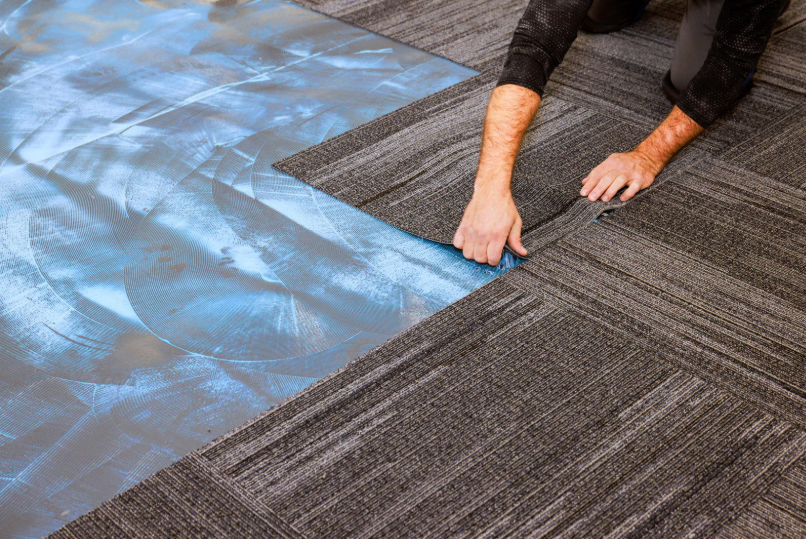
A mistake that is often invisible at first concerns the installation surface. Laying gym flooring on an uneven or unlevel base immediately compromises the system’s performance. Even the best material loses effectiveness if installed incorrectly.
The consequences are subtle but impactful: instability during workouts, uneven wear, and difficulty with joints. Prevention: always ensure the surface is clean, dry, and perfectly level. If needed, address this beforehand with leveling or corrective solutions.
Ignoring noise and vibration issues
In a home setting, especially in an apartment building, noise is one of the most critical factors. Many people realize this too late—when neighbors start complaining. The issue is not just direct sound, but also structural vibrations that travel through the floor.
Inadequate flooring amplifies this effect. Prevention: choose materials with good shock absorption and, if necessary, integrate technical platforms in impact zones. This significantly reduces vibration transmission.
Neglecting stability and tile interlocking
Many modular systems promise easy installation, but not all guarantee real stability. Tiles that move or separate during use compromise not only the experience but also safety.
This issue is especially common with lightweight materials or poorly designed interlocking systems. Prevention: always check the quality of the joints and, if necessary, choose more stable solutions or those with fixing systems. Stability is essential for controlled and safe exercises.
Focusing only on price instead of durability
The initial price is often the main decision factor, but it is also the most misleading. Cheap flooring that lasts only a few months ends up costing far more than a more durable solution that lasts for years.
This mistake comes from a short-term perspective. Prevention: always evaluate the relationship between cost and durability. A slightly higher initial investment prevents replacements, inconvenience, and additional costs over time.
Choosing without considering training comfort
Finally, one of the most underestimated mistakes concerns comfort. Flooring that is too hard or too soft directly affects training quality and joint well-being.
Training on an unsuitable surface leads to early fatigue and increased stress on joints and muscles. Prevention: choose a balance between stability and cushioning based on your type of exercises. Comfort is not a luxury, but a fundamental component of performance.
Understanding these mistakes means moving from a fear-driven choice to a decision based on control and awareness. This is where an effective, durable, and truly functional home gym begins.
Comments (0)