
Trolley
You have no items in your shopping cart

 Budgets
 Dumbers
 Discs
Discs
 Benches
 Racks and Rigs
 Weights Holders
 Isotonic machines
 Calisthenics
 Cardio
 Kettlebells
 Flooring
 Gym Set
 Accessories
 Combat
 ARTI MARZIALI
 CONTAINER GYM
 Tug-Of-War
 Used Gym Equipment
 PILATES MACCHINARI
 GINNASTICA ARTISTICA
 CAMPI DA PADEL
 Prodotti in Pronta Consegna
 Informazioni
 IRONMAN
 Gift Card
- Donatif
- General information
- 0 I like it
- 1888 Views
- 0 comments
- gym flooring, safety flooring, gym safety, shock-absorbing materials
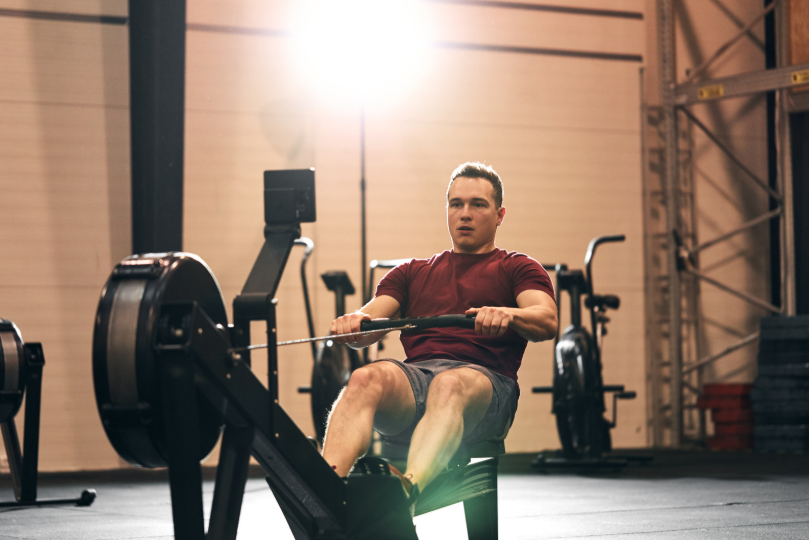
HIIT Rowing Workout: An Effective 20-Minute Protocol
A HIIT rowing workout can be a practical solution for people with limited time who still want to maintain an intense and well-structured training routine. The combination of cardiovascular work and full-body muscular engagement makes the rowing machine one of the most complete fitness tools for short but dynamic sessions, especially when daily schedules are packed with work and other commitments.
A shorter duration does not necessarily mean a superficial workout. A protocol built around proper recovery periods, progressive intensity, and controlled effort can provide an effective training session without requiring long workouts or excessive volume. The main advantage of a HIIT rowing workout is the ability to adapt the pace according to individual fitness levels while maintaining control and safety throughout the session.
Read also:
How a HIIT rowing protocol works
The principle behind HIIT is alternating phases of intense work with controlled recovery periods. On a rowing machine, this approach allows you to engage legs, back, core, and upper body in a single session. Compared to other cardio equipment, the rowing machine also enables precise resistance adjustments, making it suitable for both experienced users and people gradually building their fitness level.
In a 20-minute rowing workout, effort distribution is more important than the total duration itself. Poor pacing during the first intervals can compromise technique quality and the ability to maintain intensity in the final stages. For this reason, it is useful to work with measurable intervals using parameters such as watts, perceived exertion, or pace expressed over 500 meters.
20-minute HIIT rowing protocol
Complete session structure
A balanced session should begin with at least 4 minutes of progressive warm-up. During this phase, the pace remains moderate, with emphasis on driving technique and fluid movement. The body should gradually increase temperature and heart rate without entering fatigue too early. This step helps reduce stiffness and supports more consistent performance during intense intervals.
After the warm-up, the central block of the protocol begins. A commonly used structure involves 40 seconds of intense work followed by 20 seconds of active recovery, repeated for 10 consecutive rounds. Recovery does not mean stopping completely but rowing slowly and under control. The final 3 minutes are dedicated to cooldown, gradually returning breathing to normal levels.
Intensity targets and effort management
During intense phases, it is useful to maintain a perceived exertion level around 7 or 8 out of 10, avoiding overly aggressive starts. Users with a performance monitor can track watts or average 500-meter pace to maintain consistency across intervals. The goal is not to achieve a single peak effort, but to sustain stable quality throughout the entire protocol.
Within a HIIT rowing workout, recovery is just as important as the high-intensity phase. Excessively shortening recovery periods can compromise technique and increase the risk of uncontrolled movements. A properly calibrated session should leave a manageable sense of fatigue rather than complete exhaustion, especially for people training several times per week.
Three intensity levels and scaling
Beginner level
People new to rowing workouts can start with shorter intervals and longer recovery periods. A simple setup involves 20 seconds of work and 40 seconds of recovery for 8 total rounds. At this stage, the focus should remain on posture and coordination between legs, torso, and arms rather than chasing high speed.
For senior users or individuals with lower cardiovascular tolerance, the pace should remain manageable throughout the entire session. A moderate but consistent intensity helps build confidence with the machine without creating excessive stress. This approach makes the HIIT rowing workout more sustainable over the long term.
Intermediate level
Users who already have a solid aerobic base can adopt the standard protocol of 40 seconds of intense work and 20 seconds of recovery. At this level, it becomes useful to introduce more precise references, such as maintaining a consistent pace or a specific wattage range. Consistency between intervals becomes an important indicator of workout quality.
The intermediate level often represents the ideal balance between intensity and sustainability. The workout remains short but demanding enough to provide a significant cardiovascular stimulus without requiring excessively long recovery times in the following days.
Advanced level
Advanced users can increase the challenge by shortening recovery periods or introducing longer sprints. A common setup involves 45 seconds of intense work and 15 seconds of recovery for 12 rounds. In this context, maintaining technical control becomes essential, especially during the final phase of the stroke and breathing management.
However, very intense workouts should not turn into random or unstructured sessions. Even experienced athletes benefit from organized progression, alternating HIIT days with smoother, steady-state rowing sessions. This helps avoid excessive fatigue accumulation and reduces the risk of overtraining.
How to manage intensity and recovery
Monitoring watts and heart rate
Many modern rowing machines include monitors that track parameters such as watts, distance, calories, and pace. Using these metrics makes training more measurable and consistent. Even without advanced tools, it is still possible to train effectively through perceived exertion, maintaining an intensity that allows all intervals to be completed without a major breakdown in technique.
Heart rate tends to increase rapidly during sprints, especially in short and intense protocols. For this reason, breathing should never be neglected. Poor breathing control can make recovery between rounds more difficult, increasing fatigue perception even when muscular load remains manageable.
Recovery between sessions
A HIIT protocol should not be performed every day. Generally, two or three weekly sessions are sufficient to maintain a good balance between stimulus and recovery. On intermediate days, lighter activities such as brisk walking, mobility work, or steady-state rowing can be beneficial.
The quality of recovery directly affects the ability to sustain high intensity over time. Poor sleep, training while excessively fatigued, or increasing workout volume too quickly can reduce performance quality and increase the risk of joint pain or persistent fatigue.
Mistakes to avoid during the workout
Starting too aggressively in the first minutes
One of the most common mistakes is using too much energy during the first intervals. This often leads to a significant drop in pace during the second half of the session. On a rowing machine, effort management is crucial because muscular involvement is extensive and energy expenditure can rise quickly.
A slightly more controlled starting pace instead allows continuity and technical quality to be maintained until the end of the workout. The final perception of the training session also tends to feel more positive and sustainable, an important factor for anyone looking to build long-term consistency.
Poor technique and rigid posture
A rowing stroke performed without proper coordination can create unnecessary stress on the back and shoulders. In the correct movement, the drive begins primarily with the legs, while the torso and arms complete the stroke fluidly. Pulling immediately with the arms or excessively rounding the back reduces efficiency and control.
Even during an intense workout, technique should not completely deteriorate. If movement becomes disorganized or recovery periods are no longer sufficient to restore breathing control, it may be useful to slightly reduce the pace or extend the pauses. This approach keeps the short rowing workout safer and more effective over time.
Comments (0)