
Trolley
You have no items in your shopping cart

 Budgets
 Dumbers
 Discs
Discs
 Benches
 Racks and Rigs
 Weights Holders
 Isotonic machines
 Calisthenics
 Cardio
 Kettlebells
 Flooring
 Gym Set
 Accessories
 Combat
 ARTI MARZIALI
 CONTAINER GYM
 Tug-Of-War
 Used Gym Equipment
 PILATES MACCHINARI
 GINNASTICA ARTISTICA
 CAMPI DA PADEL
 Prodotti in Pronta Consegna
 Informazioni
 IRONMAN
 Gift Card
- Donatif
- General information
- 0 I like it
- 1734 Views
- 0 comments
- stress reduction, improved self-esteem, physical and mental well-being, gym training
READING TIME: 7 MINUTES ➤➤
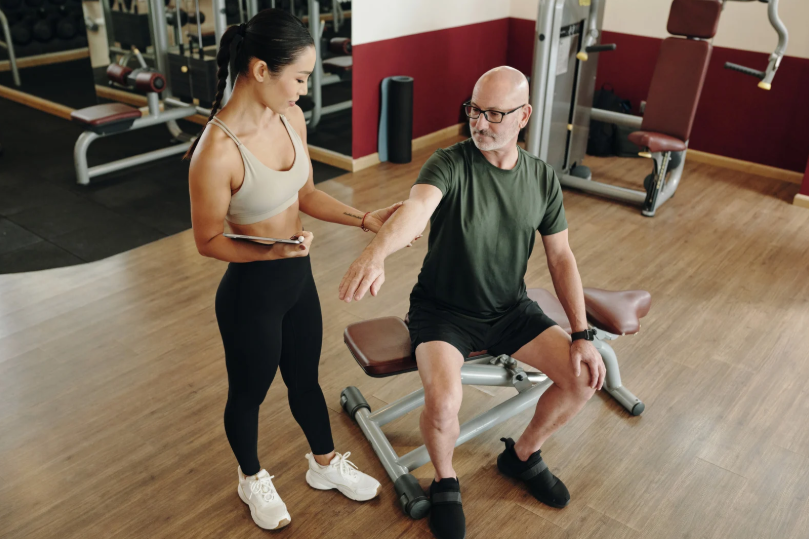
The ACL rehabilitation in the gym represents one of the most delicate and decisive phases for returning to movement safely, regaining strength, and rebuilding confidence in athletic performance. After anterior cruciate ligament surgery, the process does not end with pain management or basic joint mobility recovery. The real difference is made when the knee begins to handle progressive loads again, controlled movements, and repeatable motor patterns, following a precise logic that integrates physiotherapy, strengthening, and injury prevention.
For an advanced athlete or someone training in a well-equipped home gym, the gym can become an extremely effective environment—provided it is used with a structured approach. The goal is not simply to “do exercises,” but to build a pathway where every machine, every load, and every movement angle is selected to improve motor control. In this context, equipment reliability and movement precision make a real difference: working with solid, stable machines designed to ensure clean execution—such as professional solutions engineered in Italy—helps make recovery safer, more measurable, and more aligned with the real needs of post-operative rehabilitation.
- When the gym becomes an active part of ACL recovery
- Quadriceps strengthening and safe strength recovery
- Leg extension in ACL rehabilitation: benefits, limits, and progression
- Isotonic machines and free weights: how to integrate them
- Return to sport: movement control, confidence, and consistency
When the gym becomes an active part of ACL recovery
The transition from the acute phase to the weight room does not follow a fixed timeline, but rather depends on achieving specific functional milestones. After ACL reconstruction, the knee must first regain full extension, adequate flexion, proper swelling control, and progressively normal walking mechanics. Only on this foundation can the gym become a concrete recovery tool. The correct approach is not to rush loading, but to introduce it when the body is ready to tolerate it without compensation, persistent pain, or compromised movement quality.
At this stage, the gym shifts from being a simple training space to a true environment for movement re-education. Guided machines reduce variability, allow precise control of the range of motion, and support repeatable execution—key elements when rebuilding reliable motor patterns. This is why equipment quality becomes a functional requirement: a stable, smooth, and precise machine allows the athlete to focus on the movement rather than adapting to the equipment. In post-operative ACL rehabilitation, this precision is not a luxury, but a necessity.
Quadriceps strengthening and safe strength recovery
One of the main priorities in recovery is quadriceps strengthening after ACL surgery, as this muscle group tends to lose strength and activation within the first weeks post-operation. This deficit affects not only the appearance of the leg but, more importantly, the knee’s ability to stabilize, absorb forces, and control movement during walking, running, deceleration, and directional changes. Restoring strength means restoring function—and reducing the risk of protective compensations that can slow down recovery.
Effective training is not measured solely by the amount of weight lifted, but by the ability to produce force with clean mechanics, without knee valgus collapse, pelvic shifts, or significant asymmetries between limbs. In this context, post-ACL exercises must follow a structured progression, starting from simple, highly controlled movements and gradually evolving into more complex tasks. The gym provides a critical advantage: it allows precise load management and progressive overload. When using professional machines with linear mechanics and stable design, the athlete can better focus on muscle activation and execution quality—two essential factors for a solid recovery.
Leg extension in ACL rehabilitation: benefits, limits, and progression
Leg extension in rehabilitation is often debated, but the key question is not whether it is inherently right or wrong. What matters is when it is introduced, the range of motion used, the applied load, and the purpose behind its inclusion. Within a structured program, leg extension can be valuable for targeted quadriceps activation, especially when there is still significant neuromuscular inhibition or difficulty generating sufficient tension through more complex exercises. Its main advantage lies in isolating the muscle and precisely controlling intensity and movement range.
However, as an isolation exercise, it must be used carefully. Introducing it too early, performing it with inappropriate ranges, or relying on it as the only strengthening method would be limiting. Its role is to complement a broader progression, not replace it. When performed with stable equipment, accurate adjustments, and proper positioning, it becomes a useful tool for restoring symmetry and confidence. In environments equipped with high-quality machines designed for smooth and controlled movement, the athlete can train more safely and better distinguish between mere execution and true muscle activation.
Isotonic machines and free weights: how to integrate them
An effective protocol does not place isotonic machines and free weights in opposition but integrates them within a logical progression. Machines are especially useful when reducing external instability, focusing on specific muscle groups, and precisely controlling load. Leg press, leg curl, calf machines, and guided variations are valuable tools for rebuilding foundational strength and load tolerance. In post-ACL rehabilitation, the ability to repeat a consistent movement pattern is a major advantage, allowing progress tracking, minimizing compensations, and improving confidence.
Free weights are introduced progressively when the knee demonstrates sufficient load tolerance and control. Exercises such as split squats, controlled lunges, step-ups, box squats, and both unilateral and bilateral variations help transfer strength to more functional, sport-specific patterns. However, this transition should only occur once a solid base has been established. This is where program quality becomes evident: precision is built first, complexity comes later. Using robust, stable, and professionally designed machines helps create that foundation, making the transition to free weights a natural step toward a more complete and performance-oriented recovery.
Return to sport: movement control, confidence, and consistency
Returning to sport after ACL surgery is not simply about completing physiotherapy or resuming running. A true return means being able to absorb forces, decelerate, change direction, jump, and re-accelerate without physical or psychological limitations. For this reason, gym-based training must bridge the gap between clinical recovery and performance, integrating strength, neuromuscular control, local endurance, and movement quality. Each phase should have a clear objective: first restore function, then reduce asymmetries, and finally prepare the body to handle sport-specific demands.
Alongside physical parameters, confidence plays a crucial role. Many athletes regain strength but hesitate during explosive movements, fear directional changes, or still perceive instability in the operated leg. A well-structured program, built on reliable equipment and measurable progression, also supports this psychological aspect. Seeing consistent improvements in load capacity, movement quality, and knee stability restores confidence and motivation. In this sense, choosing a training environment equipped with precise, professional-grade machines—such as those offered by Donatif—means not just investing in equipment, but creating the ideal conditions for a safe, structured, and lasting recovery.
Comments (0)