
Trolley
You have no items in your shopping cart

 Budgets
 Dumbers
 Discs
Discs
 Benches
 Racks and Rigs
 Weights Holders
 Isotonic machines
 Calisthenics
 Cardio
 Kettlebells
 Flooring
 Gym Set
 Accessories
 Combat
 ARTI MARZIALI
 CONTAINER GYM
 Tug-Of-War
 Used Gym Equipment
 PILATES MACCHINARI
 GINNASTICA ARTISTICA
 CAMPI DA PADEL
 Prodotti in Pronta Consegna
 Informazioni
 IRONMAN
 Gift Card
- Donatif
- General information
- 0 I like it
- 1583 Views
- 0 comments
- gym flooring, safety flooring, gym safety, shock-absorbing materials
READING TIME: 5 MINUTES ➤➤
Guided Multi-Gym or Open Modular Equipment: What Works Better for Beginner Clients?
When designing a PT studio or a micro gym, one of the most common questions concerns the choice between a guided multi-gym machine and a setup built around simple, more open modules. The topic becomes even more relevant when the main audience consists of beginner clients, meaning people with little training experience, limited autonomy, or their first real exposure to structured workouts. In many situations, people automatically associate beginners with guided machines, as if the combination were always the correct and inevitable choice.
In reality, the relationship between motor learning, perceived safety, and coaching quality is far more complex. A guided machine can certainly help in some situations, but it does not always represent the smoothest or most effective solution from the client experience perspective. At the same time, an environment built around benches, dumbbells, and compact racks does not necessarily mean greater difficulty or less control. The real difference often depends on how the gym’s structure supports the coach’s work and the client’s understanding of movement.
- Why many PT studios automatically associate beginners with guided machines
- What beginner clients really look for during their first sessions
- Guided multi-gym: practical advantages and operational limits
- Simple and open modules in beginner coaching
- Practical comparison between multi-gym machines and modular setups
- Which setup best supports a PT studio or micro gym
Why many PT studios automatically associate beginners with guided machines
The connection between a beginner client and a multi-gym machine mainly comes from a sense of protection. A guided structure immediately communicates control, order, and simplicity. For someone entering a gym for the first time, seeing predefined movement paths and apparently “mandatory” trajectories reduces the fear of making mistakes. Coaches themselves, especially during the early stages of a service, may view the machine as a reassuring tool that keeps sessions more predictable and structured.
However, this effect is often driven more by the perception of safety than by the actual quality of learning. Many beginners do not simply need to feel protected; they need to understand movement, develop coordination, and build confidence progressively. A highly guided machine may simplify the environment, but it can also limit body feedback and reduce the client’s ability to truly understand how to move through space.
What beginner clients really look for during their first sessions
Perceived safety does not always match real learning
A beginner client rarely judges a session solely on the apparent ease of an exercise. More often, they look for clarity, guidance, and a growing sense of control. If the movement feels overly restricted or unnatural, the machine risks becoming a passive tool that the client uses without truly understanding what they are doing.
On the other hand, simple exercises with light dumbbells, an adjustable bench, or a small rack can provide more immediate motor feedback. The client becomes more aware of posture, balance, and load management. In a well-guided coaching environment, this controlled freedom can encourage faster learning and greater long-term autonomy.
The role of simplicity in smoother coaching
Many professionals underestimate how much the simplicity of a setup affects session quality. A beginner-oriented gym does not necessarily need to be filled with complex equipment. In many cases, a simple, readable, and coherent environment works better because clients can immediately understand what is happening and why.
An overly complicated setup can increase cognitive load. Beginners already need to manage coordination, breathing, listening to instructions, and body awareness. If the machine itself also requires constant adjustments or unintuitive positioning, coaching can become less fluid and less reassuring despite the presence of a guided structure.
Guided multi-gym: practical advantages and operational limits
When a guided machine genuinely speeds up the process
Multi-gym stations offer real advantages in several contexts. They allow quick management of certain exercises, reduce explanation time, and help clients feel more stable. In studios with high client turnover or users who feel particularly insecure, guided machines can make the early stages of training smoother.
There are also situations where limiting movement variables is genuinely useful. Some highly sedentary beginners or individuals with very limited body awareness may benefit from a more controlled environment. In these cases, the multi-gym becomes a tool for building initial confidence and reducing performance anxiety.
Where multi-gym machines may slow down autonomy and adaptability
The limitation appears when the machine completely replaces the educational role of coaching. A trajectory that is too constrained can prevent clients from developing motor adaptation and body awareness. In addition, many multi-gym stations force users to work within standardized heights, angles, and positions that may not fit different body types effectively.
From an operational standpoint, variety can also become less flexible. In a limited space, a large multi-gym machine occupies significant floor area without necessarily improving overall session quality. In some PT studios, a more modular setup allows for better personalization of coaching while keeping the environment dynamic and easier to adapt.
Simple and open modules: why they can improve beginner coaching
More natural motor feedback and controlled progression
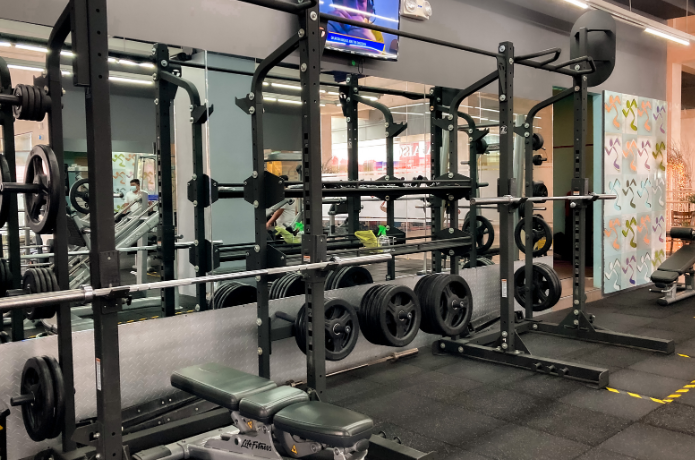
A setup built around benches, dumbbells, and compact racks may appear less protective at first glance, but it often delivers more effective learning. Beginners receive more realistic movement feedback and gradually learn how to manage balance, coordination, and joint control.
The key is not to leave the client without structure, but to create controlled freedom. Through simple progressions, reduced ranges of motion, and moderate loads, coaches can create a safe environment even without relying entirely on guided machines.
Benches, dumbbells, and compact racks as learning tools
Modular tools also provide an important communication advantage. Beginner clients more easily understand simple relationships between body, load, and movement. This improves their perception of personal control and reduces psychological dependence on equipment.
In addition, a modular environment tends to evolve more effectively over time. The same setup used for a beginner can later be adapted for intermediate-level training without completely changing the structure. This makes the gym more sustainable both economically and from a client progression perspective.
Practical comparison between multi-gym machines and modular setups
Guided multi-gym: stronger immediate perception of safety, faster initial learning in certain exercises, reduced movement freedom, more limited adaptability, and a strong sense of external control. Ideal when the main goal is reducing anxiety and complexity during early sessions.
Simple modular setup: more natural motor learning, better movement transferability, more customizable coaching, greater useful variety, and progressive growth in autonomy. However, it requires clear technical guidance and careful progression management.
From the perspective of session fluidity, the real difference often depends less on the machine itself and more on the professional’s ability to simplify the environment. A highly complex multi-gym machine can feel less intuitive than an essential circuit built around a few well-used tools.
Which setup best supports a PT studio or micro gym
For a PT studio or a micro gym, the most effective solution is rarely ideological. There is no universal answer that works for every beginner client. The best setup usually comes from balancing guidance, simplicity, and adaptability.
In many situations, a lightweight modular configuration combined with a few strategically chosen guided solutions creates the best compromise. Clients feel supported while also developing genuine autonomy and movement understanding. This approach makes coaching smoother, improves the perception of professionalism, and creates an experience less dependent on the machine itself.
The core issue, therefore, is not deciding whether a multi-gym machine is “right” or “wrong” for beginners. The real question is which setup helps professionals explain exercises more clearly, adapt movements more efficiently, and create sessions that make clients feel safe without limiting their long-term motor development.
Comments (0)