
Trolley
You have no items in your shopping cart

 Budgets
 Dumbers
 Discs
Discs
 Benches
 Racks and Rigs
 Weights Holders
 Isotonic machines
 Calisthenics
 Cardio
 Kettlebells
 Flooring
 Gym Set
 Accessories
 Combat
 ARTI MARZIALI
 CONTAINER GYM
 Tug-Of-War
 Used Gym Equipment
 PILATES MACCHINARI
 GINNASTICA ARTISTICA
 CAMPI DA PADEL
 Prodotti in Pronta Consegna
 Informazioni
 IRONMAN
 Gift Card
- Donatif
- General information
- 0 I like it
- 4239 Views
- 0 comments
READING TIME: 7 MINUTES ➤➤
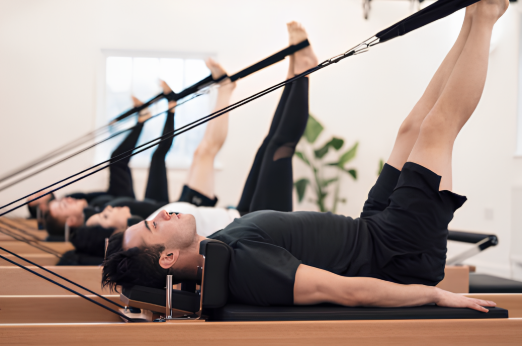
When people think about Pilates, the collective imagination often associates it with a “soft” activity, predominantly female and without real physical impact. Yet this perception is not only limiting, but completely wrong. When practiced properly, Pilates can offer men strength, control, and psychophysical well-being in a surprising way. It is not just an alternative to the gym: it is a powerful tool for those seeking balance, performance, and endurance.
This in-depth guide is dedicated to men who are curious, skeptical, or simply looking for new stimuli for their physical and mental fitness. You will discover why more and more athletes, managers, and performers choose Pilates as a daily ally. This is not about trends, but about real results. Get ready to change your perspective: Pilates is not what you thought it was.
- What Pilates Is and Why It Also Concerns Men
- More Strength and Control: The Physical Benefits of Pilates for Men
- Less Stress, More Clarity: Pilates as a Mental Ally
- Not Only for Women: Why Pilates Is Perfect for Men Too
- At the Gym or at Home: How to Integrate Pilates into Your Routine
- Where to Start: Tips for Men Approaching Pilates
What Pilates Is and Why It Also Concerns Men
A clear and practical introduction to the Pilates method
Pilates is a training system that combines controlled movement, breathing, and concentration with the goal of strengthening the body in a balanced way. Created in the early twentieth century by Joseph Pilates, this method is based on principles of stability, precision, and fluidity, which make it unique in the fitness world. Far from being a marginal or “soft” activity, Pilates is actually a deep and technical practice that involves postural muscles, deep abdominal muscles, back muscles, and pelvic muscles.
Many men are unaware that professional athletes—from football players to rugby players—regularly use Pilates to prevent injuries, improve balance, and increase functional strength. It is not simply a discipline “for people who do not like to sweat,” but a refined practice that trains the body to move with greater efficiency, responsiveness, and precision. This is why more and more men are beginning to consider it a real opportunity for physical and personal growth.
The common perception and how to overcome it
One of the main obstacles preventing men from entering the world of Pilates is a cultural and perceptual barrier. The prejudice that sees it as a women’s activity is deeply rooted but increasingly outdated. This perception is not only unfounded, but it deprives the male audience of an extremely powerful tool for their well-being. In reality, Pilates is designed for all bodies and can effectively respond to male muscular needs, often focused on strength, responsiveness, and post-workout recovery.
Overcoming this stereotype means opening the door to a more conscious, complete, and intelligent form of training. Men who choose Pilates are not “giving up” the masculinity of a workout—they are enhancing it with a discipline that requires rigor, control, and mental presence. The real shift starts here: understanding that being strong also means being flexible, precise, and centered.
More Strength and Control: The Physical Benefits of Pilates for Men
Strengthening the core and improving posture
One of the main advantages of Pilates is its ability to develop a strong and functional core. By “core,” we do not mean just visible abs, but the entire muscular belt that stabilizes the pelvis, supports the spine, and improves movement efficiency. For the modern man—whether sedentary or athletic—this area is often weak or dysfunctional. Pilates works precisely here, generating deep internal strength that translates into better balance, coordination, and athletic performance.
In addition to the core, the Pilates method works on the overall posture of the body. Through targeted and mindful exercises, every movement helps realign the spine, open the shoulders, and release accumulated tension. Men, who are often prone to stiffness in the lower back and thoracic area, can benefit greatly from this corrective action, rediscovering a more natural and energetic posture.
Muscle control and superior physical performance
Unlike other workouts that focus primarily on load or intensity, Pilates teaches the body conscious and controlled movement. This approach stimulates often-neglected muscles, develops isometric endurance, and improves proprioception. In practical terms, you become more skilled at moving, reacting, and managing effort. For a man who practices sports or simply wants to feel more efficient in daily life, this type of control becomes a strategic advantage.
Additionally, thanks to its focus on symmetry and balance, Pilates reduces the risk of muscle compensation and overuse injuries. Each exercise is designed to develop “intelligent strength”—distributed, effective, and sustainable. This makes it an ideal complement to any other form of training, from running to weightlifting, helping the body work more efficiently and safely.
Less Stress, More Clarity: Pilates as a Mental Ally
Focus and concentration through breathing
Pilates does not only train the body—it is also a powerful tool for developing concentration and mental control. Each exercise is performed in sync with breathing, creating a rhythm that promotes awareness and self-listening. For men accustomed to fast-paced routines, multitasking, and cognitive overload, this practice represents a valuable active pause. It is not about disconnecting the mind, but about training it to be present, clear, and focused.
This mental dimension makes Pilates particularly effective in contexts of work stress or daily pressure. Through diaphragmatic breathing and mindful movement, the nervous system rebalances, oxygenation improves, and the mind recharges. The result? A tangible sense of centeredness, clarity, and active relaxation that reflects in every aspect of life.
Stress, anxiety, and tension: why Pilates makes the difference
Many men live with high levels of physical and mental tension without even realizing it. Stiff shoulders, tight backs, insomnia, irritability—common symptoms that Pilates helps address directly. Through breathwork and joint mobility exercises, physiological mechanisms are activated that reduce cortisol levels and improve sleep quality and mood.
Practicing Pilates regularly means learning to manage emotions through the body. This is not a “spiritual” or abstract concept: it is a physical skill developed over time. The results? Greater tolerance to stress, more patience, and more balance. An aspect often overlooked in male training routines, yet fundamental for a healthy and high-performing life.
Not Only for Women: Why Pilates Is Perfect for Men Too
Debunking myths: what men think (and what they should know)
The biggest obstacle between men and Pilates is prejudice. Many consider it too gentle, not challenging enough, or even “not masculine.” These beliefs are based on outdated images and completely ignore the reality of the discipline. Pilates is actually a demanding, technical, and physically intense practice that requires strength, coordination, and precision.
Those who try Pilates quickly realize that the challenge is not only muscular but also mental. You cannot hide behind power or speed—every movement must be performed with full control. This very difficulty is what makes Pilates so effective and valuable.
Athletes, professionals, and performers: real success stories
Many men have integrated Pilates into their routines with surprising results. From the NBA to professional soccer, from marathon runners to executives seeking balance, more and more people recognize Pilates as an essential tool to improve performance and well-being.
Pilates adapts to all levels but reaches depth like few other methods. This is the key to its growing popularity among men who discover it: it offers far more than it promises. It challenges, transforms, and improves.
At the Gym or at Home: How to Integrate Pilates into Your Routine
Pilates as cross-training and injury prevention
Pilates fits perfectly into any male training program as a form of cross-training. Whether you lift weights, run, swim, or play football, Pilates can enhance what you already do by improving joint mobility, balance, and muscle recovery.
One of the most tangible benefits is injury prevention. By strengthening stabilizing muscles and correcting faulty movement patterns, Pilates significantly reduces the risk of strains, overload injuries, and muscular imbalances.
Combining it with other disciplines for concrete results
Integrating Pilates into your routine does not mean giving up what you enjoy—it means completing it intelligently. One or two sessions per week can make a big difference, especially when scheduled between more intense workouts.
Many men begin Pilates thinking they will do “a little stretching,” but soon discover a complete and transformative method. Whether practiced in the gym with a qualified trainer or at home with videos and small equipment, Pilates adapts to your lifestyle.
Where to Start: Tips for Men Approaching Pilates
Types of classes, levels, and equipment needed
The first step in approaching Pilates is understanding that it is a progressive method, suitable for both beginners and advanced athletes. Classes can be individual or group-based, matwork or equipment-based (Reformer, chair, ring).
To begin, all you need is a mat, comfortable clothing, and the willingness to challenge yourself. Programs designed specifically for men often focus on functional strength, mobility, and injury prevention.
How to choose the right path for you
Every man has a different starting point. Some are already active and seek intelligent integration, while others want to return to movement after years of sedentary lifestyle or injury. Pilates works in both cases but must be adapted to individual goals and fitness levels.
Start with basic lessons focused on breathing, control, and body awareness. Within a few weeks, you will notice improvements in posture, core strength, and stress management. From there, the path can evolve toward more advanced or integrated forms of training.
The secret? Consistency and an open mind. Pilates does not promise miracles—but it delivers real results to those willing to engage with it.
Comments (0)