
Trolley
You have no items in your shopping cart

 Budgets
 Dumbers
 Discs
Discs
 Benches
 Racks and Rigs
 Weights Holders
 Isotonic machines
 Calisthenics
 Cardio
 Kettlebells
 Flooring
 Gym Set
 Accessories
 Combat
 ARTI MARZIALI
 CONTAINER GYM
 Tug-Of-War
 Used Gym Equipment
 PILATES MACCHINARI
 GINNASTICA ARTISTICA
 CAMPI DA PADEL
 Prodotti in Pronta Consegna
 Informazioni
 IRONMAN
 Gift Card
- Donatif
- General information
- 0 I like it
- 1776 Views
- 0 comments
- gym flooring, safety flooring, gym safety, shock-absorbing materials
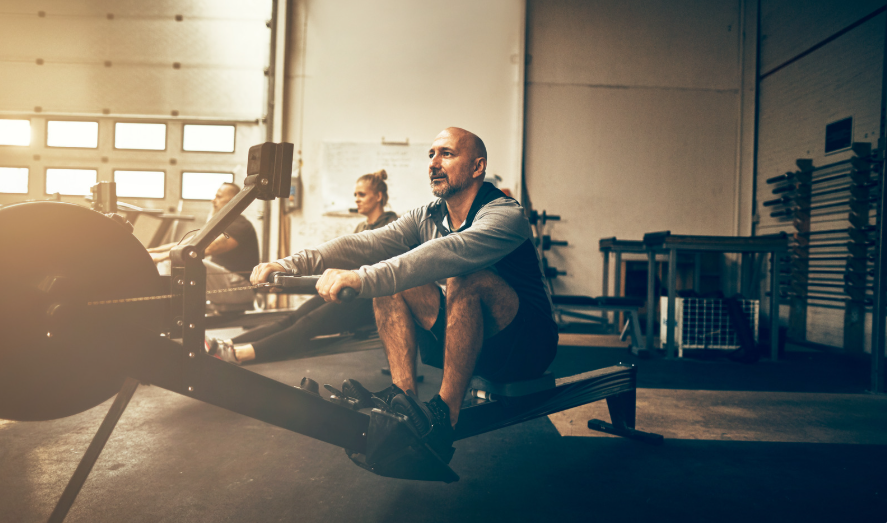
How to Integrate the Rowing Machine into a Hypertrophy Program
Integrating a rowing machine into a hypertrophy-oriented training program requires more attention than simply adding cardio at the end of a workout. Those aiming to increase or maintain muscle mass often have a legitimate concern: that aerobic work may drain energy, impair recovery, or slow strength progression. In reality, the key point is not whether rowing and hypertrophy are compatible in absolute terms, but how to structure frequency, intensity, and timing in a way that supports the primary goal.
The rowing machine is a unique tool because it engages the legs, back, arms, and core in a cyclical movement with high coordination demands. This makes it extremely effective from a cardiovascular standpoint, but also more demanding than other forms of passive or localized cardio. For amateur athletes, intermediate fitness enthusiasts, or trainers designing combined programs, the priority is preventing the rower from becoming a second untracked muscular fatigue session. When used strategically, however, it can improve conditioning, work capacity, and recovery management without compromising muscle gains.
Rowing and hypertrophy: a compatibility that requires planning
Why cardio is not automatically an obstacle to muscle growth
Cardio and muscle mass can coexist when aerobic work is adjusted according to the athlete’s main priority. Problems arise when cardio is added without considering total training volume, recovery between sessions, and the stress placed on the same muscle groups already involved in weight training. The rowing machine, when used at controlled intensities, can improve the ability to sustain longer workouts, enhance work tolerance, and contribute to body composition management. It does not replace resistance training, but it can complement it effectively if it remains secondary to hypertrophy goals.
When rowing can become an interference factor
The risk increases when rowing sessions involve excessive volume, overly frequent high intensity, or are placed too close to demanding lower-body or back workouts. In these cases, fatigue can accumulate in the quadriceps, hamstrings, glutes, lower back, and lats — the same muscle groups heavily involved in squats, deadlifts, rows, and pull-ups. Interference is not caused simply by doing cardio, but by how that cardio fits into the weekly workload. If performance on compound lifts declines, sleep quality worsens, or fatigue remains elevated for several days, rowing volume should be reduced or repositioned.
Proper timing: where to place rowing sessions during the week
Post-workout sessions and separate conditioning work
When hypertrophy is the primary objective, resistance training should remain the main focus of the session. For this reason, rowing is generally more manageable after strength training rather than before it, especially if the workout includes complex exercises or progressive overload. A short rowing phase at the beginning may work as a warm-up, but it should not turn into a hidden cardio workout. After lifting, however, 10–20 minutes at moderate intensity can be sustainable, provided it does not compromise recovery for upcoming sessions. In more advanced programs, separating cardio and lifting into different times of the day may offer additional benefits.
Dedicated cardio days and fatigue management
Placing rowing sessions on days separate from weight training can work well for individuals with good recovery capacity. However, a “rest” day should not become an opportunity to accumulate unnecessary fatigue. If a heavy leg workout is scheduled for the following day, a long or intense rowing session may leave residual fatigue and reduce training quality. A cautious strategy is to schedule lighter cardio after upper-body sessions or on days that are distant from demanding lower-body and posterior chain workouts. The goal is to protect progression, not to fill every available training slot.
Volume and intensity: finding the right balance
Low and moderate intensity to support recovery
For those aiming to maintain or increase muscle mass, rowing volume should initially remain moderate. Two weekly sessions lasting 15–25 minutes at low or moderate intensity are often more sustainable than long and frequent workouts. The objective is not to finish exhausted, but to improve cardiovascular conditioning without stealing resources from hypertrophy adaptations. A manageable intensity allows controlled breathing, stable technique, and the sensation of productive rather than destructive work. This approach is especially useful during periods where weight training volume is already high.
When to use higher-intensity intervals without overdoing it
High-intensity intervals on the rowing machine can be effective, but they should be treated as a true training stimulus. They are not a simple finisher because they demand neural energy, coordination, and muscular recovery. In a hypertrophy-oriented program, they can be included once per week, preferably far from the heaviest lifting sessions or during phases where weight-training volume is slightly reduced. A conservative structure may include short intervals, adequate recovery periods, and a limited number of repetitions. Once technical quality deteriorates, the session stops being strategic and becomes additional fatigue.
Practical examples for combining strength, muscle growth, and rowing
Programming for an intermediate recreational athlete
An intermediate recreational athlete training with weights four times per week can integrate rowing gradually and effectively. For example, one light rowing session after an upper-body workout and one moderate session on a separate day may provide a balanced approach. During hypertrophy-focused phases, rowing should remain secondary, with controlled volume and intensity. During maintenance or body recomposition phases, it may play a slightly larger role. The priority remains monitoring whether loads, repetitions, and overall training quality continue progressing or at least remain stable.
Signals to monitor and adjustments to make
The most practical way to determine whether rowing is compatible with hypertrophy is to monitor performance indicators. If working sets become less stable, recovery worsens, or appetite increases without proper nutritional support, the program should be adjusted. Even smaller warning signs, such as heavy legs during squat sessions or back fatigue during rows, may indicate excessive overlap. In these situations, it is preferable to first reduce intensity, then volume, and finally frequency. Rowing for hypertrophy works best when it remains measurable, adjustable, and aligned with the rest of the training plan.
A sustainable strategy for better training
The rowing machine as a tool, not a competing objective
The key concept is to view the rowing machine as a tool that supports the program rather than a competing objective. If the primary goal is building muscle mass, cardio should improve general conditioning without reducing the quality of hypertrophy-focused training. This requires a moderate programming approach built around clear priorities and regular monitoring of individual responses. There is no universally perfect amount of rowing, but there is one consistent principle: rowing is properly integrated when it makes training feel more efficient, not when it constantly forces reductions in lifting performance.
How to choose a setup that fits your training environment
In a home gym or professional fitness facility, a rowing machine can effectively complement an equipment setup focused on strength, hypertrophy, and conditioning. The investment makes sense when space, usage frequency, and user profiles justify a versatile machine capable of improving endurance and coordination without requiring multiple stations. For those building a complete training environment, choosing a stable, smooth rowing machine suitable for regular sessions helps maintain consistency between aesthetic and performance-oriented goals. Compatibility with hypertrophy does not depend on the machine itself, but on the quality of the programming built around it.
Comments (0)