
Trolley
You have no items in your shopping cart

 Budgets
 Dumbers
 Discs
Discs
 Benches
 Racks and Rigs
 Weights Holders
 Isotonic machines
 Calisthenics
 Cardio
 Kettlebells
 Flooring
 Gym Set
 Accessories
 Combat
 ARTI MARZIALI
 CONTAINER GYM
 Tug-Of-War
 Used Gym Equipment
 PILATES MACCHINARI
 GINNASTICA ARTISTICA
 CAMPI DA PADEL
 Prodotti in Pronta Consegna
 Informazioni
 IRONMAN
 Gift Card
- Donatif
- General information
- 0 I like it
- 1416 Views
- 0 comments
- gym flooring, safety flooring, gym safety, shock-absorbing materials
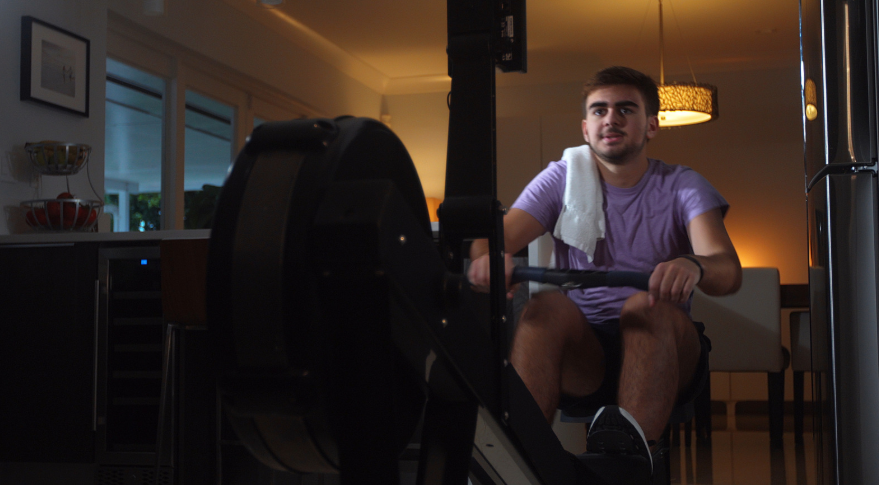
Rowing Machine at Home: How Much Space Do You Need and Where Should You Put It?
Buying a rowing machine for home workouts may seem simple until the most practical question comes up: where can you actually put it? This concern is completely normal, especially in apartments where every square meter matters and noise can become an issue for family members or downstairs neighbors. Before giving up on the idea, it’s worth evaluating the space needed for a rowing machine at home, its actual footprint, the best positioning, and how to manage vibrations.
A rowing machine does not necessarily require a dedicated workout room. What it really needs is a practical assessment: available length, free surrounding space, suitable flooring, and the possibility of storing it when not in use. With accurate measurements and a few useful accessories, such as an anti-vibration mat or a space-saving cover, the machine can fit even in already furnished environments.
How much space is needed for a rowing machine at home
Measurements to consider before buying
When talking about rowing machine dimensions, it is not enough to look only at the length listed in the product specifications. You also need to consider the space required to get on, get off, and complete the rowing motion without hitting furniture, walls, or doors. In many cases, a rowing machine occupies a long and narrow surface area, making it easier to fit compared to other cardio equipment, but it still requires enough side clearance for safe movement.
The most useful approach is to measure a rectangle on the floor matching the machine’s footprint and add extra free space around it. This simple check reduces the risk of buying equipment that is technically suitable but difficult to use in the chosen room. For apartment living, the real question is not only “Will it fit?” but also “Can I use it comfortably without moving half the room every time?”.
Footprint during use and when stored
The rowing machine footprint changes significantly between workout mode and storage mode. Some models can be lifted vertically or folded, while others maintain a more stable but less compact structure. This difference strongly affects the final choice, especially when the machine must share space with a living room, bedroom, office, or laundry area.
Before choosing, it helps to imagine both situations. During workouts, you need a stable and unobstructed area; after training, a corner, a free wall, or even the space behind a door may be enough if the model allows it. In this context, a space-saving cover can help protect the machine and make it less visually intrusive when left visible at home.
Where to place a rowing machine without making your home uncomfortable
Living room, bedroom, or office: choosing the most practical spot
To position a rowing machine effectively, you should start from your real habits rather than the idea of a perfect home gym. The living room may be practical if it is the largest area, but the impact on family life should be considered. A bedroom can offer more privacy, while a home office is often a good solution for people who train during short breaks and want the equipment easily accessible.
The best spot is the one where the machine can be used without becoming an obstacle. If every workout requires moving chairs, rugs, toys, or lightweight furniture, consistency may quickly decline. The most functional choice is therefore a balance between available space, ease of access, and visual discretion, especially if the rowing machine remains assembled at all times.
Flooring, ventilation, and distance from furniture
The floor should be stable, level, and ideally protected. Even when a rowing machine is not particularly noisy, repetitive movement can transmit small vibrations, especially on parquet, thin tile flooring, or apartment structures. An anti-vibration mat reduces direct contact with the floor, protects surfaces, and keeps the workout area more organized.
It is also best to avoid placing the machine too close to delicate furniture, long curtains, or busy walkways. During rowing, the body moves back and forth, so extra free space is needed even where it may not seem necessary at first glance. Good positioning improves safety and also changes the perception of the equipment: the less it feels “in the way,” the more natural it becomes to use regularly.
Noise, vibrations, and apartment living
What affects the noise level of a rowing machine
Fear of noise is one of the most common concerns for people considering a home rowing machine. Sound levels depend on the type of resistance, build quality, frame stability, and the floor surface where the equipment is placed. Even poor rowing technique can increase impacts and vibrations because the movement becomes less controlled.
In a home environment, the issue is rarely just the sound heard inside the room. More often, the concern is vibration transmission to downstairs neighbors or adjacent walls. For this reason, it is helpful to choose reasonable workout hours, place the machine on a shock-absorbing surface, and make sure the feet and frame are properly adjusted.
How to reduce disturbance for family and neighbors
The solution does not need to be invasive. In most cases, it is enough to create a small dedicated workout area with a technical mat, adequate distance from walls, and a workout routine compatible with everyday home life. A rowing machine should not be placed directly against bookcases, wardrobes, or lightweight partition walls because these elements may amplify vibrations and minor impacts.
For people living with family members or roommates, predictability also matters. Training consistently in the same place and at similar times makes the equipment feel less disruptive in daily routines. The goal is not to turn the home into a gym, but to integrate the rowing machine in a practical, tidy, and sustainable way over time.
What to check before buying
A simple checklist to avoid mistakes
Before purchasing, it is useful to verify three aspects: workout space, storage space, and floor compatibility. This small practical checklist helps transform a vague concern into a concrete evaluation. Measuring the area with a tape measure, simulating the footprint with masking tape, and checking nearby door or drawer openings can prevent unsuitable purchases.
It is also worth considering delivery and assembly access. A rowing machine may fit perfectly in a room but still be difficult to move through narrow staircases, hallways, or interior doors. People with limited space should carefully review technical specifications and evaluate foldable or easier-to-move models.
Useful accessories to adapt the rowing machine to your space
Some accessories are not meant to make workouts more complicated, but more manageable. The anti-vibration mat is among the most useful because it protects the floor and reduces movement transmission. A cover may help if the rowing machine stays in the living room or a shared area, while a simple space measuring tool can help better evaluate available dimensions before ordering.
The best choice is the one that reduces everyday friction. If the machine is easy to use, does not create disturbances, and does not require constant moving around, it becomes much easier to maintain a consistent routine. To evaluate models and accessories suitable for your home, it is always useful to start with the actual room measurements and compare them with the specifications of available home gym rowing machines.
Comments (0)