
Trolley
You have no items in your shopping cart

 Budgets
 Dumbers
 Discs
Discs
 Benches
 Racks and Rigs
 Weights Holders
 Isotonic machines
 Calisthenics
 Cardio
 Kettlebells
 Flooring
 Gym Set
 Accessories
 Combat
 ARTI MARZIALI
 CONTAINER GYM
 Tug-Of-War
 Used Gym Equipment
 PILATES MACCHINARI
 GINNASTICA ARTISTICA
 CAMPI DA PADEL
 Prodotti in Pronta Consegna
 Informazioni
 IRONMAN
 Gift Card
- Donatif
- General information
- 0 I like it
- 1092 Views
- 0 comments
- stress reduction, improved self-esteem, physical and mental well-being, gym training
READING TIME: 5 MINUTES ➤➤
The mistakes that make you believe custom is the solution for a home gym that’s still unclear
When you start planning a home gym, it’s normal to feel uncertain. The space seems limited, the organization unclear, and the choices endless. In this scenario, custom solutions often appear to be the safest option: something that solves everything, fits perfectly, and removes all doubt. But this perception is often misleading.
The biggest risk is confusing a clarity problem with a space problem. In many cases, the home setup hasn’t been properly defined yet, and moving to custom becomes a mental shortcut. This article is meant to prevent exactly that mistake: helping you distinguish between what seems complex and what simply needs to be clarified better.
- When the problem isn’t space
- Measurement mistakes
- Unclear priorities
- Underrated standard solutions
- The cost of going custom too early
- Understanding if you really need custom
When the “space problem” is actually a definition problem
Many users interpret initial clutter as a physical limitation. In reality, it’s often a lack of clearly defined priorities. It’s not clear what you want to do, how often, or with which equipment. At this stage, every space feels inadequate.
Custom solutions then step in as a reassuring answer. But it’s a premature one. Without a clear vision, even the most tailored solution risks being ineffective because it’s built on assumptions that aren’t solid yet.
The initial confusion that leads to custom
At the beginning, it’s easy to overestimate problems. You imagine intense usage, consider advanced equipment, and fear not having enough space. This leads to thinking that only a tailor-made solution can work.
In reality, this phase requires exploration, not optimization. Moving straight to custom means crystallizing initial confusion instead of resolving it.
The mental bias of the “final solution”
The brain tends to look for shortcuts. Custom is perceived as a definitive solution that removes the need for further decisions. This is a classic case of effort reduction: less decision-making effort, more apparent peace of mind.
But this simplification is misleading. Without clarity, even custom becomes just an expensive solution to an undefined problem.
Measurement errors and misinterpretation of home space
One of the most common mistakes involves space measurement. It’s often done roughly, without considering real movements, dynamic space, and actual equipment use.
This leads to wrong conclusions: the space seems insufficient when it’s actually just misunderstood. And from there comes the idea that something “custom” is needed.
Poor measurements and rushed conclusions
Measuring only the available surface isn’t enough. You need to consider height, safety margins, and movement flow. Without these elements, you risk overestimating space limitations.
Correction: testing real configurations with standard equipment, such as compact racks and foldable benches, provides a much more accurate perception.
Untested layouts and rigid thinking
Many users imagine a fixed layout without ever trying it. This creates a mental rigidity that leads to rejecting simple solutions.
Correction: experimenting with modular and temporary configurations helps you understand what actually works before committing to definitive solutions.
Unclear priorities: the real limit isn’t space
Another critical mistake is failing to distinguish between what you truly need and what you want. Without this distinction, every decision becomes more complex and space always seems insufficient.
The truth is that an effective home gym starts with clear priorities, not complex solutions. Custom cannot compensate for a lack of direction.
Imagined use vs real use
Many people design their gym based on ideal usage, not real habits. This leads to including equipment that will rarely be used.
Correction: start from a realistic minimum usage and build from there. This drastically reduces initial complexity.
Necessary vs desired equipment
The difference between need and desire is crucial. Confusing them leads to overcrowding the space and searching for more complex solutions than necessary.
Correction: identify a functional base setup before expanding. It’s often already enough to achieve concrete results.
When standard solutions are already enough (but get ignored)
Standard solutions are often underestimated. They’re perceived as limited, inflexible, or unsuitable for home environments. In reality, many are designed specifically for compact spaces.
Ignoring them means missing opportunities for simplicity, efficiency, and cost savings, and unnecessarily moving toward custom solutions.
Compact solutions that solve real problems
Compact racks, foldable benches, vertical storage systems, and modular flooring are concrete examples of highly effective standard solutions.
These elements allow you to optimize space without complications, offering a solid and adaptable foundation.
Concrete examples of effective standard setups
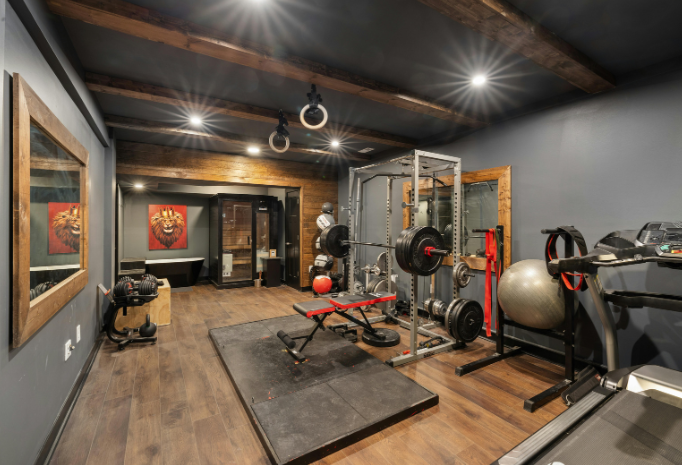
A setup with a compact rack, an adjustable bench, and EVA mats can cover most needs of an entry-level or intermediate user.
This type of configuration shows that what is perceived as a “custom-level problem” is often solvable with standard solutions.
The hidden cost of moving to custom too early
Custom is not just about financial cost. It also brings increased complexity, longer timelines, and reduced future flexibility.
Choosing it too early means taking on these costs without having a clear foundation to build on.
Avoidable complexity
Every custom element requires design, adaptation, and often compromises. This increases both decision-making and operational load.
Correction: simplifying the initial setup reduces complexity and improves the quality of future decisions.
Unnecessary spending and future rigidity
Investing too early in custom solutions can limit future changes. The space becomes less adaptable over time.
Correction: maintaining a flexible structure allows evolution without constraints.
How to understand if you really need custom
Custom solutions make sense only when the problem is clearly defined and cannot be solved with standard options. This requires direct experience and awareness.
Reaching this point too early means skipping essential steps in the decision-making process.
Real signals vs perceived signals
Real signals include specific structural limitations or highly particular needs. Perceived signals, on the other hand, often stem from uncertainty.
Distinguishing between the two is essential to avoid poor investment decisions.
The correct decision path
An effective path starts with standard solutions, moves through testing and adjustments, and only later evaluates custom options.
This approach leads to greater clarity, control, and confidence, avoiding premature and ineffective choices.
Comments (0)