
Trolley
You have no items in your shopping cart

 Budgets
 Dumbers
 Discs
Discs
 Benches
 Racks and Rigs
 Weights Holders
 Isotonic machines
 Calisthenics
 Cardio
 Kettlebells
 Flooring
 Gym Set
 Accessories
 Combat
 ARTI MARZIALI
 CONTAINER GYM
 Tug-Of-War
 Used Gym Equipment
 PILATES MACCHINARI
 GINNASTICA ARTISTICA
 CAMPI DA PADEL
 Prodotti in Pronta Consegna
 Informazioni
 IRONMAN
 Gift Card
- Donatif
- General information
- 0 I like it
- 1788 Views
- 0 comments
- stress reduction, improved self-esteem, physical and mental well-being, gym training
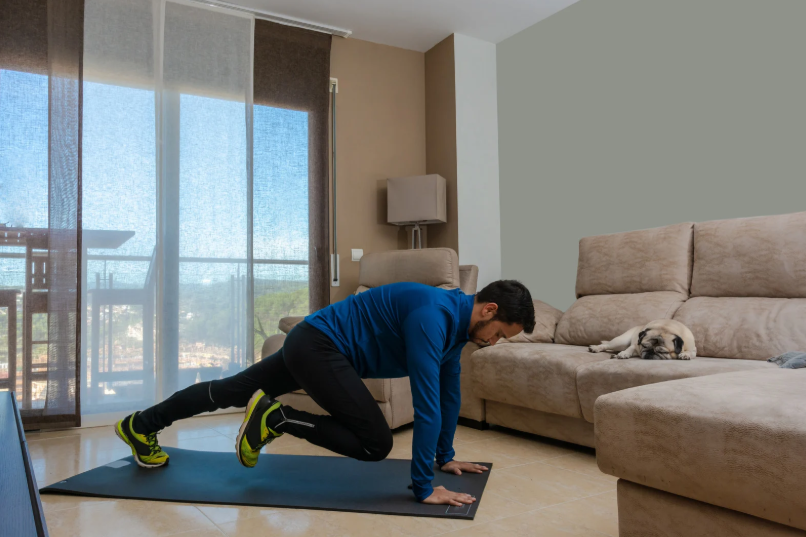
What is the minimum equipment you really need to train at home if your goal is to lose weight
When you decide to work out at home with the goal of losing weight, the first reaction is often to look for a list of equipment to buy. The problem is that these lists tend to grow quickly, turning a simple need into a confusing and often inefficient investment. The result is a room full of rarely used tools and a constant feeling of having wasted money.
The truth is that weight loss does not depend on the amount of equipment, but on the ability to build a system that is consistent, sustainable, and repeatable over time. In this article, we’ll look at which tools really matter, which ones can wait, and how to avoid common mistakes that lead to impulsive and ineffective purchases.
- Why the problem is not how much equipment you have
- Essential equipment
- Useful but not essential equipment
- Equipment you can postpone
- How to build a coherent minimal setup
Why the problem is not how much equipment you have, but what you actually use
One of the most common mistakes is thinking that having more tools automatically leads to better results. In reality, the opposite happens: the more options you have, the more likely you are to use none of them consistently. This phenomenon is known as decision overload, and it reduces workout frequency.
When it comes to weight loss, consistency is the key variable. A minimal setup used regularly is far more effective than a fully equipped home gym used occasionally. Reducing choices increases the likelihood of action, and therefore results.
The myth of “more equipment = better results”
The fitness market often pushes toward complete, multifunctional, or highly technological solutions. However, these tools require space, maintenance, and above all, a well-established training habit. Without these conditions, they quickly become unused.
For beginners or those with limited space, such as in an apartment setting, it is much more effective to focus on a few versatile tools that cover essential functions: movement, resistance, and consistency.
Weight loss and operational consistency: what really matters
Losing weight means creating a sustainable caloric deficit over time. This is achieved through frequent workouts, even short ones, but repeated consistently. Equipment should support this process, not complicate it.
A good setup reduces friction, preparation time, and complexity. If setting up or choosing equipment becomes a barrier, workouts are skipped—and that’s where the system breaks down.
Essential equipment: the minimal core that makes a difference
There is a minimal set of equipment that allows you to train effectively, progressively, and completely at home. This core is designed to maximize the ratio between usefulness, space, and frequency of use.
It’s not about having everything, but about having what you will actually use. Each item here has a clear and non-overlapping function.
Workout mat: the invisible but necessary foundation
The mat is often underestimated because it is not perceived as “equipment.” In reality, it enables comfortable and consistent floor training, especially at home.
It allows you to perform bodyweight exercises without discomfort, reducing initial friction. Without a mat, many exercises are avoided, limiting both variety and effectiveness.
Resistance bands: the best balance between effectiveness and space
Resistance bands are probably the most efficient tool in a home setup. They take up very little space, are inexpensive, and allow for a wide range of exercises.
From a weight loss perspective, they introduce progressive resistance, which is essential for stimulating metabolism and preserving muscle mass during a caloric deficit.
Light dumbbells: metabolic stimulus and progression
Dumbbells, even light ones, add an important dimension to training: load. This allows you to gradually increase intensity and make exercises more effective over time.
You don’t need heavy weights at the beginning. What matters is the ability to progress and vary the stimulus, keeping workouts challenging and therefore effective for weight loss.
Useful but not essential equipment: when it makes sense to add it
Once a consistent training habit is established, it may make sense to add tools that enhance the experience or increase calorie expenditure. However, these are not essential in the early stages.
Adding them too soon increases the risk of unnecessary purchases, especially if a stable routine has not yet been developed.
Compact exercise bike: real advantages and limits
The exercise bike is one of the most common tools for home cardio, especially in apartment settings where noise is a concern. It is easy to use and accessible to everyone.
However, its main limitation is monotony. Without a clear strategy, it risks being underused. For this reason, it is useful but not a priority in a minimal setup.
Cardio alternatives without machines
It’s important to remember that cardio does not necessarily require machines. Bodyweight circuits, dynamic exercises, and high-intensity sequences can effectively replace tools like the exercise bike.
This approach further reduces the need for equipment while maintaining a high level of effectiveness and adaptability.
Equipment you can postpone: what you do NOT need at the beginning
Many purchases are driven by perception rather than actual need. This leads to filling your space with tools that will not be used consistently.
Understanding what to avoid is just as important as knowing what to buy. It protects your investment and keeps your focus on the real goal.
Bulky and multifunction machines
Multifunction machines promise completeness, but require space, experience, and strong motivation. Without these elements, they quickly become unused.
In an entry-level home setup, they represent unnecessary complexity and are often counterproductive.
Secondary accessories and unnecessary duplication
Many accessories perform functions already covered by simpler tools. Buying them means duplicating options without actually increasing effectiveness.
The guiding principle is simple: every piece of equipment must have a clear and frequent use. If not, it can be postponed.
How to build a coherent minimal setup (without wasting money)
Building an effective setup means following a clear logic, not a random list. The three variables to consider are function, space, and frequency of use.
An item is valuable if it is used often, takes up little space, and has a real impact on your training. Everything else is secondary.
Priority: function, space, frequency of use
Every choice should answer a simple question: will I use this at least three times a week? If the answer is no, it is probably not a priority.
Reducing options means increasing control and building a more stable, sustainable, and results-oriented system.
Concrete example of a minimal setup
An effective minimal setup for home weight loss can include: a mat, resistance bands, and a pair of light dumbbells. This combination covers all essential needs: movement, resistance, and progression.
Only after building a consistent habit does it make sense to consider adding a compact exercise bike or other tools. This shifts the approach from accumulation to intentional construction.
Comments (0)