
Trolley
You have no items in your shopping cart

 Budgets
 Dumbers
 Discs
Discs
 Benches
 Racks and Rigs
 Weights Holders
 Isotonic machines
 Calisthenics
 Cardio
 Kettlebells
 Flooring
 Gym Set
 Accessories
 Combat
 ARTI MARZIALI
 CONTAINER GYM
 Tug-Of-War
 Used Gym Equipment
 PILATES MACCHINARI
 GINNASTICA ARTISTICA
 CAMPI DA PADEL
 Prodotti in Pronta Consegna
 Informazioni
 IRONMAN
 Gift Card
- Donatif
- General information
- 0 I like it
- 1875 Views
- 0 comments
- gym flooring, safety flooring, gym safety, shock-absorbing materials
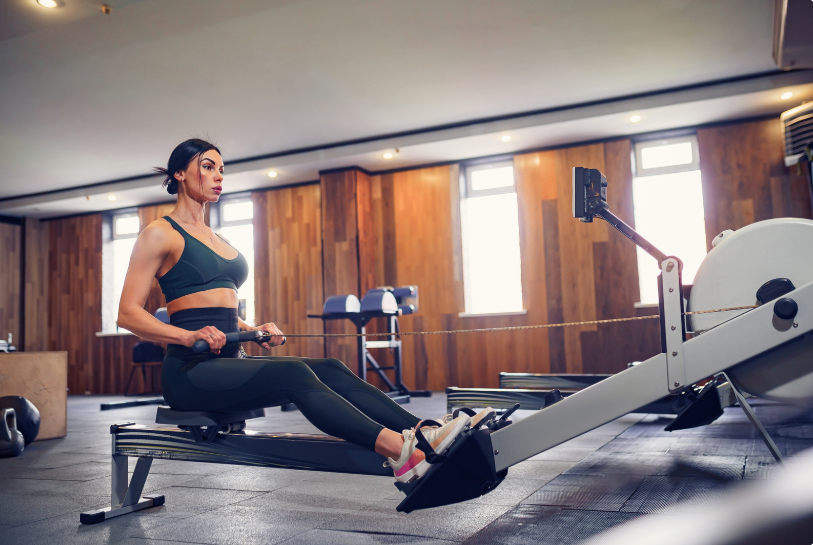
How Many Calories Does a Rowing Machine Burn? Realistic Charts
Understanding how many calories a rowing machine burns is especially useful when the goal is not just “doing cardio,” but organizing workouts that are clearer, measurable, and sustainable. The rowing machine is often perceived as a demanding piece of equipment, yet its real value lies in its ability to engage the legs, back, arms, and core in one coordinated movement. This means energy expenditure can become significant even with relatively short sessions, provided the intensity matches your fitness level.
The calories burned with a rowing machine, however, are not a fixed number. They depend on body weight, duration, pace, technique, resistance level, and workout consistency. A person weighing 60 kg and another weighing 90 kg will not burn the same amount of energy during the same session, just as a relaxed rowing pace cannot be compared to high-intensity intervals. This is why charts are useful only when interpreted as realistic estimates rather than absolute promises.
What affects calorie burn on a rowing machine
The first factor to consider is body weight. At the same duration and intensity, a heavier person tends to burn more calories because they must move more mass and sustain a higher metabolic workload. This does not automatically make the workout more effective for everyone, but it explains why generic charts may seem inaccurate when they do not account for the user’s weight.
The second factor is the actual rowing intensity. A light session performed with controlled breathing and a comfortable rhythm produces a different calorie expenditure compared to a vigorous workout with a high heart rate. Technique also matters: when the drive starts correctly from the legs and the movement stays fluid, muscular work is distributed more efficiently and the calorie estimate becomes more realistic. On the other hand, pulling mostly with the arms may feel exhausting while delivering lower overall efficiency.
Rowing machine calorie chart by weight, duration, and intensity
The following chart uses estimated values based on three intensity levels: light, moderate, and vigorous. It provides a practical reference for anyone wondering whether a rowing machine for weight loss can fit into a home or gym routine. The numbers are rounded because, in real-life situations, calorie expenditure can vary depending on technique, breaks, fitness level, and monitor accuracy.
To interpret the chart correctly, it is better to focus on progression rather than a single number. Increasing a session from 20 to 40 minutes or moving from light to moderate intensity can significantly change total energy expenditure. However, for fat loss, workout calorie burn should always be considered alongside nutrition, recovery, and weekly consistency.
| Body Weight | 20 min light | 30 min moderate | 45 min moderate | 60 min vigorous |
|---|---|---|---|---|
| 60 kg | 105 kcal | 220 kcal | 330 kcal | 510 kcal |
| 70 kg | 123 kcal | 257 kcal | 386 kcal | 595 kcal |
| 80 kg | 140 kcal | 294 kcal | 441 kcal | 680 kcal |
| 90 kg | 158 kcal | 331 kcal | 496 kcal | 765 kcal |
How to calculate calories using the MET method
The MET method estimates calorie expenditure using a simple formula: MET x body weight in kg x duration in hours. A light activity may be estimated around 5 METs, a moderate session around 7 METs, and a vigorous workout around 8.5 METs. It is not a perfect system, but it is useful for comparing different scenarios without relying entirely on the machine’s display.
A practical example makes the calculation easier to understand. A person weighing 80 kg who rows for 30 minutes at moderate intensity can estimate: 7 x 80 x 0.5 = approximately 280 kcal. If the same person extends the workout to 45 minutes, the value increases to around 420 kcal. This helps create a more controlled training plan and avoids judging workout effectiveness only by perceived fatigue.
How to use these numbers in a weekly workout plan
For people aiming to lose weight, the rowing machine works best when included in a sustainable routine. Three moderate 30-minute sessions can generate a meaningful weekly calorie expenditure for many users without requiring extreme workouts. For example, an 80 kg person may reach approximately 840 kcal per week with three moderate half-hour sessions.
A more advanced strategy can alternate one easy session, one moderate workout, and one interval-based session. The easy session helps build consistency, the moderate one develops endurance, while intervals increase intensity without dramatically extending workout duration. In this way, rowing machine calories burned become a planning tool rather than a rigid number to chase.
When rowing machine monitor data may be inaccurate
Rowing machine monitors can provide useful estimates, but they do not always accurately measure individual metabolism. Some estimate calories based on watts, pace, or resistance, while others use generic formulas. Without correct personal data such as weight, age, and heart rate, the result may be overestimated or underestimated. For this reason, it is better to use the monitor as a comparative reference between similar workouts rather than treating it as an absolute measurement.
To improve reliability, it can help to pair the rowing machine with a heart rate monitor, especially when the goal is controlling workout intensity. Even then, the data should never be interpreted in isolation: consistency, progression, and long-term adherence matter most. A rowing machine can be highly effective for reducing body fat, but its real effectiveness comes from combining realistic numbers, proper technique, and regular weekly training.
Comments (0)