
Trolley
You have no items in your shopping cart

 Budgets
 Dumbers
 Discs
Discs
 Benches
 Racks and Rigs
 Weights Holders
 Isotonic machines
 Calisthenics
 Cardio
 Kettlebells
 Flooring
 Gym Set
 Accessories
 Combat
 ARTI MARZIALI
 CONTAINER GYM
 Tug-Of-War
 Used Gym Equipment
 PILATES MACCHINARI
 GINNASTICA ARTISTICA
 CAMPI DA PADEL
 Prodotti in Pronta Consegna
 Informazioni
 IRONMAN
 Gift Card
- Donatif
- General information
- 0 I like it
- 2474 Views
- 0 comments
READING TIME: 9 MINUTES ➤➤
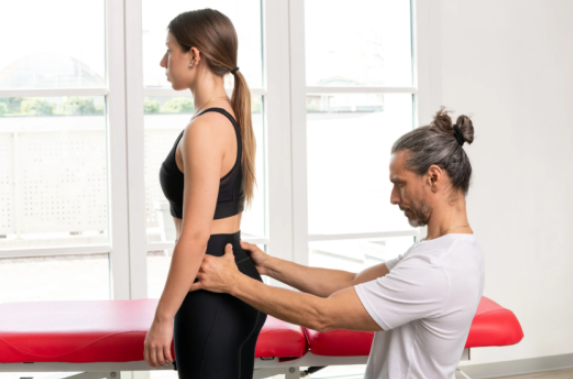
When we stand up, we often think only about looking "presentable" for a photo. Yet what happens to our body in that moment has a much deeper and more immediate impact than we realize. There is an invisible line connecting the ear, shoulder, pelvis, and ankle. This vertical line is the foundation of physical presence: it not only determines our posture but also influences how we perceive ourselves and how others perceive us.
Understanding and experiencing this body alignment is the first step toward a tangible transformation. It's not simply about "standing up straight"—it's about feeling your body as a cohesive, stable, and confident whole. In this article, you'll learn how to identify this line, test it yourself, and discover why it can transform your self-image in just a few seconds.
- What Is Vertical Body Alignment?
- The Wall Test: How to Assess Your Posture
- Physical Presence and Posture: An Immediate Connection
- Training Your Body for Better Alignment: Awareness and Practice
What Is Vertical Body Alignment?
From Head to Toe: The Ear-Shoulder-Pelvis-Ankle Line
Imagine a straight line running from your ear down to your ankle, passing through your shoulder and pelvis. This represents the body's ideal standing alignment. It isn't a forced posture or a military stance, but rather a natural position in which the body supports itself with minimal effort. When these key points are aligned, the spine remains neutral, the muscles work in balance, and body weight is distributed efficiently.
This alignment is often disrupted by everyday life. Hours spent sitting, repetitive movements, and poor postural habits gradually pull the body away from its natural axis. Yet once this alignment is restored, the body quickly "remembers" what it feels like to move and stand comfortably. The change isn't just physical—it also affects perception and is immediately noticeable.
Why It's Essential for Standing Posture
When the body is properly aligned, weight is distributed naturally throughout the skeleton and muscles. This reduces muscular fatigue and helps prevent chronic tension. But there's more: vertical alignment gives our presence a sense of stability, confidence, and authority. A well-aligned person appears more grounded, centered, and self-assured—even without saying a word.
Other people's brains unconsciously interpret these signals. At the same time, our own nervous system recognizes this balanced position and provides positive feedback. Self-image improves, breathing becomes easier, and the body feels more fully inhabited. It's a silent language that communicates a great deal instantly.
The Wall Test: How to Assess Your Posture
How to Perform the Test Correctly
One of the easiest ways to evaluate your alignment is the classic wall test. Stand with your back against a wall, leaving your heels slightly away from it. Try to gently bring your sacrum, shoulder blades, and the back of your head into contact with the wall. Continue breathing normally and simply notice how your body feels.
In a well-aligned posture, these three points should touch the wall without strain. If you have to force your head backward or excessively arch your lower back, postural imbalances may be present. The wall test isn't meant to judge your posture—it's a tool for increasing awareness and beginning to retrain your body toward its natural alignment.
What to Notice During the Exercise
While performing the test, ask yourself: Where do I feel tension? Can I maintain the contact points without stiffening? Does my breathing change? These questions are essential for moving beyond a purely mechanical posture toward a posture that feels natural and alive. The goal isn't simply to touch the wall but to experience your body adapting, organizing itself, and becoming more aware.
Practiced regularly, this simple exercise becomes an internal reference point. You can use it before a job interview, a presentation, or any social situation where you want to feel more grounded and confident. Within seconds, your body reconnects with its central axis—and your mind naturally follows.
Physical Presence and Posture: An Immediate Connection
The Mirror Effect: How You See Yourself and How Others See You
Posture isn't just biomechanics—it's also about image, communication, and first impressions. Someone who stands with an aligned body, eyes looking forward, and head properly positioned naturally conveys confidence. This influences not only those who observe them but also the person adopting that posture. This phenomenon is often described as the mirror effect: when your body changes, your mental perception of yourself changes as well.
Numerous studies suggest that an open, upright posture can increase self-confidence and improve the ability to cope with challenging situations. This happens because posture also influences the autonomic nervous system, encouraging responses associated with calmness, control, and emotional balance.
Self-Esteem, Confidence, and Nonverbal Communication
Nonverbal communication is often more powerful than words. Standing with awareness and proper body alignment changes the quality of every interaction. People naturally perceive someone who appears present, confident, and approachable. Most importantly, however, the first person to experience this change is you.
Whenever you feel uncertain, reconnecting the line between your shoulders, pelvis, and feet can become a remarkably simple yet powerful gesture. It's more than posture—it's a form of silent self-affirmation. It's a way of reconnecting with yourself, grounding your body, and facing the world with greater confidence.
Training Your Body for Better Alignment: Awareness and Practice
Everyday Habits That Shape Your Posture
Your posture is the result of countless small daily habits: how you walk, how you hold your phone, how you sit, and even how you breathe. For this reason, learning vertical alignment isn't about memorizing a single position—it's about gradually changing your relationship with space and with your own body.
Small daily adjustments—taking breaks to stretch, walking more mindfully, or adjusting your chair correctly—can produce lasting improvements. The body responds with remarkable intelligence whenever it's given the opportunity to "remember" its natural alignment.
The Importance of Body Awareness
Body awareness is the key to this entire process. Understanding the theory isn't enough—you have to experience it. Taking just a few minutes each day to explore your alignment, perhaps using a mirror or a wall as feedback, becomes an act of self-care, attention, and presence.
Rediscovering the invisible line connecting your ear, shoulder, pelvis, and ankle is a way of reconnecting with yourself. And every time your body finds that alignment again, your mind follows. That's the moment when the way you see yourself changes—and inevitably, so does the way others see you.
Comments (0)