
Trolley
You have no items in your shopping cart

 Budgets
 Dumbers
 Discs
Discs
 Benches
 Racks and Rigs
 Weights Holders
 Isotonic machines
 Calisthenics
 Cardio
 Kettlebells
 Flooring
 Gym Set
 Accessories
 Combat
 ARTI MARZIALI
 CONTAINER GYM
 Tug-Of-War
 Used Gym Equipment
 PILATES MACCHINARI
 GINNASTICA ARTISTICA
 CAMPI DA PADEL
 Prodotti in Pronta Consegna
 Informazioni
 IRONMAN
 Gift Card
- Donatif
- General information
- 0 I like it
- 1254 Views
- 0 comments
- stress reduction, improved self-esteem, physical and mental well-being, gym training
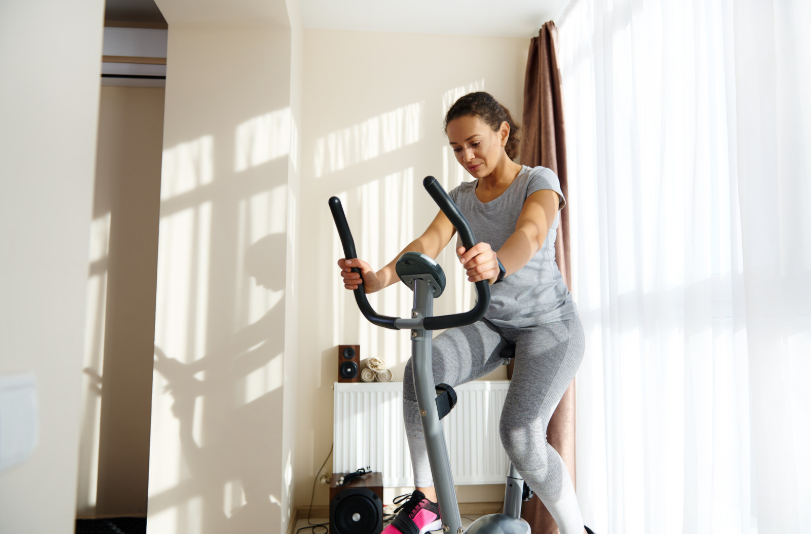
Treadmill, Exercise Bike or Nothing: What Really Matters to Lose Weight at Home
When it comes to losing weight at home, one of the most common beliefs is that you necessarily need a cardio machine like a treadmill or an exercise bike. It’s an intuitive idea, but often misleading. Before investing in something bulky and expensive, it’s essential to understand what truly impacts your results.
This article is designed to bring clarity: not to push you toward a purchase, but to help you realistically evaluate whether a cardio machine actually fits your real-life context. Because the biggest risk isn’t choosing the wrong model, but buying something that will end up unused.
- The real goal
- Treadmill and exercise bike
- Selection criteria
- When you don’t need one
- Decision matrix
The Real Goal: Losing Weight or Moving More?
Weight loss does not depend on a machine, but on a much simpler principle: caloric deficit. This means burning more energy than you consume, and it can be achieved in many different ways, not necessarily through specific equipment.
Cardio, therefore, is not the solution but a tool. It can help increase calorie expenditure, but it is not essential. Thinking that you can’t lose weight without a treadmill or an exercise bike is a mental shortcut that often leads to ineffective decisions.
The Role of Caloric Deficit
Every physical activity contributes to calorie burn, but the final result depends on consistency and sustainability. Walking, bodyweight training, or simply increasing daily movement can lead to the same results if placed within a coherent routine.
This completely changes the perspective: you don’t need the perfect machine, but a system you can actually maintain over time. That’s where the difference between intention and results lies.
Why Cardio Is Just a Tool
A treadmill won’t make you lose weight on its own, just as an exercise bike doesn’t guarantee results. These are tools that only work if used consistently within a sustainable routine.
The key question is: will I really use it? If the answer isn’t clearly yes, the problem isn’t the equipment, but the strategy.
Treadmill and Exercise Bike: Real Benefits and Hidden Limits
Both treadmills and exercise bikes have real advantages, but also often overlooked limitations. Understanding them before buying is essential to avoid costly mistakes.
There is no universally better choice: everything depends on your context, habits, and how realistically you evaluate your future usage.
When a Treadmill Makes Sense
A treadmill is useful if you enjoy walking or running and want to do it regardless of weather conditions. It offers a more dynamic experience and can be more engaging for those seeking variety.
However, it requires space, can be noisy, and often becomes a bulky object. Without an existing habit of movement, the risk of abandonment is high.
When an Exercise Bike Is a Smart Choice
An exercise bike is generally more compact and quieter. It’s a more accessible solution for those living in apartments who want to avoid noise issues.
The main limitation is monotony: many people stop using it after a few weeks. Again, the issue isn’t the machine, but the sustainability of its use.
The Most Common Risk: They Go Unused
The real mistake isn’t choosing between a treadmill and a bike, but overestimating your initial motivation. Many purchases are driven by enthusiasm rather than realistic evaluation.
An unused machine represents a double loss: money and space. That’s why it’s crucial to think before buying, not after.
The Criteria That Really Matter in Your Choice
To decide whether to buy a cardio machine, you need to move away from “what is best” and toward “what is right for me.”
The key criteria are simple, but often ignored. And this is exactly where the quality of your decision is determined.
Space and Real Footprint
It’s not enough to know that a machine is compact: you need to understand where it will go and how it will affect your daily life. An inconvenient object tends to be avoided.
Space is not just physical, but also mental. If you have to move furniture every time, you’ll likely stop using it quickly.
Noise and Living Context
In an apartment, noise is a critical factor. A treadmill can create vibrations and disturb neighbors, while an exercise bike is generally more discreet.
Ignoring this aspect creates friction that reduces usage over time.
Sustainable Frequency of Use
The key question is: how many times per week will you actually use it? Not in theory, but in your real routine.
A machine only makes sense if it becomes part of your habits. Otherwise, it quickly becomes unnecessary.
Realistic Long-Term Use
Many decisions are optimistic. People imagine an ideal version of themselves, more disciplined and consistent.
But the best choice is the one that works even on “off” days. That’s the real test of sustainability.
When You DON’T Need a Cardio Machine
There are many situations where buying a cardio machine is not the best choice. In fact, it can become a barrier rather than a help.
Simplicity, in many contexts, is more effective than complexity.
Effective Alternatives Without Machines
Bodyweight workouts, daily walks, high-intensity circuits: all valid options to increase calorie expenditure.
These solutions have a huge advantage: they require no investment and easily adapt to real life.
The Value of Simplicity
A minimal setup reduces barriers to action. Fewer obstacles mean greater consistency.
In many cases, not buying anything is the smartest choice. Not because cardio doesn’t work, but because it’s not necessary to achieve results.
Decision Matrix: Machine or Not?
The final decision should not be based on trends or common beliefs, but on a concrete evaluation of your situation.
A simple mental matrix can help you avoid common mistakes.
When Buying Makes Sense
A machine makes sense if you have dedicated space, tolerance for noise, an already established habit of movement, and a clear intention to use it consistently.
In this case, it can become an effective and convenient ally.
When It’s Better to Avoid
If you’re just starting, unsure about consistency, short on space, or worried about clutter, it’s better to postpone the purchase.
Build the habit first, then choose the tool. This approach protects your investment and increases your chances of success.
Comments (0)