
Trolley
You have no items in your shopping cart

 Budgets
 Dumbers
 Discs
Discs
 Benches
 Racks and Rigs
 Weights Holders
 Isotonic machines
 Calisthenics
 Cardio
 Kettlebells
 Flooring
 Gym Set
 Accessories
 Combat
 ARTI MARZIALI
 CONTAINER GYM
 Tug-Of-War
 Used Gym Equipment
 PILATES MACCHINARI
 GINNASTICA ARTISTICA
 CAMPI DA PADEL
 Prodotti in Pronta Consegna
 Informazioni
 IRONMAN
 Gift Card
- Donatif
- General information
- 0 I like it
- 1283 Views
- 0 comments
- stress reduction, improved self-esteem, physical and mental well-being, gym training
READING TIME: 5 MINUTES ➤➤
How to set up a garage gym floor without underestimating noise and impact
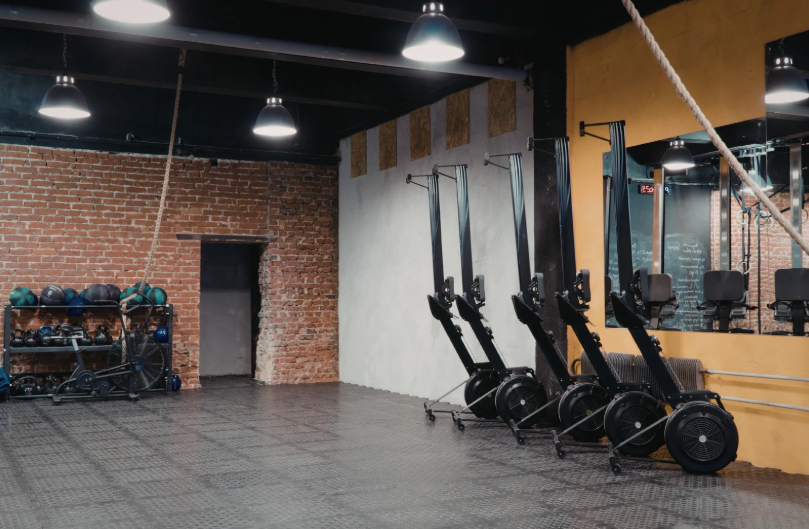
Setting up a garage gym often seems simpler than it actually is. The most common reasoning starts from a wrong assumption: if the garage is already a solid space, then it can accommodate any type of training without special precautions. In reality, the floor is one of the elements that most affects the quality of the experience, the stability of equipment, and the management of noise, impacts, and vibrations. Overlooking it means exposing yourself to a range of issues that only become apparent after installation, when fixing them becomes more expensive and less practical.
A well-configured garage gym flooring is not just about making the space “more comfortable.” It is about building a foundation that aligns with loads, movements, and the actual context in which training takes place. This becomes even more important when the garage is located in a residential building or a shared environment, where noise is not just a matter of comfort but also of coexistence, usability over time, and the ability to use the space without recurring issues.
- Why a garage is a technical environment, not a neutral one
- Stability, support, and surface continuity
- Impacts, vibrations, and noise in a garage gym
- How to choose thickness, density, and structure
- When a lifting platform is needed
- Common mistakes to avoid
- A smarter setup for private and shared garage gyms
Why a garage is a technical environment, not a neutral one
A garage is often perceived as a “utility room,” and therefore automatically suitable for a training area. This interpretation is convenient, but incomplete. A garage is designed for a different purpose than a fitness space and presents conditions that directly affect flooring performance: concrete surfaces that are not always perfectly even, possible drainage slopes, the presence of moisture, previous vehicle traffic, abrasive dirt, and localized loads concentrated in specific areas. When installing a training base, these factors do not disappear—they continue to influence support, wear, and material response.
For this reason, the garage should be considered a technical environment. It’s not enough to ask whether the flooring “covers the ground well,” but whether it realistically meets the needs of subfloor protection, comfort under load, continuity of support, and impact reduction. In a very simple home gym, a basic setup may be enough, but when barbells, heavy dumbbells, or more dynamic movements are involved, the margin for error becomes smaller. This is where seemingly secondary choices—like material or thickness—significantly affect the final outcome.
Stability, support, and surface continuity
One of the main goals of a good setup is to ensure stability. Training on a surface that flexes inconsistently, has poorly fitted joints, or responds differently across areas alters movement perception and makes support less reliable. This is particularly important for exercises such as squats, presses, deadlifts, and work with racks or supports, where load transfer to the ground must be as predictable as possible. An improvised floor may seem adequate at first, but over time it reveals micro-movements, settling, and inconsistencies that compromise training quality.
Surface continuity matters just as much as material strength. Installing rubber flooring over an uneven base without correcting critical points will not result in true stability. Rubber tends to follow the surface beneath it: if the support is inconsistent, the training area will be too. In a private garage gym, this may result in a less precise feeling underfoot; in a shared residential gym, it can also increase noise levels, as loads are not absorbed and distributed evenly. Before choosing the material, it is the logic of the base construction that makes the real difference.
Impacts, vibrations, and noise in a garage gym
When discussing garage gyms, noise is often associated only with weights hitting the floor. In reality, the issue is broader. There are direct impacts, caused by the abrupt contact between load and floor, but also structural vibrations and secondary noises generated by racks, benches, supports, and small plate movements. An inadequate floor fails to manage these aspects effectively and often amplifies perceived noise, especially in enclosed spaces or those connected to other parts of a building.
Understanding this distinction helps avoid a common mistake: believing that simply “adding rubber” solves everything. Rubber is useful, but it does not eliminate every issue on its own. When loads are high, movements are explosive, or barbells are frequently used, factors such as system mass, load distribution, and the presence of a dedicated technical area become crucial. In a residential context, this becomes even more sensitive, because controlling noise is not only about personal comfort but also about preventing conflicts, usage restrictions, and dissatisfaction among others sharing the building.
How to choose thickness, density, and structure
Flooring selection should not start from aesthetics or ease of installation, but from the relationship between expected activities and stress levels. In a garage gym mainly used for bodyweight training, light dumbbells, mobility, and non-invasive machines, a simpler solution may work. However, when free weights, racks, barbells, and regular strength training are involved, parameters such as thickness, material compactness, and long-term consistency become essential. A surface that is too thin or too soft may feel comfortable initially but fails to provide the protection or stability truly needed.
The density of rubber flooring must also be interpreted correctly. A very soft material may seem protective but tends to deform more under concentrated loads; a very rigid one, on the other hand, may transmit more impact and vibration to the subfloor. The most effective configuration balances protection, stability, and durability according to actual use. In many cases, it is useful to think in terms of layering, considering not only the surface covering but the entire installation system, including the existing base, any leveling corrections, and reinforcement in high-impact areas.
When a lifting platform is needed
Not all garage gyms require a lifting platform, but many underestimate its value. A platform is not only for those lifting heavy weights competitively. It is a practical solution for concentrating technical work in a specific area, improving support quality, and protecting the subfloor where impacts occur most frequently. It allows the gym to be functionally organized: a general-use area can have different requirements compared to the zone where the barbell is used.
A simple mat, especially if chosen generically, is not always sufficient. It may work as a light protective layer or base covering, but when the goal is to manage impacts, stability, and noise control together, a more structured solution is often required. A platform also brings order to the setup, reduces improvisation, and clarifies how the space should be used—an advantage both in private garages and small shared residential gyms. In essence, it is not about adding complexity, but about removing ambiguity from how the floor should perform.
Common mistakes to avoid
The most common mistake is the underestimation of the context. Many assume that since the garage already has a hard surface, no special measures are needed. This leads to rushed decisions: flooring that is too thin, materials chosen only based on price, installation over uneven surfaces, and no distinction between low- and high-impact areas. The problem is that these mistakes are not immediately visible. They emerge over time through premature wear, reduced stability, increased noise, and an overall sense of a poorly designed setup.
Another frequent mistake is treating all activities the same way. A garage used for cycling, stretching, and light equipment does not have the same requirements as a space with barbells, racks, and heavy lifting. Without this distinction, the risk is twofold: either overspending where it’s unnecessary or lacking protection where it matters most. Ignoring maintenance is also a common oversight. Dust, debris, moisture, and abrasive particles typical of garages affect flooring performance over time, joints, and overall surface quality, making a well-thought-out configuration even more important.
A smarter setup for private and shared garage gyms
An effective setup follows a simple but often overlooked sequence: first analyze the context, then define the requirements, and finally choose the material. In a private garage gym, this means understanding which exercises will actually be performed, how often, with what loads, and in which areas of the space. In a shared residential gym, additional attention must be given to usability over time, structural protection, and minimizing disturbance. The floor should not be treated as a generic finish, but as an integral part of how the gym functions.
The most sensible configuration is the one that reduces the risk of mistakes before chasing theoretical performance. A stable base, aligned with loads and capable of reasonably managing noise and impacts, allows for better training and preserves the space over time. This approach is practical: it avoids improvisation, supports more informed decisions, and transforms the garage from a generic environment into a technically suitable fitness space. When flooring is designed with this logic, the entire garage gym gains clarity, control, and a level of quality that is immediately noticeable from the first use.
Comments (0)