
Trolley
You have no items in your shopping cart

 Budgets
 Dumbers
 Discs
Discs
 Benches
 Racks and Rigs
 Weights Holders
 Isotonic machines
 Calisthenics
 Cardio
 Kettlebells
 Flooring
 Gym Set
 Accessories
 Combat
 ARTI MARZIALI
 CONTAINER GYM
 Tug-Of-War
 Used Gym Equipment
 PILATES MACCHINARI
 GINNASTICA ARTISTICA
 CAMPI DA PADEL
 Prodotti in Pronta Consegna
 Informazioni
 IRONMAN
 Gift Card
- Donatif
- General information
- 0 I like it
- 5835 Views
- 0 comments
READING TIME: 7 MINUTES ➤➤
From a simple architectural element to the emblem of a philosophy of life, the tatami represents far more than a traditional feature of Japanese flooring. It is a symbol deeply rooted in history, filled with meaning and values that connect body and mind. This in-depth article will guide you through the discovery of the meaning of tatami, exploring centuries of Japanese tradition and examining the influence this object still has today on design, meditation, and well-being.
Through the lens of Japanese symbolism, we will explore how the tatami has become an element of discipline and awareness, a true tool for the search for inner harmony. A story that intertwines spirituality, culture, and Zen inspiration.
- Tatami in Japanese culture
- Symbolism and spiritual meaning of tatami
- Tatami as inspiration for modern well-being
Tatami in Japanese culture
Historical origins and spread of tatami
The tatami originated as a distinctive element of traditional Japanese architecture during the Heian period (794–1185), initially reserved for nobles and aristocrats. Made with a core of compressed rice straw and covered with woven rush grass, the tatami has gone through centuries of evolution while maintaining its essential purpose: creating an orderly, modular, and quiet space.
Over time, its use spread across all social classes, becoming a democratic architectural element while still retaining a strong cultural significance. The modular nature of tatami mats influenced the very concept of interior spaces, leading to an architectural style based on proportion, simplicity, and functionality.
The role of tatami in the traditional Japanese home
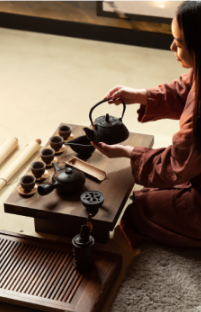
In every traditional Japanese home, there is at least one room entirely covered with tatami, known as the “washitsu.” This space is used for guests, ceremonies, or moments of reflection and follows behavioral rules that reflect respect for both the environment and other people. Walking barefoot, sitting in seiza, and avoiding sudden movements: every gesture performed on a tatami becomes an act of awareness.
The tatami is therefore not simply a building material, but a living component of Japanese daily life. Its natural scent, soft texture, and modular order help create an atmosphere of serenity and balance, where everything is measured and nothing is left to chance.
The use of tatami in dojos and martial arts
In dojos, places dedicated to martial arts practice, the tatami takes on an even deeper meaning. It is not just a training surface, but a ground of discipline, concentration, and respect. Every student learns to treat the tatami with care, entering the dojo with a bow and maintaining an attitude of silence and attention.
During practice, the tatami supports the body and absorbs movement, becoming an integral part of the practitioner’s physical and mental journey. It is a surface upon which the relationship between mind, body, and space is built, an essential aspect of Japanese martial arts philosophy.
Symbolism and spiritual meaning of tatami
Tatami as a space of awareness and respect
In Japanese thought, the tatami represents a symbolic boundary between the external world and the inner self. Stepping onto a tatami means entering a sacred space that requires presence, respect, and silence. In this sense, the tatami is a threshold toward awareness, an implicit invitation to leave distractions and tensions behind.
Every behavioral rule associated with the tatami – from the way one walks to the arrangement of objects – is a tangible expression of a culture that transforms simple gestures into ritual acts. Within this space, the body learns calmness and the mind opens itself to listening, creating a true experience of inner connection.
Rhythm, proportion, and harmony: the silent grammar of tatami
The tatami surface, divided into rectangles with precise proportions, speaks a geometric language that evokes harmony and balance. In the arrangement of tatami mats, one can see a philosophy of living that rejects excess and values emptiness, space, and proportion.
This visual order is not accidental: it acts as an invisible guide that directs movement and interaction, like a silent grammar suggesting composure and fluidity. Living or practicing on a tatami means allowing oneself to be guided by this subtle harmony, transforming it into a daily exercise of mental centering.
The meditative value of tatami in the Zen lifestyle
In Zen Buddhism, the tatami often serves as the silent background for meditation. Its natural and regular surface supports posture and concentration, making it an ideal space for zazen – seated meditation. But above all, it is the immaterial quality of the tatami that makes it special: its ability to absorb noise, define space without resistance, and provide support without imposing itself.
In this sense, the tatami becomes a tool for introspection. It invites people into a state of presence and listening, becoming part of a spiritual practice aimed at achieving harmony between human beings and the surrounding world.
Tatami as inspiration for modern well-being
From aesthetics to practice: integrating tatami into everyday life
Today, the tatami is experiencing a new wave of popularity even outside Japan. Architects, interior designers, and wellness enthusiasts are rediscovering it as a design element capable of transforming domestic environments into harmonious and centered spaces. With its natural texture and minimalist style, the tatami responds to the modern need for authenticity, simplicity, and calm.
This is not merely an aesthetic revival, but a genuine lifestyle choice: integrating tatami into one’s home means bringing a fragment of Zen philosophy into everyday life, creating space for quietness, silence, and inner connection.
Interior design, mindfulness, and the balance between body and mind
Using a tatami can become a daily mindfulness practice. Whether for yoga, meditation, or simply taking time to rest, the tatami provides a surface that encourages introspection and respect for the body. Its silent presence reminds us of the importance of slowing down, consciously inhabiting space, and nurturing inner balance.
In a world dominated by speed and constant stimulation, the tatami represents an anchor of peace. It is an invitation to rediscover that essential dimension where the body breathes and the mind becomes calm, a timeless symbol that continues to speak to us about discipline, harmony, and respect.
Comments (0)