
Trolley
You have no items in your shopping cart

 Budgets
 Dumbers
 Discs
Discs
 Benches
 Racks and Rigs
 Weights Holders
 Isotonic machines
 Calisthenics
 Cardio
 Kettlebells
 Flooring
 Gym Set
 Accessories
 Combat
 ARTI MARZIALI
 CONTAINER GYM
 Tug-Of-War
 Used Gym Equipment
 PILATES MACCHINARI
 GINNASTICA ARTISTICA
 CAMPI DA PADEL
 Prodotti in Pronta Consegna
 Informazioni
 IRONMAN
 Gift Card
- Donatif
- General information
- 0 I like it
- 1109 Views
- 0 comments
- gym flooring, safety flooring, gym safety, shock-absorbing materials
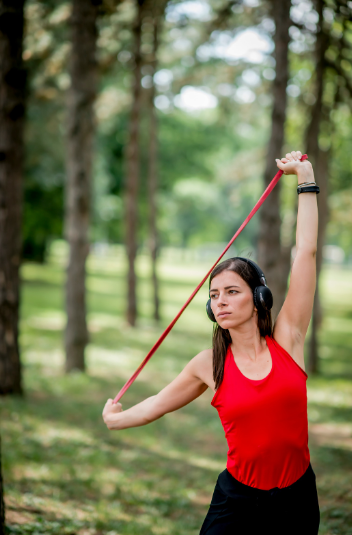
Complementary Posterior Chain Exercises with Resistance Bands
When it comes to lower-body training, the focus is often placed on the glutes. Movements such as hip thrusts, squats, and lunges are now included in most workout programs, but they are not always accompanied by exercises that effectively engage the entire posterior chain. This approach can limit strength development and coordination among the various muscle groups involved in daily and athletic movements.
The glutes, hamstrings, and spinal erectors function as an integrated system. Using resistance bands makes it possible to include complementary exercises that are accessible, progressive, and suitable for both home gyms and professional training environments. A balanced approach helps improve movement quality and reduce the risk of compensations resulting from excessive focus on a single muscle group.
Why Train the Entire Posterior Chain and Not Just the Glutes
The Role of the Glutes, Hamstrings, and Lower Back in Movement
The muscles of the posterior chain are involved in nearly every hip extension movement and trunk stabilization task. The glutes generate much of the force during hip-driven movements, while the hamstrings contribute to knee and hip control during running, jumping, and changes of direction. The lower back muscles, meanwhile, help maintain spinal stability under load.
Training these structures in a coordinated manner promotes more balanced strength development. A program that includes specific exercises for each area allows for a better distribution of training stimuli and greater efficiency in both athletic performance and everyday activities.
The Most Common Imbalances in Glute-Focused Programs
A training program based almost exclusively on hip thrusts and their variations can create developmental differences among the various segments of the posterior chain. The hamstrings may receive insufficient stimulation, while trunk stabilization capacity may not be adequately trained.
For this reason, many coaches include complementary resistance band exercises at the end of the main training sets. The goal is not to replace fundamental movements but to complete the workout through more targeted and controllable stimuli.
Hamstring Exercises with Resistance Bands
Prone Resistance Band Leg Curl
The resistance band leg curl is one of the most effective exercises for the hamstrings. The band is anchored to a stable point and attached to the ankles, creating increasing resistance during knee flexion. This feature makes the movement particularly valuable for home workouts.
During execution, it is important to keep the pelvis stable and control both the concentric and eccentric phases. Beginners can use lighter bands, while more experienced athletes can increase tension or perform the exercise one leg at a time.
Standing Leg Curl with Low Anchor Point
This variation requires less space and allows each leg to be trained individually. Unilateral work helps identify strength imbalances between sides while improving motor control.
A useful coaching cue is to keep the knee stationary and focus solely on the bending movement. This keeps the workload centered on the hamstrings without excessive involvement of other muscle groups.
Hip Hinge and Band Deadlift Variations
Exercises based on the hip hinge pattern replicate the mechanics of traditional deadlifts. The resistance band progressively increases tension during hip extension, stimulating the glutes and hamstrings in a coordinated manner.
This category of exercises serves as an effective bridge between traditional strength work and complementary training. Attention should remain focused on pushing the hips backward while maintaining a neutral spine.
Complementary Exercises for the Glutes and Posterior Chain
Resistance Band Pull-Through
The pull-through emphasizes hip extension and is an excellent complement to hip thrusts and squats. The constant tension provided by the band enhances muscle activation and makes the exercise easy to adapt to different training levels.
Proper execution requires a clear separation between hip movement and spinal movement. The objective is to generate force through the glutes while keeping the trunk stable.
Monster Walks and Lateral Band Walks
Although often associated with glute training, these exercises also improve pelvic stability and lower-limb control. They are particularly useful as complementary movements in programs focused on preventing muscular imbalances.
Using mini bands around the ankles or above the knees allows the difficulty level to be adjusted. Movement control remains more important than execution speed.
Single-Leg Band Glute Bridge
This variation increases stabilization demands and allows unilateral strength development. The resistance band adds tension during hip extension and helps maintain muscular engagement throughout the entire set.
For intermediate athletes, it represents a natural progression from the traditional glute bridge. It is particularly suitable for improving balance and coordination.
Lower Back Strengthening and Pelvic Stability
Resistance Band Good Morning
The resistance band good morning simultaneously targets the glutes, hamstrings, and lower back muscles. Thanks to the progressive resistance of the band, the exercise remains manageable even in home training environments.
The primary focus should be maintaining proper trunk positioning. Correct execution improves the ability to remain stable during more demanding exercises such as deadlifts and squats.
Trunk Extensions Against Band Resistance
Trunk extensions can be performed using various anchoring methods and allow the spinal erectors to be trained without specialized equipment. The workload should be increased progressively and always performed under control.
This exercise is particularly valuable during phases focused on injury prevention and improving local muscular endurance, aspects often overlooked in general training programs.
Posterior Core Control Exercises
Posterior chain stability depends on more than strength alone. The ability to maintain a neutral pelvic position during movement also plays a crucial role in movement quality.
Including motor-control exercises with resistance bands helps consolidate the adaptations achieved through strength training and contributes to more efficient athletic performance.
How to Choose Variations and Difficulty Levels
Exercises for Beginners
Less experienced individuals should begin with lighter resistance bands and bilateral movements. The initial goal is to learn proper movement patterns and develop body awareness.
At this stage, exercise quality should take priority over training volume. Gradual progression reduces the likelihood of technical errors and unnecessary overload.
Progressions for Intermediate Athletes
Once good technical proficiency has been achieved, band tension can be increased or unilateral variations introduced. This approach raises the difficulty level without requiring complex equipment.
Progressions may also involve longer time under tension, isometric holds, and a higher number of repetitions per set.
Including Complementary Exercises in Your Program
How to Pair Them with Hip Thrusts, Squats, and Deadlifts
Complementary exercises are generally placed after the primary movements. Following a hip thrust-focused session, for example, specific hamstring work and lower back stability exercises can be added.
This strategy allows training stimuli to be distributed more effectively and helps create a more comprehensive workout without excessively increasing overall training stress.
Volume, Frequency, and Recovery
In most cases, two or three complementary exercises per session are sufficient. The goal is not to accumulate excessive volume but to provide targeted stimulation to areas that receive less attention during the main exercises.
A balanced posterior chain resistance band training program allows the glutes, hamstrings, and lower back to develop in a coordinated manner, contributing to a more complete and functional level of fitness over the medium and long term.
Comments (0)