
Trolley
You have no items in your shopping cart

 Budgets
 Dumbers
 Discs
Discs
 Benches
 Racks and Rigs
 Weights Holders
 Isotonic machines
 Calisthenics
 Cardio
 Kettlebells
 Flooring
 Gym Set
 Accessories
 Combat
 ARTI MARZIALI
 CONTAINER GYM
 Tug-Of-War
 Used Gym Equipment
 PILATES MACCHINARI
 GINNASTICA ARTISTICA
 CAMPI DA PADEL
 Prodotti in Pronta Consegna
 Informazioni
 IRONMAN
 Gift Card
- Donatif
- General information
- 0 I like it
- 1711 Views
- 0 comments
- stress reduction, improved self-esteem, physical and mental well-being, gym training
READING TIME: 5 MINUTES ➤➤
Common mistakes when designing combat spaces without distinguishing between disciplines
When designing a space dedicated to combat sports, one of the most common mistakes is assuming that all disciplines have similar requirements. This belief often leads to superficial technical choices that, over time, turn into real issues: premature surface wear, safety risks, and a perception of low professionalism among users.
The reality is that each combat discipline has completely different logic, dynamics, and impact patterns. Ignoring these differences means compromising the effectiveness of the space and putting both the investment and the facility’s reputation at risk. Understanding the most common mistakes is the first step to avoiding them and creating truly functional environments.
- Why each discipline requires specific choices
- Surface and material mistakes
- Protection and safety mistakes
- Layout mistakes
- Early warning signs of errors
- How to fix issues without starting over
Why each combat discipline requires specific choices
Combat disciplines can be divided into macro-categories with very different requirements: striking, grappling, and mixed systems. Treating them as equivalent means ignoring key factors such as type of impact, frequency of falls, and use of space. A room designed for boxing cannot function the same way for judo or Brazilian Jiu-Jitsu.
Design must start with a clear analysis of the main activities. It is not enough to know that it involves “combat sports”: it is essential to go into operational detail. This approach helps avoid structural mistakes and creates a space that truly supports training rather than limiting it.
Technical differences between striking, grappling, and mixed disciplines
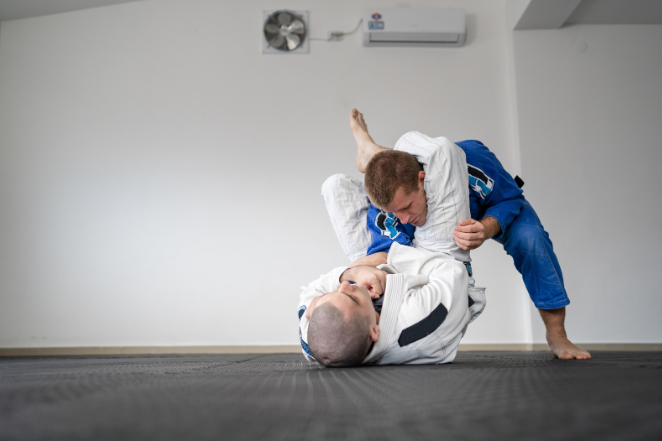
Striking disciplines, such as boxing and kickboxing, require stable surfaces and often the integration of elements like rings or heavy bags. Grappling, on the other hand, requires continuous shock-absorbing surfaces to reduce the risk of injury during falls. Mixed disciplines combine both needs, making material selection even more critical.
Ignoring these differences leads to ineffective compromises. A surface that is too rigid penalizes grappling, while one that is too soft reduces stability in striking sports. The result is a space that does not truly work for any discipline.
The most common mistake: standardizing surfaces and materials
One of the most frequent mistakes is using a single type of flooring for all activities. This choice, often driven by simplification or budget constraints, represents a significant risk. Combat surfaces must be selected based on actual use, not design convenience.
A generic tatami, for example, may seem like a universal solution, but in practice it often proves inadequate. Density, thickness, and shock absorption must match the discipline being practiced, otherwise both safety and performance are compromised.
Tatami, rings, and flooring: when and why they differ
Tatami for grappling must ensure shock absorption and continuity, while striking may require structures such as rings or defined areas. Using the same material in both contexts means failing to fully meet either need.
Practical note: if a space hosts multiple disciplines, it is better to create differentiated areas rather than standardizing everything. Even a simple division can significantly improve functionality and safety.
Protection and safety: where mistakes happen most
Safety is often approached in a generic way, without distinguishing between different impact dynamics. This leads to insufficient or poorly positioned protections. Each discipline generates specific risks that must be anticipated.
Walls, for example, become a critical element in grappling or MMA spaces, where movement is wider and throws are frequent. Ignoring this aspect increases the risk of injury and lowers the perceived quality of the facility.
Impacts, falls, and space management
Not all impacts are the same. Falls in judo require completely different surfaces and protections compared to impacts in striking disciplines. Effective design considers direction, intensity, and frequency of impacts.
Practical note: adding modular protections in critical areas allows the space to adapt over time without invasive structural changes.
Layout and organization: invisible but critical mistakes
Layout is often underestimated because it is less visible than equipment. However, poor space distribution can completely compromise the training experience. The coexistence of different disciplines requires careful planning of movement flows.
A typical mistake is creating hybrid spaces without a clear logic, where activities overlap and generate confusion. This not only reduces efficiency but also conveys an unprofessional image.
Space distribution and usage flows
Each discipline needs a space consistent with its movements. Grappling requires continuity and no obstacles, while striking can better manage compartmentalized areas. Ignoring these aspects leads to interference between activities.
Practical note: defining functional zones within the same room is an effective solution to improve organization without increasing square footage.
Early warning signs of a flawed project
There are clear signals that indicate design mistakes. These include users struggling to adapt to the space, abnormal surface wear, and the constant need for improvised adjustments. These elements should not be ignored.
Another important indicator is implicit feedback: if athletes avoid certain areas or spontaneously change how they train, it means the space is not aligned with the discipline.
When the space does not support the discipline
A well-designed space facilitates training, while a flawed one hinders it. If the structure imposes limitations instead of supporting practice, action must be taken quickly to avoid greater issues.
Practical note: observing how the space is actually used is one of the most effective ways to identify hidden problems.
How to fix mistakes without starting over
Fixing a project does not necessarily mean starting from scratch. Many mistakes can be resolved with targeted interventions that significantly improve functionality without compromising the initial investment.
The correct approach is analytical: identify the main issues and intervene progressively on surfaces, protections, and layout. This allows optimization of the space while maintaining cost control.
Practical interventions and investment optimization
Among the most effective solutions are integrating specific materials, dividing areas, and adding targeted protections. These interventions align the space with real needs without invasive changes.
Practical note: investing in targeted corrections is always less expensive than maintaining an inefficient space over time. Design precision therefore becomes a key factor for the long-term sustainability of the facility.
Comments (0)