
Trolley
You have no items in your shopping cart

 Budgets
 Dumbers
 Discs
Discs
 Benches
 Racks and Rigs
 Weights Holders
 Isotonic machines
 Calisthenics
 Cardio
 Kettlebells
 Flooring
 Gym Set
 Accessories
 Combat
 ARTI MARZIALI
 CONTAINER GYM
 Tug-Of-War
 Used Gym Equipment
 PILATES MACCHINARI
 GINNASTICA ARTISTICA
 CAMPI DA PADEL
 Prodotti in Pronta Consegna
 Informazioni
 IRONMAN
 Gift Card
- Donatif
- General information
- 0 I like it
- 2311 Views
- 0 comments
- stress reduction, improved self-esteem, physical and mental well-being, gym training
READING TIME: 5 MINUTES ➤➤
In the world of streetlifting, pull-ups are no longer just a bodyweight exercise. Once you start adding weight with a belt and plates, the mechanical demand placed on the equipment increases rapidly. In this context, a simple home pull-up bar is no longer enough: the structure must be designed to withstand high and repeated loads over time.
Anyone who performs weighted pull-ups knows that the critical factor is not only how much weight the bar can theoretically support. The real difference lies in stability, the quality of materials, and the safety of the installation. A streetlifting pull-up bar should become a solid anchor point in your home gym, capable of supporting years of training without bending, vibrations, or structural failure.
- Why a standard pull-up bar isn’t enough
- Key features of a streetlifting pull-up bar
- Types of pull-up bars
- Installation and safety
- Checklist before buying
Why a standard pull-up bar isn’t enough for streetlifting
Pull-up bars designed for casual home fitness are often built to support average bodyweight loads. However, when it comes to weighted streetlifting, the situation changes drastically. An athlete weighing 80 kg performing pull-ups with an additional 40 kg is already generating a load of over 120 kg on the structure, without even considering the dynamic forces produced during the movement.
A cheap or poorly designed bar can begin to bend, vibrate, or loosen over time. This not only affects performance but also safety. For this reason, anyone practicing weighted pull-ups should treat the bar as a structural piece of gym equipment, choosing solutions designed for durability, stability, and long-term reliability.
What features should a streetlifting pull-up bar have
A professional pull-up bar is not defined by aesthetics alone. The real differences lie in the quality of the materials, the construction, and the finishing of the surface. These elements determine how stable the bar will feel during training and how well it will hold up over time without losing reliability.
When evaluating a bar for your home gym, it is important to analyze several technical parameters: tube thickness, the type of steel used, the surface finish, and the quality of the welds. All of these factors contribute to creating a reliable pull-up bar capable of supporting intense training sessions for years.
Materials and structural design
The first aspect to evaluate is the material. The best streetlifting pull-up bars are made of high-strength structural steel, often with thick tubing. This ensures rigidity and reduces flex when the load increases.
Another key element concerns the welds and mounting plates. A bar designed for serious use features large and reinforced fixing points that distribute the load across the structure. This is one of the reasons why many professional pull-up bars appear visibly more robust than entry-level models.
Bar diameter and grip
The diameter of the bar directly affects the grip feeling. In most cases, the ideal diameter for a streetlifting pull-up bar ranges between 28 and 32 millimeters. This measurement allows for a strong grip without excessively fatiguing the forearms during heavy sets.
A bar that is too thin can feel unstable, while one that is too thick may reduce your ability to generate force. For this reason, many advanced athletes prefer bars specifically designed for weighted pull-ups, where every detail is optimized to improve movement control.
Coating and anti-slip finish
The surface of the bar is often underestimated. A good anti-slip coating improves grip and reduces the need for chalk or grip aids. Some bars use powder coatings with a textured finish designed to provide greater friction.
This feature becomes especially important during heavy sets. With high loads, even a slight loss of grip can compromise the execution of the movement. A professional pull-up bar should therefore offer a durable surface that maintains consistent grip over time.
Wall-mounted bar, rack bar, or fixed bar: which one to choose
The choice of bar type mainly depends on the available space and the structure of your home gym. The three most common options are wall-mounted pull-up bars, rack-integrated bars, and independent fixed bars.
Each option offers specific advantages. The main differences involve stability, ease of installation, and the ability to handle very heavy loads. Understanding these differences helps you choose the most suitable pull-up bar for your level of training.
Wall-mounted pull-up bars for home gyms
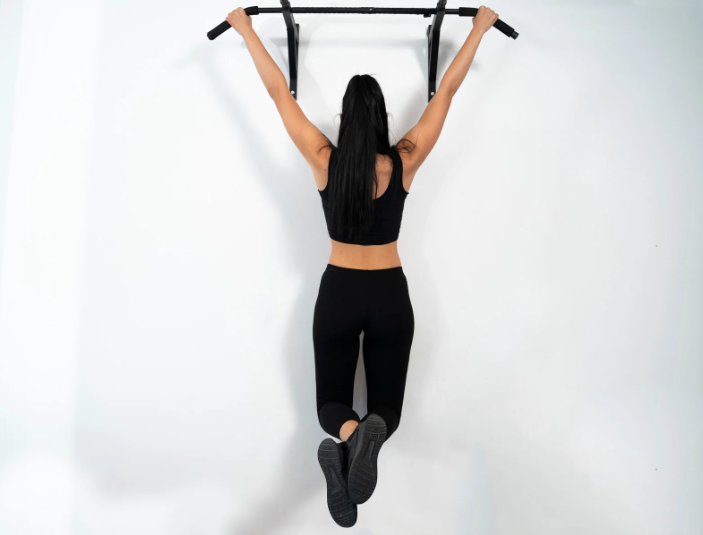
The wall-mounted pull-up bar is one of the most common solutions in home gyms. When installed correctly on a load-bearing wall, it can provide excellent stability and support very high loads. Many models use long side brackets that distribute the weight across multiple mounting points.
This type of bar is particularly appreciated by streetlifting athletes because it allows greater freedom of movement and offers a feeling very similar to professional gym setups.
Rack-integrated pull-up bars
Rack-mounted bars are an extremely stable solution. In this case, the pull-up bar is part of the power rack structure and benefits from the overall rigidity of the equipment.
For those who already own a solid rack, this option can be the most logical choice. The structure distributes the load across the entire frame, making weighted pull-ups particularly safe even with heavy loads.
Professional fixed pull-up bars
Independent fixed bars are less common in home gyms but represent an extremely robust solution. These structures are often found in professional gyms or outdoor calisthenics parks.
They are designed to withstand very heavy loads and continuous use. For those who want a permanent solution and have the necessary space, this type of professional pull-up bar offers maximum stability and durability.
Installation and safety: the most overlooked factor
Even the best pull-up bar on the market can become unsafe if installed incorrectly. In the case of wall-mounted bars, the quality of the fixing system is crucial. Chemical anchors or heavy-duty structural bolts are often the best choice to guarantee long-term stability.
The surface where the bar is mounted must be able to withstand the dynamic load generated by pull-ups. Drywall or lightweight structures are not suitable. A streetlifting pull-up bar should always be installed on reinforced concrete, solid brick, or equivalent structural materials.
Checklist before buying a pull-up bar for weighted pull-ups
Before purchasing a bar for serious training, it is useful to verify several key aspects. The first is the load capacity declared by the manufacturer, which should be significantly higher than the weight you plan to use during weighted pull-ups.
It is equally important to check the mounting system, the bar diameter, the quality of the welds, and the surface finish. A well-built streetlifting pull-up bar is not just a piece of equipment: it is an investment in safety and training consistency. If your goal is to progress over time with heavier and heavier loads, one rule always applies: the bar must be stronger than you.
Comments (0)