
Trolley
You have no items in your shopping cart

 Budgets
 Dumbers
 Discs
Discs
 Benches
 Racks and Rigs
 Weights Holders
 Isotonic machines
 Calisthenics
 Cardio
 Kettlebells
 Flooring
 Gym Set
 Accessories
 Combat
 ARTI MARZIALI
 CONTAINER GYM
 Tug-Of-War
 Used Gym Equipment
 PILATES MACCHINARI
 GINNASTICA ARTISTICA
 CAMPI DA PADEL
 Prodotti in Pronta Consegna
 Informazioni
 IRONMAN
 Gift Card
- Donatif
- General information
- 0 I like it
- 2328 Views
- 0 comments
- gym flooring, safety flooring, gym safety, shock-absorbing materials
READING TIME: 5 MINUTES ➤➤
Modular vs Multi-Function: How to Evaluate Space Efficiency in a Small Gym
When available space is limited, the choice between a multi-function machine and a configuration made up of essential modules should not be based solely on purchase price. The most critical aspect is understanding how much value each occupied square meter can generate, especially in a fitness facility where surface area, accessibility, and user flow directly impact service quality. A machine that combines multiple functions may immediately appear efficient, but that compactness does not always translate into greater real-world usability.
For a gym owner, installer, or B2B designer, the issue is not simply “which equipment costs less,” but rather which layout makes a small area more understandable, more functional, and easier to reconfigure over time. In this comparison, modular vs multi-function becomes both a technical and commercial evaluation: it is necessary to assess occupied space, the number of exercises that are realistically accessible, downtime, user interference, and the ability to adapt the space in the future.
Space Efficiency: Why a Square Meter Does Not Always Deliver the Same Value
In a small gym, the cost of occupying space is often more important than the visible cost of the equipment itself. Two solutions may occupy a similar footprint while producing completely different outcomes. A compact station may combine several functions within the same footprint, while a configuration including a rack, bench, storage, and accessories may distribute movement more effectively, reduce overlap, and allow multiple users to train without blocking the entire area.
Efficiency per square meter also depends on accessibility. A multi-function machine occupies not only its physical footprint, but also requires entry space, adjustment areas, loading clearance, movement range, and safety margins. In the same way, essential modules should not be evaluated as isolated components but as part of a complete system: a well-positioned rack, an adjustable bench, and organized storage can create a more fluid training area than a single machine that appears more complete at first glance.
When a Multi-Function Machine Appears Efficient but Limits Workflow
A multi-function machine is useful when the goal is to offer multiple exercise possibilities in a single station, especially in environments where technical supervision is limited and a guided solution is required. It may be ideal for hospitality fitness areas, small corporate gyms, condominium fitness rooms, or facilities where the average user prefers simple and immediate movements. In these situations, concentrating functions into one machine reduces design complexity and makes equipment usage easier to understand.
The limitation appears when multiple functions do not translate into simultaneous use. If one person occupies the machine to complete a sequence of exercises, the entire station becomes unavailable to everyone else. In addition, some integrated functions may be rarely used, while others become congestion points. For this reason, the right question is not how many functions the machine contains, but how many of those functions are actually used, how often they are used, and what impact they have on the operational flow of the facility.
When Essential Modules Increase Operational Value
A modular configuration can perform better when the area must adapt to different users, changing programs, and future modifications. Racks, benches, weight plate holders, barbell storage, and accessory storage systems make it possible to create a more flexible zone where each component has a specific function and can be repositioned or expanded over time. This approach is especially useful in fitness centers looking to maximize limited space without being tied to a single rigid structure.
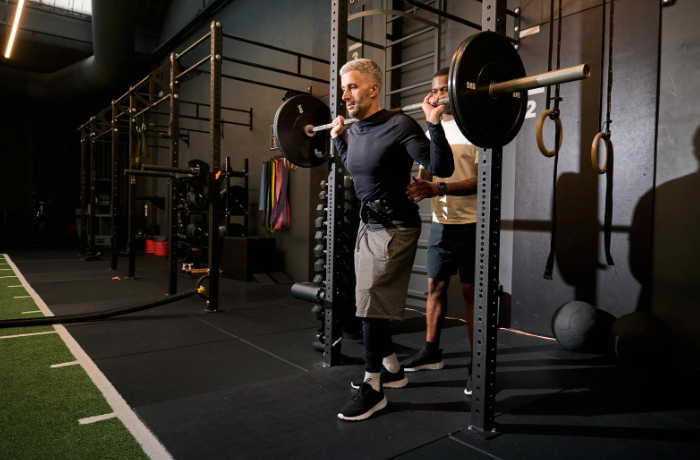
A practical example is a small strength-training area where a compact rack, an adjustable bench, and vertical storage allow users to perform pressing exercises, pulling movements, assisted squats, barbell work, and accessory training. With the same floor area, a modular system can provide greater operational efficiency because it offers more rotational freedom, improves organization, and allows components to be replaced or expanded without redesigning the entire space.
How to Choose Between a Single Machine and a Modular Configuration
The decision should start with four criteria: actual occupied space, accessibility, real-world usage, and reconfiguration potential. A multi-function solution is more rational when a guided, compact, and easy-to-understand station is needed. Essential modules are more suitable when the space must generate value over time, support more free exercises, and adapt to a more technical audience or an evolving fitness facility.
To avoid inefficient investments, the comparison must shift from purchase price to efficiency per square meter and workflow performance. A solution that initially appears convenient may become expensive if it blocks movement, creates waiting times, or occupies valuable floor space with rarely used functions. Conversely, a well-designed modular configuration may require more careful planning at the beginning but can offer greater control, efficiency, and growth potential. In a small gym, space creates value only when it is used effectively, not when it is simply filled.
Comments (0)