
Trolley
You have no items in your shopping cart

 Budgets
 Dumbers
 Discs
Discs
 Benches
 Racks and Rigs
 Weights Holders
 Isotonic machines
 Calisthenics
 Cardio
 Kettlebells
 Flooring
 Gym Set
 Accessories
 Combat
 ARTI MARZIALI
 CONTAINER GYM
 Tug-Of-War
 Used Gym Equipment
 PILATES MACCHINARI
 GINNASTICA ARTISTICA
 CAMPI DA PADEL
 Prodotti in Pronta Consegna
 Informazioni
 IRONMAN
 Gift Card
- Donatif
- General information
- 0 I like it
- 10648 Views
- 0 comments
READING TIME: 5 MINUTES ➤➤
Artistic Gymnastics: History, Apparatus, Technique and Timeless Passion
Artistic gymnastics is one of the most fascinating and complete disciplines in the entire world of sport. It combines power, flexibility, balance and artistic expression, transforming physical exercise into a true form of art. Every competition is a spectacle of precision, elegance and strength, the result of years of intense training and a tradition that has its roots in ancient times.
The origins of artistic gymnastics
The history of this discipline begins in ancient Greece, where acrobatic and agility exercises were an integral part of soldiers’ training and sporting competitions. The goal was to develop a harmonious and agile body capable of facing physical challenges efficiently. Over the centuries, these practices were preserved and adapted by the Romans and, in modern times, reinterpreted in military and educational settings.
In the 19th century, in Germany and Sweden, figures such as Friedrich Ludwig Jahn and Per Henrik Ling codified gymnastics as a sporting discipline, introducing apparatus such as the balance beam, parallel bars and the horizontal bar. Men’s artistic gymnastics officially entered the first modern Olympic Games in Athens in 1896, while women’s gymnastics made its debut in Amsterdam in 1928, paving the way for generations of champions.
Categories and events
Artistic gymnastics is divided into two main categories: men’s and women’s, each with specific events. Men compete in six disciplines: floor exercise, pommel horse, rings, vault, parallel bars and horizontal bar. Women compete in four: vault, uneven bars, balance beam and floor exercise.
Each event has unique characteristics. For example, the floor exercise combines acrobatics with choreographed movements set to music, the pommel horse requires continuous circular movements with perfect rhythm, and the balance beam tests concentration and balance on a surface only 10 cm wide.
The apparatus in artistic gymnastics
The apparatus are not simple tools but true protagonists of the discipline. The floor exercise takes place on a spring floor that allows spectacular jumps; the pommel horse is a cylindrical apparatus covered with leather used for continuous leg and body movements; the suspended rings demand extraordinary strength and stability.
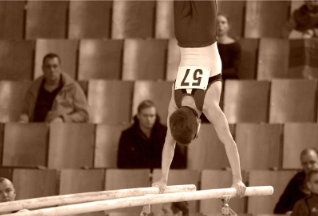
The vault includes a 25-meter run-up, an explosive take-off and a controlled landing. The bars – parallel for men and uneven for women – require agility and precision when transitioning between the bars. Finally, the balance beam is an exercise of concentration and equilibrium where every step and jump must be performed without hesitation.
Training and athletic preparation
Behind every perfect routine lies extremely demanding daily work. A gymnast trains between four and six hours a day, alternating muscle strengthening sessions, flexibility exercises, technical practice on apparatus and competition simulations. The body is prepared to sustain repeated and intense efforts, and the mind to remain focused even under the pressure of the audience and judges.
Preparation is guided by a team of coaches, physiotherapists, nutritionists and sports psychologists, because the mental component is just as important as the physical one. The ability to manage stress and stay calm in decisive moments is what distinguishes a good gymnast from a champion.
Competitions and scoring system
Competitions take place at various levels: local, national, international and Olympic. The modern scoring system, introduced in 2006, no longer includes a maximum score of 10 points. Today the evaluation combines two factors: the D score (Difficulty), which measures the technical value of the performed elements, and the E score (Execution), which evaluates precision, form and fluidity.
This system rewards athletes who attempt complex routines, while at the same time penalizing even the smallest mistake. Every detail matters: from the precision of the landing to the line of the legs during a jump.
The benefits of artistic gymnastics
Artistic gymnastics develops an exceptional physical condition: it increases muscular strength, endurance, coordination and joint mobility. Mentally, it teaches discipline, determination, fear management and resilience. For children, it represents an ideal activity to grow in a balanced and safe way while learning to understand and control their bodies.
Even at an amateur level, it is a complete workout that involves all muscle groups, improves posture and stimulates balance. Furthermore, the relationship between coach and athlete creates an environment of trust and continuous motivation.
Curiosities and great champions
The history of artistic gymnastics is full of legendary moments. Nadia Comăneci, in 1976, was the first athlete to achieve a “perfect 10” at the Olympic Games in Montréal. Simone Biles, considered the greatest gymnast of all time, has revolutionized the discipline by introducing elements of difficulty never seen before. In Italy, names such as Jury Chechi, known as “The Lord of the Rings”, and Vanessa Ferrari, world champion, have left an unforgettable mark.
An interesting fact is that many elements are named after the athlete who first performed them in competition, becoming part of the official Code of Points. In this way, champions remain forever in the history of the discipline not only for the medals they win but also for the technical contributions they leave behind.
Conclusion
Artistic gymnastics is not only a sport but also a life journey. It is a unique combination of art and athletics, where every movement tells a story of sacrifice, passion and the pursuit of perfection. From the floor exercise mat to the narrow balance beam, from the roar of Olympic applause to the focused silence of daily training, this discipline continues to inspire generations of athletes and enthusiasts all over the world.
If you enjoyed this post, read also ➤➤ Martial Arts: Origins, Styles and Benefits
Comments (0)