
Trolley
You have no items in your shopping cart

 Budgets
 Dumbers
 Discs
Discs
 Benches
 Racks and Rigs
 Weights Holders
 Isotonic machines
 Calisthenics
 Cardio
 Kettlebells
 Flooring
 Gym Set
 Accessories
 Combat
 ARTI MARZIALI
 CONTAINER GYM
 Tug-Of-War
 Used Gym Equipment
 PILATES MACCHINARI
 GINNASTICA ARTISTICA
 CAMPI DA PADEL
 Prodotti in Pronta Consegna
 Informazioni
 IRONMAN
 Gift Card
- Donatif
- General information
- 0 I like it
- 1508 Views
- 0 comments
- stress reduction, improved self-esteem, physical and mental well-being, gym training
READING TIME: 5 MINUTES ➤➤
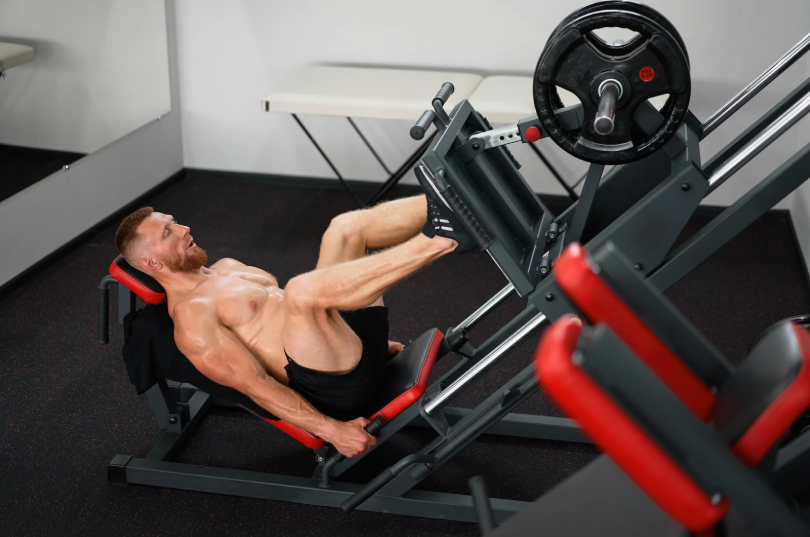
In post-meniscectomy recovery, the gym can become a valuable ally only when every technical choice respects knee mechanics and tissue adaptation timelines. Meniscus rehabilitation in the gym is not simply a return to strength training, but a structured progression where load, range of motion, and machine quality must work together to rebuild stability, confidence, and force production. In this context, the professional Leg Press stands out as a particularly effective solution, as it allows work in a closed kinetic chain with more predictable movement paths and greater control compared to free-weight alternatives, which are often introduced too early.
For a Personal Trainer or a Micro Gym, the goal is not just to “use the leg press,” but to understand how to apply it to optimize strength recovery without turning the exercise into a source of compensation patterns, unnecessary compression, or repeated micro-trauma. This is where the difference between a generic machine and one designed for smoothness, stability, and precision becomes critical. When movement is consistent and predictable, the client’s perception improves: muscle guarding decreases, confidence in loading increases, and it becomes easier to work within a truly tolerable ROM.
- Why the Leg Press is useful in post-meniscectomy recovery
- Working angles and ROM: where useful training ends and overload begins
- How to set up the Leg Press without stressing the knee
- Why Donatif bearing smoothness makes a difference for the meniscus
- What to assess before introducing it in rehab
- When a professional Leg Press becomes a competitive advantage for PTs and Micro Gyms
Why the Leg Press is useful in post-meniscectomy recovery
After a meniscectomy, one of the most delicate goals is restoring the knee’s ability to tolerate load without triggering excessive joint reactions. In this phase, the professional Leg Press can be an effective tool because it allows controlled loading of the lower limb extensors while keeping the movement more manageable. The key benefit is not just quadriceps strengthening, but the ability to deliver a progressive, repeatable pushing pattern that can be closely monitored. When the client perceives a clear and stable trajectory, muscle activation becomes more efficient and the training session more productive.
Another crucial aspect is progression management. In meniscus recovery with weights, a common mistake is transitioning too quickly from protected exercises to demanding movements involving deep ranges, speed, or instability. The leg press instead acts as a bridge between rehabilitation and strength training, allowing gradual load increases without sacrificing control. This makes it particularly valuable for individuals aiming to regain efficiency in daily life, general fitness, or foundational athletic preparation.
Working angles and ROM: where useful training ends and overload begins
Discussing working angles means addressing the core of the exercise. In post-meniscectomy recovery, it’s not just about which machine is used, but within which range the movement is performed. Excessive ROM introduced too early or with poorly tolerated loads can increase compressive forces and compromise movement quality. Conversely, a well-selected ROM allows the knee to be trained within a functional zone, where force can be produced without stiffness or loss of control during the eccentric phase.
For many individuals, early-stage work is more manageable within a controlled range, avoiding unnecessary depth simply to “feel more” of the exercise. Practically, ROM should be guided by three criteria: absence of significant pain during execution, no increase in swelling afterward, and consistent technical quality throughout the movement. When these remain stable, the range can be progressively expanded. When compensations, misalignment, or protective stiffness appear, it indicates that the joint is not benefiting from the additional depth being imposed.
How to set up the Leg Press without stressing the knee
Back, pelvis, and foot positioning
The first key adjustment concerns the relationship between the back, pelvis, and footplate. A stable trunk position allows force to be transferred efficiently without dispersion or compensations in the lower back, which often translate into poorer knee control. Feet should be fully supported, aligned with the individual’s structure, and positioned to allow a natural movement pattern. When foot placement is too low or too narrow, the movement becomes more aggressive and less controlled; when properly set, the push appears smoother and more continuous.
In the context of knee exercises in the gym, observing knee tracking is more important than the amount of weight lifted. The knee should follow a line consistent with the foot and hip, avoiding inward collapse or abrupt deviations between descent and ascent. The pelvis also requires attention: if it loses contact or tilts at the bottom, the ROM is likely exceeding the useful range for that stage. In rehabilitation, technical precision outweighs perceived depth or aesthetic execution.
Load, tempo, and eccentric control
The load must be sufficient to create a stimulus, but not so high that it forces the client into protective stiffness. In practice, an effective set is one where the push remains consistent, breathing stays controlled, and muscular effort does not turn into joint discomfort. Tempo is as important as load: a controlled descent and smooth ascent help distribute stress more evenly and reduce sudden accelerations that make the movement less tolerable. Eccentric control is where the difference between structured progression and superficial execution becomes evident.
For this reason, in meniscus recovery with weights, it is advisable to focus on technical sets, clean repetitions, and conservative progressions, avoiding early muscle failure, bouncing at the bottom, or explosive starts. The goal is not to demonstrate maximal strength, but to rebuild reliable strength, meaning strength that can be expressed without negative reactions afterward. When the client leaves the session feeling worked but without increased stiffness or swelling, the signal is positive: the machine is supporting recovery rather than challenging it prematurely.
Why Donatif bearing smoothness makes a difference for the meniscus
In an exercise like the leg press, perceived movement quality depends not only on biomechanics but also on machine mechanics. Bearing smoothness is a detail that directly impacts execution: if movement is irregular, load transfer becomes inconsistent, forcing the user to manage micro-jerks, friction, or unexpected resistance changes. In a recovering knee, these discontinuities can lead to muscle guarding, reduced confidence, and poorer control during transition phases.
Within Donatif’s positioning, smoothness is not just a commercial feature, but a strong technical argument for professionals working with precision-demanding clients. A stable machine with a robust structure, integrated shock absorption, and consistent motion allows trainers to focus on ROM and movement quality instead of compensating for equipment flaws. This shifts perceived value: for the client, the machine “feels different”; for the trainer, it becomes easier to justify a premium positioning based on build quality and real reliability rather than generic claims.
What to assess before introducing it in rehab
Before including the leg press in a program, the coach should evaluate a few key indicators. The first is load tolerance in daily activities: walking, stairs, sit-to-stand transitions, and assisted single-leg work provide valuable insights into the knee’s readiness. The second is movement quality under low stress: if the client cannot control a mini squat or shows clear alignment issues, introducing the leg press with significant load is rarely appropriate. The third is the 24-hour response: an exercise is not judged only during execution, but by how the joint reacts afterward.
Context matters as well. Not all post-meniscectomy clients present the same profile: age, muscle tone, body weight, sport demands, and prior rehabilitation all influence programming. This is why a well-adjustable professional leg press is far more valuable than a rigid or imprecise machine. The more precise the setup, the more tailored the intervention. In a serious meniscus rehabilitation in the gym, personalization is not optional—it is what makes loading therapeutically effective.
When a professional Leg Press becomes a competitive advantage for PTs and Micro Gyms
For professionals working with adults, former athletes, or clients in reconditioning phases, having reliable equipment is not just about expanding the gym floor. It means being able to deliver a higher level of service where clients seek not only training, but applied expertise. In this context, a machine like the Donatif Leg Press supports a credible BOFU positioning: it’s not about selling generic equipment, but about offering a solution that enables precise and safe training for those who cannot afford approximation.
This is where Anchoring Effect and Social Proof come into play. When clients immediately perceive robustness, smoothness, and attention to detail, they anchor the service to a higher value standard. When this perception is reinforced by consistent results and positive feedback, the machine evolves from a cost into a reputational asset. For Personal Trainers and Micro Gyms, investing in build quality means differentiating not through abstract messaging, but through an experience that communicates competence from the first set to long-term retention.
Comments (0)