
Trolley
You have no items in your shopping cart

 Budgets
 Dumbers
 Discs
Discs
 Benches
 Racks and Rigs
 Weights Holders
 Isotonic machines
 Calisthenics
 Cardio
 Kettlebells
 Flooring
 Gym Set
 Accessories
 Combat
 ARTI MARZIALI
 CONTAINER GYM
 Tug-Of-War
 Used Gym Equipment
 PILATES MACCHINARI
 GINNASTICA ARTISTICA
 CAMPI DA PADEL
 Prodotti in Pronta Consegna
 Informazioni
 IRONMAN
 Gift Card
- Donatif
- General information
- 0 I like it
- 3161 Views
- 0 comments
READING TIME: 4 MINUTES ➤➤
When it comes to core training, Pilates is often considered an effective and intelligent choice. However, for those with a sensitive back or a history of lower back pain, even simple movements can become a source of stress or discomfort. In this article, we explore how to make Pilates a truly spine-safe practice by selecting exercises, variations, and cues that strengthen and mobilize the body without compromising the health of the lumbar area.
- Why choose a spine-safe approach in Pilates
- Basic principles of spine-safe Pilates
- Safe Pilates exercises for the lower back
- Gentle progressions and smart adaptations
- Cues and tips for teachers and practitioners
- Planning sessions with respect for the lower back
Why choose a spine-safe approach in Pilates
Preventing lower back pain during training
Back pain is one of the most common musculoskeletal conditions among adults. In many cases, the cause is not a serious injury but rather poor movement management or inappropriate loading. For those practicing Pilates, it is essential to adopt an approach that takes into account lumbar vulnerability, avoiding positions or dynamics that could intensify latent symptoms or worsen chronic conditions.
When Pilates can become a risk for the back
Not all Pilates exercises are automatically safe for those with lower back problems. Movements such as roll-ups, teasers, or deep extensions can expose the spine to shear and compressive loads that should not be underestimated. The key lies in knowing when and how to introduce these challenges, offering modified versions or alternatives that preserve the benefits without compromising structural integrity.
Basic principles of spine-safe Pilates
Movement control and body awareness
One of the cornerstones of Pilates is motor control. In spine-safe protocols, this principle becomes even more important: every movement should be guided by deep awareness, with particular attention to pelvic positioning, spinal neutrality, and balanced load distribution. It is not just about performing the movement, but about listening, adapting, and correcting.
Using breath and the core as stabilizers
Breathing is an extremely powerful ally in therapeutic Pilates. Activating the transverse abdominis through diaphragmatic breathing helps create a natural protective corset around the lumbar region. Integrating breath with movement promotes stability and reduces the likelihood of abrupt or compensatory movements.
Safe Pilates exercises for the lower back
Selection of spine-sparing exercises
Not all exercises need to be excluded. In fact, many classic Pilates movements can be adapted. Exercises such as the leg slide, knee folds, or supported bridge offer excellent options for engaging the core while keeping the spine neutral. Progression should be gradual, with attention to form and sensory feedback during every repetition.
Useful variations for practitioners with a sensitive back
Often, simple modifications make an exercise safe: reducing the range of motion, supporting the legs with props, or shifting from supine exercises to quadruped positions can drastically change the load on the lumbar region. It is essential to observe the body’s response, avoid excessive fatigue, and offer regressions whenever necessary.
Gentle progressions and smart adaptations
How to scale intensity without losing effectiveness
Training the core in a low back–friendly way does not mean giving up intensity. It means building it on stable foundations. Using progressions that respect the body’s biological timing and adjusting stimuli according to daily conditions allows you to maintain a high level of training effectiveness without increasing risk. The key word is gradual progression.
Tools and supports for low back–friendly training
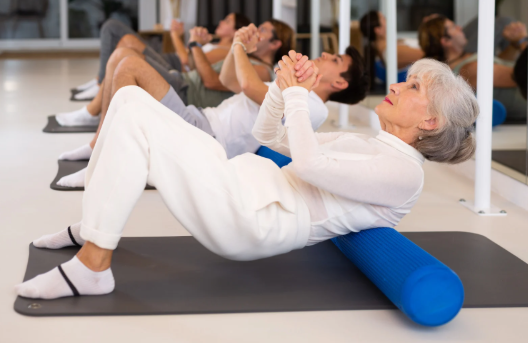
The use of small props such as cushions, soft balls, or foam rollers can make exercises more accessible and protective. These supports help distribute weight, improve alignment, and reduce joint stress. However, it is important to know when to use them and when to gradually reduce reliance on them in order to promote functional independence.
Cues and tips for teachers and practitioners
Signals to observe to avoid overload
A key aspect of any spine-safe practice is the ability to read the body’s signals: asymmetrical shaking, visible compensations, sensations of stiffness or excessive tension are indicators of potential overload. When these signals appear, the exercise should be modified or stopped. The goal is to build strength and mobility within a space of neurological comfort.
Verbal and tactile cues to improve safety
Good cueing can make the difference between a safe exercise and a potentially harmful one. Verbal cues such as “imagine lengthening the spine” or “draw the navel toward the spine” help integrate more protective motor patterns. Tactile cues, when appropriate, can also facilitate the correct recruitment of the core and encourage deeper, more targeted activation.
Planning sessions with respect for the lower back
Realistic goals for strength, mobility, and well-being
Those practicing Pilates with a sensitive back should not give up on improvement, but they may need to redefine their goals. The focus shifts toward improving everyday functionality, active mobility, and dynamic stability. Goals should be specific, measurable, and progressive, but always subordinate to respecting the body.
Frequency, duration, and variation of stimuli
The ideal programming for those with lumbar sensitivity includes regular but balanced frequency, shorter sessions (30–45 minutes), and alternating static, dynamic, and breathing exercises. Including moments of release, stretching, and proprioceptive work promotes a balance between activation and recovery, allowing the body to integrate improvements without accumulating unnecessary fatigue.
Comments (0)