
Trolley
You have no items in your shopping cart

 Budgets
 Dumbers
 Discs
Discs
 Benches
 Racks and Rigs
 Weights Holders
 Isotonic machines
 Calisthenics
 Cardio
 Kettlebells
 Flooring
 Gym Set
 Accessories
 Combat
 ARTI MARZIALI
 CONTAINER GYM
 Tug-Of-War
 Used Gym Equipment
 PILATES MACCHINARI
 GINNASTICA ARTISTICA
 CAMPI DA PADEL
 Prodotti in Pronta Consegna
 Informazioni
 IRONMAN
 Gift Card
- Donatif
- General information
- 0 I like it
- 4283 Views
- 0 comments
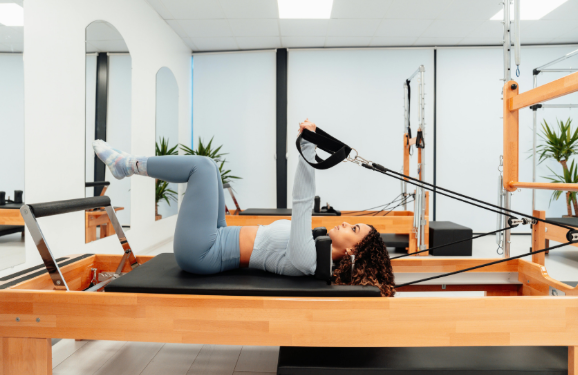
READING TIME: 10 MINUTES ➤➤
Somatic Pilates represents one of the deepest evolutions of mindful movement. It is not simply about exercising the body, but about listening to it, understanding it, and re-educating it through slow, intentional, and respectful practices. In a world that rewards speed and performance, Somatic Pilates proposes a quiet revolution: reprogramming your movement patterns with intelligence and mental presence.
This approach is designed for those who wish to reconnect with their body from the inside, for those looking for a method that speaks of mind–body connection rather than repetitive automatisms. It is a space where slowness becomes a value and every gesture becomes an opportunity for change.
- What is Somatic Pilates?
- The foundational principles of Somatic Pilates
- Somatic exercises in Pilates practice
- Postural reset and changing movement patterns
- Toward a new somatic balance
What is Somatic Pilates?
Origin and meaning of the term
The term "Somatic Pilates" combines two profound concepts: the Pilates method and somatics. While the former is widely recognized for its effectiveness in strengthening and posture improvement, somatics introduces the dimension of internal listening and self-perception. Somatic Pilates therefore arises as an integration of these two perspectives, with the aim of acting not only on muscles but on the neurological patterns that control them.
It is a relatively young discipline but built upon decades of studies and practices that view the body not as an object to correct but as a system to understand and guide through change. Its roots are both educational and therapeutic.
Differences from traditional Pilates
In traditional Pilates, the goal is often linked to improving posture and physical shape through structured exercises. In Somatic Pilates, by contrast, attention shifts to the sensory experience of movement. The exercises are slower, less choreographed, yet extremely targeted.
The focus is not on the external form but on the internal experience: feeling how the body moves, where it encounters resistance, what compensations it activates, and consciously modifying these automatisms. It is a practice that values quality over quantity and presence over performance.
The foundational principles of Somatic Pilates
Body awareness and mind–body connection
At the core of Somatic Pilates lies a deep body awareness. Movements are not simply performed—they are explored. Each exercise becomes an opportunity to understand how the body organizes itself in space, how it relates to gravity, and how it responds to the stimulus of breath and weight.
The mind does not command the body; it listens to it. This continuous dialogue between perception and action leads to a level of attention that profoundly changes the way we move, improving balance, fluidity, and coordination.
Slow and intentional movement: the key to re-education
Somatic Pilates rejects automatic speed. Every gesture is slow, precise, and intentional. This slowness is not a lack of energy but a strategy. Only by slowing down can we observe, understand, and transform.
This approach allows chronic tensions to dissolve, inefficient movement habits to break, and new patterns of movement to develop—patterns that are more functional and sustainable. This is where the body re-educates itself, not through effort but through presence.
Somatic exercises in Pilates practice
Examples of effective sequences and protocols
A Somatic Pilates session may begin on the floor, in a supine position, where gravity becomes a support rather than an obstacle. The work focuses on minimal movements: a pelvic rotation, a spinal elongation, a slow shoulder rotation. Each exercise is accompanied by a deep observation of bodily sensations.
These sequences may include exercises such as the “pelvic clock,” somatic oscillations, or the “cat curl” performed with pauses and micro-repetitions—each designed to reorganize the body from within and promote freer, more functional movement.
Execution methods and expected benefits
The exercises are not “performed” but explored. The aim is not performance but the body’s response. Each movement is linked to breathing, which guides and accompanies the practice, turning it into a meditative experience.
Among the main benefits are improved posture, reduced chronic pain, postural reset, increased joint mobility, and above all a new perception of oneself. A transformation that begins in the body but extends to the mind and emotions.
Postural reset and changing movement patterns
Kinesthetic perception and new movement patterns
The true goal of Somatic Pilates is the transformation of movement patterns. To achieve this, it is essential to develop kinesthetic perception: the ability to feel movements from within, to perceive direction, range, and intensity of each gesture.
This sensitivity allows the body to choose new pathways that are more efficient and less tiring. It is a reset—not only muscular but neurological. It is the possibility of acting on the nervous system through movement.
When and why to integrate it into your practice
Somatic Pilates is suitable for everyone, but it becomes particularly valuable for those who have practiced for years and feel they have lost connection with intention. It helps to recover the meaning of movement, break free from automatisms and rigidity, and rediscover the natural harmony of movement.
Integrating it into your practice means opening a new level of dialogue with the body. No longer just performing, but understanding. Not only training, but evolving.
Toward a new somatic balance
From the body to everyday life: the long-term effect
Somatic Pilates does not remain confined to the mat. Its effects extend into everyday life: in simple gestures, in posture at work, in the way we walk, sit, and breathe. It is a transformation that permeates every aspect of life.
Those who practice regularly report greater emotional stability, more energy, less pain, and a general sense of well-being. The body, finally listened to, no longer needs to shout through tension.
A practice in continuous conscious evolution
Somatic Pilates is not a static technique but a practice in constant evolution. Every session is different, every exploration brings new awareness. There is no “advanced level,” because the only true progress lies in the depth of listening.
It is a discipline for those willing to look inward, ask questions, and challenge themselves. A path back to the body—but also back to oneself. Slowly. Intelligently. Respectfully.
Comments (0)