
Trolley
You have no items in your shopping cart

 Budgets
 Dumbers
 Discs
Discs
 Benches
 Racks and Rigs
 Weights Holders
 Isotonic machines
 Calisthenics
 Cardio
 Kettlebells
 Flooring
 Gym Set
 Accessories
 Combat
 ARTI MARZIALI
 CONTAINER GYM
 Tug-Of-War
 Used Gym Equipment
 PILATES MACCHINARI
 GINNASTICA ARTISTICA
 CAMPI DA PADEL
 Prodotti in Pronta Consegna
 Informazioni
 IRONMAN
 Gift Card
- Donatif
- General information
- 0 I like it
- 1704 Views
- 0 comments
- gym flooring, safety flooring, gym safety, shock-absorbing materials
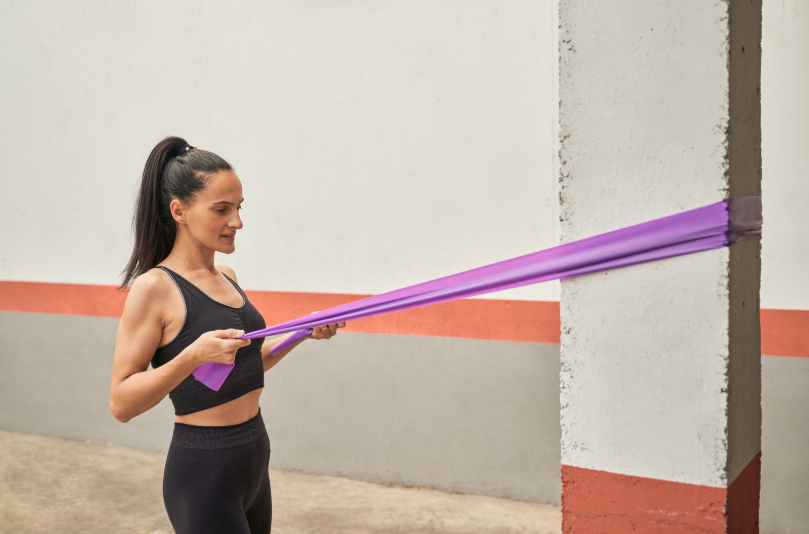
30-Minute Full-Body Resistance Band Workout Program
Training when time is limited requires a clear structure, not a rushed session squeezed between commitments. A full-body resistance band workout can be a practical solution for people who travel frequently, work long hours, or want to maintain a fitness routine without access to a gym. Resistance bands take up very little space, are easy to carry, and allow you to train your legs, back, chest, shoulders, arms, and core with a single set of equipment.
The goal is not to promise quick results but to build a structured, repeatable session that is intense enough to support consistency. In just 30 minutes, it is possible to complete a comprehensive resistance band circuit, provided that exercise selection, recovery periods, and timing are planned properly. This approach is particularly useful for beginner home exercisers who are unsure how to train effectively in a short amount of time and worry that home workouts may be less effective than gym training.
Why a Short Workout Can Actually Work
The Value of 30 Minutes When the Program Is Well Structured
A 30-minute resistance band workout works best when unnecessary breaks are eliminated and the focus remains on essential movement patterns. Instead of choosing exercises randomly, it is better to follow a sequence that alternates lower-body movements, pulling exercises, pushing exercises, and core work. This distribution allows the entire body to be trained without immediately overloading the same muscle groups. A timer becomes a practical tool: 40 seconds of work followed by 20 seconds to transition between exercises keeps the pace controlled and efficient.
For people with limited time, simplicity is a real advantage. Setting up a mat, bands, and an anchor point only takes a few minutes, making the barrier to entry extremely low. This helps transform a workout into a habit rather than an occasional event. The session remains short but far from superficial: when the band tension is appropriate and movements are performed with control, muscles receive a progressive and clearly noticeable stimulus.
How to Use Resistance Bands Without Guesswork
Resistance bands create tension differently from free weights because resistance increases as the band stretches. For this reason, it is important to control both the pushing and return phases of every movement, avoiding rushed or unstable repetitions. Beginners should select a resistance level that allows them to complete each exercise with proper posture and without obvious compensation from the back, shoulders, or knees. Execution quality is more important than the amount of resistance used.
A complete set of resistance bands makes it possible to adjust the training stimulus according to the exercise. Legs and back often require stronger resistance, while shoulders and arms typically perform better with lighter or medium bands. Using a door anchor expands exercise possibilities by enabling horizontal pulls, controlled presses, and movements that resemble those performed on gym machines. This keeps the workout compact while making it more comprehensive.
The Full-Body Resistance Band Circuit to Follow
Warm-Up and Initial Activation
Before starting the actual circuit, five minutes are enough to prepare the joints and muscles. Begin with mobility exercises for the hips, shoulders, and spine, then move on to bodyweight squats, light band pull-aparts, and low-resistance rows. This phase is not intended to create fatigue but rather to prepare the body for movement and assess whether the selected resistance level is appropriate. A simple warm-up reduces stiffness and improves overall workout quality.
A good activation phase is especially useful for people training in small spaces such as hotel rooms or living rooms. Resistance bands do not require much room, but they do require attention to anchoring points and pulling directions. Before starting the timer, make sure the band is in good condition, the anchor point is secure, and there are no obstacles nearby. This quick check makes the workout safer and more focused.
Legs, Pull, Push, and Core Block
The circuit can last approximately 20 working minutes, consisting of five exercises repeated for four rounds. A balanced sequence may include band squats, band rows, door-anchor chest presses, resistance band Romanian deadlifts, and plank rows. Each exercise is performed for 40 seconds, followed by 20 seconds to transition. After each round, rest for 60 seconds, keeping the total session within a realistic time frame for busy individuals.
In the lower-body section, band squats target the quadriceps and glutes, while Romanian deadlifts emphasize the posterior chain and hip control. Rows stimulate the back and biceps, chest presses engage the chest, shoulders, and triceps, and core exercises provide stability throughout the workout. This structure makes the full-body resistance band workout program balanced and easy to repeat. Beginners can start with three rounds instead of four while maintaining the same exercise sequence.
Variations, Substitutions, and Recommended Equipment
How to Adapt the Exercises to Your Fitness Level
The simplest adjustment involves changing band tension. If an exercise feels unstable, switch to a lighter band or reduce the initial stretch. If the movement becomes too easy, use a stronger band, slow down the eccentric phase, or slightly increase time under tension. This allows progression without constantly changing the entire program, making the routine easier to follow and track.
Exercise substitutions are useful when space is limited or when certain movements feel uncomfortable. Squats can be replaced with controlled sit-to-stand movements from a chair, chest presses can become standing band presses with the band wrapped behind the back, and rows can be performed seated if a door anchor is unavailable. The goal is to preserve the same movement pattern rather than replicate an exercise perfectly. This keeps the workout practical even while traveling.
Resistance Band Sets and Door Anchors in Your Routine
A complete resistance band set is useful because it provides multiple resistance levels for different exercises. Lighter bands work well for shoulders, arms, and activation drills, medium bands are ideal for rows and presses, while stronger bands can be used for leg exercises and compound movements. For beginners, having multiple resistance options reduces the risk of overloading and allows for a more gradual progression.
A door anchor significantly improves workout quality, especially for those looking to train the back and chest more effectively. A stable anchor point makes it possible to perform horizontal pulls, forward presses, and controlled fly movements, adding variety without increasing equipment bulk. When choosing accessories, it is worth considering materials, stitching quality, carabiners, and handles, as confidence in the equipment plays an important role in long-term consistency.
How to Make the Program Sustainable Over Time
Weekly Frequency and Recovery
For beginners, three sessions per week represent a realistic starting point. You can alternate workout days with recovery days, giving your body time to adapt. On non-training days, complete rest is not necessary. Walking, mobility work, or light stretching can help maintain consistency without creating excessive fatigue. Sustainability comes from balancing training stimulus with adequate recovery.
After two or three weeks, those who feel more confident can gradually increase difficulty. There is no need to completely redesign the program; simply add another round, use a stronger band, or slightly reduce rest intervals. This method preserves the workout structure while making progress measurable. A sense of effectiveness grows when training remains clear, trackable, and compatible with everyday life.
The Advantage of a Simple Yet Trackable Routine
A short workout is more effective when progress is recorded. Keeping track of the bands used, completed rounds, and perceived difficulty helps identify improvements over time. There is no need for a complex training journal; a few notes after each session are enough. This simple habit makes training feel less random and more motivating, especially for those who are skeptical about the effectiveness of resistance bands compared to traditional gym workouts.
The true strength of a resistance band circuit lies in its ability to be repeated anywhere, with predictable timing and minimal equipment. At home, while traveling, or during a busy day, 30 minutes can become a reliable opportunity to maintain fitness, mobility, and consistency. To make the routine even more complete, consider using bands with multiple resistance levels and a high-quality door anchor, selecting equipment that matches your fitness level and training goals.
Comments (0)