
Trolley
You have no items in your shopping cart

 Budgets
 Dumbers
 Discs
Discs
 Benches
 Racks and Rigs
 Weights Holders
 Isotonic machines
 Calisthenics
 Cardio
 Kettlebells
 Flooring
 Gym Set
 Accessories
 Combat
 ARTI MARZIALI
 CONTAINER GYM
 Tug-Of-War
 Used Gym Equipment
 PILATES MACCHINARI
 GINNASTICA ARTISTICA
 CAMPI DA PADEL
 Prodotti in Pronta Consegna
 Informazioni
 IRONMAN
 Gift Card
- Donatif
- General information
- 0 I like it
- 3630 Views
- 0 comments
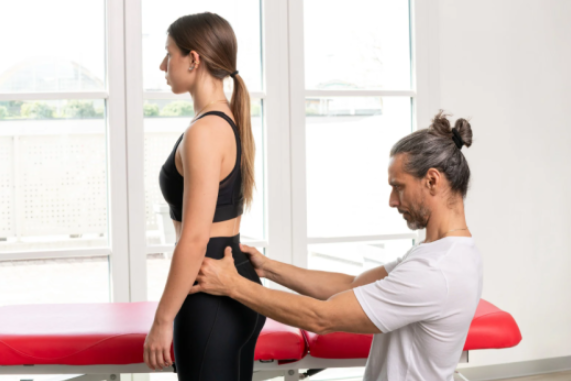
READING TIME: 9 MINUTES ➤➤
Pelvic Alignment: How to Tell if It's Tilted and Why It Affects Your Posture
When people talk about posture, attention almost always goes to the shoulders, head, or back. Yet there is a less visible element that determines much of the body's balance: the pelvis. Its position acts as a hidden control center, capable of influencing the lumbar curve, glute activation, and the distribution of loads during everyday movement.
Understanding whether your pelvis is properly aligned or tilted is more than just a technical curiosity. For an active person who already moves and trains regularly, it means improving movement quality, preventing compensations, and finally making sense of those recurring tensions that seem to have no clear cause.
- The pelvis as the hidden control center of posture
- What it really means to have a tilted pelvis
- Pelvis, lower back, and glutes: the connection
- How to tell if your pelvis is aligned
- Initial movement strategies to restore balance
The Pelvis as the Hidden Control Center of Posture
The pelvis represents the connection point between the lower limbs and the spine. It is not simply a transitional structure, but a true center of postural coordination. When its orientation changes, even by a few degrees, the entire body is forced to adapt.
This is why pelvic alignment affects overall posture far more than most people realize. A properly positioned pelvis allows the spine to maintain efficient natural curves, whereas a tilted pelvis forces muscles and joints to compensate, often without us even noticing.
What It Really Means to Have a “Tilted” Pelvis
Talking about a tilted pelvis does not mean labeling someone as “crooked” or abnormal. It means observing the orientation of the pelvis in space and understanding whether that orientation is functional for daily activities and athletic demands.
There are mainly two directions of pelvic tilt, each with specific characteristics and consequences for the body and movement.
Anterior Pelvic Tilt: When the Pelvis Rotates Forward
Anterior pelvic tilt occurs when the front portion of the pelvis rotates downward and forward. Visually, this position is often associated with an exaggerated lumbar curve and a feeling of an “arched” lower back.
The causes of a forward-tilted pelvis are never purely muscular. A combination of sedentary habits, intense physical activity, repetitive movement patterns, and poor pelvic awareness can lead the body to stabilize in this position, which eventually becomes automatic.
Posterior Pelvic Tilt: When the Pelvis Rotates Backward
In a posterior pelvic tilt, the pelvis rotates in the opposite direction, flattening the lower back. The posture often appears more closed and rigid, with a reduced ability to absorb and transfer force efficiently.
Even in this case, it should not be viewed as a postural fault but rather as a strategy. The body adopts this position when it perceives instability or when certain areas cannot manage load effectively.
Why Pelvic Position Changes Lower Back Function, Glute Activation, and Motor Control
The pelvis is closely connected to the behavior of the lumbar spine. When its position changes, the spine adapts to maintain visual and functional balance, often increasing stress on certain structures.
Understanding this relationship often creates an “aha moment”: many lower back tensions do not originate in the back itself, but are the result of a pelvis that can no longer perform its role efficiently.
Lumbar Curve and Joint Loading
An anterior pelvic tilt tends to increase the load on the lumbar facet joints, while a posterior pelvic tilt reduces the spine's elastic capacity. In both cases, the issue is not the position itself, but the lack of active control.
When the pelvis is not consciously managed, the spine is forced to compensate, becoming either excessively rigid or overly mobile depending on the situation.
Glutes, Core Muscles, and Compensation Strategies
The glutes and abdominal muscles play a crucial role in maintaining the pelvis in a functional position. If these muscles fail to work together effectively, the body adopts alternative strategies that are often less efficient.
This explains why focusing solely on strength training, without developing motor control, rarely resolves posture-related issues connected to the pelvis.
How to Tell if Your Pelvis Is Aligned
You do not need sophisticated tools to begin a process of self-monitoring. A few simple assessments can provide useful insights, especially when repeated over time.
The goal is not self-diagnosis, but rather developing greater body awareness.
Mirror Observation
Stand sideways in front of a mirror and observe the relationship between your chest, pelvis, and knees. A very pronounced lumbar curve or an almost completely flattened one may be an initial sign of pelvic tilt.
When performed regularly, this type of observation helps connect internal sensations with external posture.
Side-View Photos and Key Indicators
A simple side-view photo taken in a relaxed standing position can reveal details that are often missed in the mirror. The important thing is to maintain consistent conditions so you can compare changes over time.
This approach stimulates the need for cognition: understanding the reasons behind your bodily sensations increases motivation for change.
Initial Movement Strategies to Restore Balance
The first step is not to “correct” the pelvis, but to learn how to feel it and control it. Early movement work should focus on developing awareness of pelvic motion in relation to breathing and load distribution.
Only after regaining this awareness does it make sense to introduce more specific exercises. In this way, pelvic alignment becomes an active skill rather than a position that must be maintained through force.
Comments (0)