
Trolley
You have no items in your shopping cart

 Budgets
 Dumbers
 Discs
Discs
 Benches
 Racks and Rigs
 Weights Holders
 Isotonic machines
 Calisthenics
 Cardio
 Kettlebells
 Flooring
 Gym Set
 Accessories
 Combat
 ARTI MARZIALI
 CONTAINER GYM
 Tug-Of-War
 Used Gym Equipment
 PILATES MACCHINARI
 GINNASTICA ARTISTICA
 CAMPI DA PADEL
 Prodotti in Pronta Consegna
 Informazioni
 IRONMAN
 Gift Card
- Donatif
- General information
- 0 I like it
- 1095 Views
- 0 comments
- gym flooring, safety flooring, gym safety, shock-absorbing materials
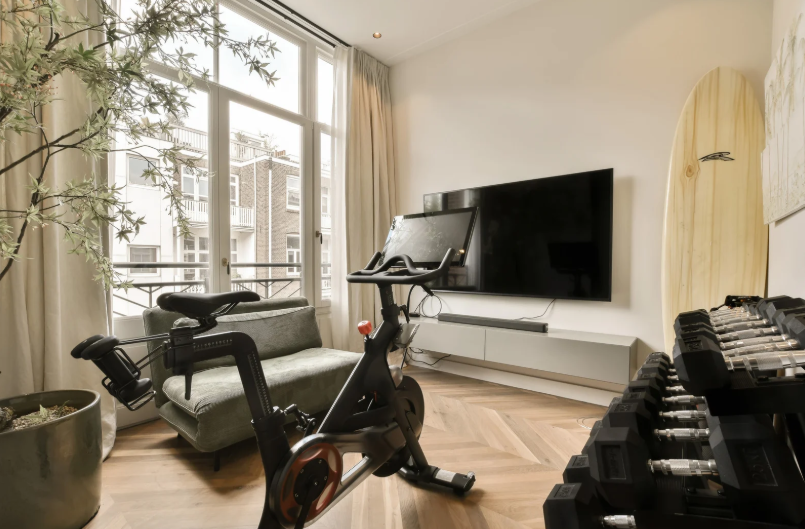
How to Set Up a Home Gym in an Apartment Using Standard Where It Works and Custom Where It Truly Matters
Setting up a home gym in an apartment is not just about space. It’s about balance. Between what you can easily fit in and what needs to adapt to real constraints, often invisible until you start planning. The most common mistake is thinking there are only two paths: either everything standard or everything custom.
This mindset often leads to practical issues. You either overload the space with unnecessarily complex solutions or choose standard equipment that doesn’t truly work within a domestic environment. An effective setup instead comes from carefully reading the constraints and making targeted decisions: standard where it’s enough, custom where it truly matters.
Read also:
Why choosing between standard and custom is a false dilemma
The risk of polarized thinking
Standard vs custom is only useful if interpreted correctly. Too often, it becomes an all-or-nothing choice. This approach creates more problems than it solves because it ignores the reality of domestic spaces, which are always shaped by compromises, movement paths, and shared functions.
Choosing only standard solutions may lead to equipment that doesn’t truly fit the space. Going fully custom can introduce unnecessary complexity, with higher costs and longer timelines that don’t improve daily usability. The result is often a less fluid environment that ends up being used less over time.
The value of a selective configuration
A selective configuration means deciding where to intervene and where not to. Not every area requires the same level of planning. Some zones work perfectly with standard solutions, while others become critical if not properly adapted.
This approach reduces decision-making errors. It helps maintain order, control bulk, and avoid future adjustments. A well-designed home gym is not the most complex one, but the one that integrates best with your home.
How to understand real apartment constraints
Spaces, pathways, and critical areas
The first step is identifying critical zones. It’s not just about square meters, but how space is used and crossed during the day. Doors, windows, hallways, and access points must remain clear, otherwise your gym becomes a daily obstacle.
A common mistake is evaluating space statically. In reality, a home gym must work dynamically: as you move, enter, and live your home. This is where the limits of poorly adapted standard setups become evident.
Home functions and coexistence with the gym
Each room has a primary function. Living rooms, bedrooms, garages, or dedicated spaces all have different needs. Adding a gym means introducing a new function without compromising existing ones.
An effective setup respects this coexistence. It doesn’t just “fit” equipment into space, it creates an environment that remains livable. This is where the standard vs custom decision becomes truly practical.
Where standard solutions are enough
Basic and modular equipment
Many home gym elements work perfectly as standard. Compact racks, adjustable benches, and barbells are already designed to fit domestic environments. In these cases, custom solutions add little to no real value.
The key is choosing equipment proportional to your space. There’s no need to adapt it, just select it correctly. This reduces complexity and keeps your setup flexible over time.
Accessories and non-critical components
Plates, dumbbells, resistance bands, and small accessories don’t require customization. Storage can often be handled with standard solutions, as long as it aligns with the available space.
Customizing these elements rarely brings real benefits. Instead, it increases rigidity and reduces modularity, which is one of the key advantages of a home gym.
Where custom makes the difference
Constraints and difficult geometries
Custom solutions become essential when dealing with structural constraints. Irregular walls, low ceilings, unused corners, or niches are situations where standard equipment struggles.
In these cases, tailored solutions help recover space and improve usability. This is not about aesthetics, but function: making otherwise problematic areas usable.
Integration with the home environment
Another key aspect is visual and functional integration. When the gym is placed in shared areas, adapting dimensions, finishes, or configurations may be necessary to maintain consistency with the rest of the home.
Here, custom solutions reduce perceived impact. The goal is not to hide equipment, but to make it compatible with the environment it lives in.
Practical decision framework
Mapping decisions by home zones
An effective approach is dividing your home into zones and analyzing each one. For example: workout area, passage area, storage area. For each zone, determine whether standard solutions are sufficient or if targeted customization is needed.
This mapping reduces uncertainty. It turns a complex decision into a series of simpler, manageable choices, preventing mistakes that only appear after installation.
Common mistakes to avoid
One of the most frequent mistakes is overestimating the need for customization. Another is ignoring it entirely. Both lead to ineffective setups: the first creates unnecessary complexity, the second causes practical issues.
Another mistake is not considering long-term evolution. A home gym must adapt over time. A setup that is too rigid, even if initially effective, can become limiting.
A real mixed configuration example
A balanced standard-custom setup
Imagine an apartment with a dedicated room and a shared living area. In the dedicated room, you can install a standard compact rack, a bench, and modular flooring. Here, standard works perfectly.
In the living area, however, you might need custom storage to integrate weights without creating clutter, or a tailored solution to make use of an unused niche. This is where custom intervention becomes targeted and meaningful.
Why it works over time
This setup works because it doesn’t force the space. It uses standard solutions where they are already optimized and custom only where real adaptation is required. The result is a clean, fluid, and sustainable environment.
Over time, this reduces the need for changes and adjustments. The gym remains usable without interfering with daily life, which is the main goal in an apartment setting.
When your setup truly works daily
Balance between function and space
A home gym truly works when it creates no friction. When you can use it without constantly moving things or reorganizing your home. This balance is only achieved through a conscious configuration.
It’s not about budget or technical level. It’s about making the right decisions in the right places. Standard and custom are not alternatives, but tools to be used strategically.
A simplifying approach that really works
Moving from an all-or-nothing mindset to a selective approach reduces complexity. It helps you decide with more confidence and avoid mistakes that are difficult to fix later.
If your goal is a tidy, effective, and well-integrated home gym, the most solid path is this: standard where it’s enough, custom where it truly matters. That’s where configuration becomes a conscious decision, not a compromise.
Comments (0)