
Trolley
You have no items in your shopping cart

 Budgets
 Dumbers
 Discs
Discs
 Benches
 Racks and Rigs
 Weights Holders
 Isotonic machines
 Calisthenics
 Cardio
 Kettlebells
 Flooring
 Gym Set
 Accessories
 Combat
 ARTI MARZIALI
 CONTAINER GYM
 Tug-Of-War
 Used Gym Equipment
 PILATES MACCHINARI
 GINNASTICA ARTISTICA
 CAMPI DA PADEL
 Prodotti in Pronta Consegna
 Informazioni
 IRONMAN
 Gift Card
- Donatif
- General information
- 0 I like it
- 1300 Views
- 0 comments
- stress reduction, improved self-esteem, physical and mental well-being, gym training
READING TIME: 5 MINUTES ➤➤
Criteria for choosing between standard and custom in an apartment
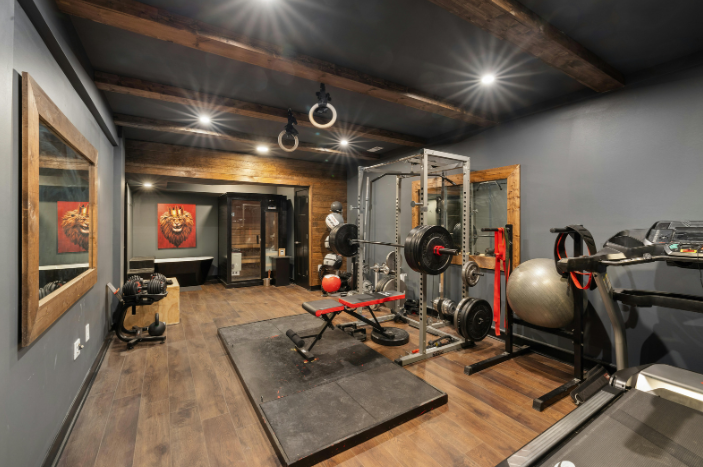
Setting up a home gym in an apartment involves a series of decisions that go beyond simply choosing equipment. The key point is not just what to buy, but understanding whether a standard solution is truly sufficient or if a custom adaptation becomes necessary. This step is often underestimated, especially by those approaching home training for the first time.
The most common risk is relying on a superficial perception of available space. People tend to think that if a piece of equipment physically fits in the room, then it will automatically be functional. In reality, the difference between available space and usable space is what determines the success or failure of the layout.
- Why domestic space changes the rules of choice
- The critical measurements that determine the choice
- When a standard solution is sufficient
- When custom becomes necessary
- Decision matrix: constraints, usage, and choice
Why domestic space changes the rules of choice
In a residential context, every centimeter matters. Unlike a commercial gym, where spaces are designed to accommodate standard equipment, in an apartment you must deal with real constraints such as walls, doors, windows, and limited ceiling heights. These elements directly affect how equipment can be used.
The first mistake is believing that checking static dimensions is enough. In reality, every piece of equipment requires dynamic space to be used properly. Movements, loads, and access points must be considered from the beginning, otherwise you risk creating an impractical or even unusable environment.
The false myth of “it fits”
Many users evaluate a rack or a bench solely based on the dimensions declared by the manufacturer. However, this approach completely ignores the space required for actual use. A barbell, for example, requires lateral clearance for loading and unloading, which is often overlooked.
This simplification leads to layout mistakes that are difficult to fix later. Even a few centimeters can make the difference between a smooth setup and a frustrating one, especially in small spaces.
Difference between available space and usable space
Available space is what you measure geometrically, while usable space takes into account accessibility, movement, and safety. This distinction is essential to avoid incorrect choices.
In practice, a space may seem sufficient on paper but turn out to be limiting during daily use. Considering this difference allows for more informed decisions and reduces the risk of forced adjustments.
The critical measurements that determine the choice
Not all dimensions carry the same weight when designing a home gym. Some measurements are decisive because they directly impact equipment functionality. Identifying these critical variables is the first step toward making the right choice.
These include ceiling height, available depth, and lateral space. Ignoring even one of these aspects can compromise the entire setup.
Real footprint and safety margins
Every piece of equipment requires additional space beyond its declared dimensions. This margin ensures safety and freedom of movement. Training without sufficient space increases the risk of mistakes and limits performance.
Considering these margins helps avoid overly tight configurations that become uncomfortable and unsustainable over time.
Openings, pathways, and movement zones
Another often overlooked element is internal circulation. Doors, corridors, and access points must remain clear and functional. A piece of equipment that seems correctly placed on paper can completely block the usability of the space.
Analyzing movement flows helps maintain a balance between training and everyday use of the home environment.
When a standard solution is sufficient
Standard solutions work well when the space has regular and predictable characteristics. In these cases, using compact and modular equipment allows you to achieve a good result without complications.
A standard setup is ideal for those with straightforward needs and moderate usage frequency. It helps contain costs and simplifies the decision-making process.
Predictable contexts and linear use
If the environment has regular dimensions and few constraints, a standard solution can be more than adequate. Simplicity becomes an advantage, especially for beginners.
In these cases, the risk of error is reduced and the required adaptation is minimal.
Adaptable and modular equipment
Many standard products are designed to be flexible. Compact racks, foldable benches, and modular systems can adapt to different contexts. This adaptability reduces the need for custom solutions.
Choosing versatile products helps maintain a good balance between functionality and simplicity.
When custom becomes necessary
Choosing custom should not be automatic, but rather a response to specific needs. It becomes necessary when constraints prevent the effective use of standard solutions.
In these cases, the value of customization lies in solving real problems, not in pursuing a more sophisticated solution.
Structural constraints and architectural limits
Low ceilings, niches, columns, or irregular walls can make many standard pieces of equipment unusable. Custom solutions allow you to make use of otherwise wasted space.
These interventions are particularly useful in complex environments, where every standard option proves inefficient.
Advanced space optimization
In very limited contexts, custom solutions allow you to maximize every available centimeter. Tailored design integrates equipment and environment in a coherent way.
This approach reduces wasted space and significantly improves the overall user experience.
Decision matrix: constraints, usage, and choice
To avoid mistakes, it is useful to adopt a structured approach. Evaluating together domestic constraints, frequency of use, and functional priorities helps identify the most suitable solution.
This analysis helps avoid both overestimating the problem, which leads to unnecessary expenses, and underestimating it, which compromises space usability.
Frequency of use and functional priorities
Occasional use requires simple and flexible solutions. On the other hand, frequent use justifies more targeted investments. The choice should be proportional to actual usage.
Aligning these variables helps optimize both space and budget.
Reducing errors between overestimation and underestimation
The real goal is to find a balance. Not everything requires custom, but not everything can be solved with standard solutions. Understanding this distinction is what leads to a conscious choice.
An approach based on concrete criteria allows you to transform a domestic environment into a functional space, avoiding unnecessary compromises and improving the overall experience.
Comments (0)