
Trolley
You have no items in your shopping cart

 Budgets
 Dumbers
 Discs
Discs
 Benches
 Racks and Rigs
 Weights Holders
 Isotonic machines
 Calisthenics
 Cardio
 Kettlebells
 Flooring
 Gym Set
 Accessories
 Combat
 ARTI MARZIALI
 CONTAINER GYM
 Tug-Of-War
 Used Gym Equipment
 PILATES MACCHINARI
 GINNASTICA ARTISTICA
 CAMPI DA PADEL
 Prodotti in Pronta Consegna
 Informazioni
 IRONMAN
 Gift Card
- Donatif
- General information
- 0 I like it
- 1234 Views
- 0 comments
- stress reduction, improved self-esteem, physical and mental well-being, gym training
READING TIME: 5 MINUTES ➤➤
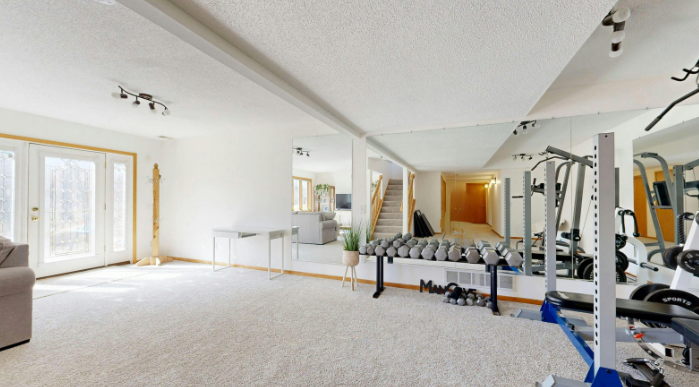
Advanced Home Gym: When to Plan a Custom Setup Instead of Adapting Standard Equipment
There comes a point, in every advanced home gym, when continuing to adapt standard solutions stops being efficient. It’s no longer about adding an accessory or optimizing a corner, but about recognizing that the system as a whole has reached a structural limit. This is a delicate phase, because the setup often “still works,” but does so at the cost of increasingly evident compromises.
Understanding when to shift from continuous adaptation to a conscious design decision is what separates a mature setup from one that has simply grown over time. In this article, we analyze the signals, the real differences between standard and custom, and a practical roadmap to make a more efficient decision.
- The breaking point of standard setups
- Signs of saturation
- Standard vs custom
- Where custom makes sense
- Informed decision-making
- Transition roadmap
The breaking point of standard setups in an advanced home gym
Standard equipment is designed to be flexible, accessible, and adaptable. But over time, that same flexibility becomes a limitation. When every new addition requires compromises, modifications, or trade-offs, it means the system has lost coherence. It is no longer designed—it is simply adjusted.
The issue is not immediately visible because the setup still works. However, the cost accumulates in the form of inefficiency, wasted time, and reduced training quality. This is where the real breaking point emerges: when adaptation stops being an advantage and becomes a constraint.
When adaptation stops being efficient
Every standard solution added requires space, compatibility, and integration. When these three variables start conflicting, efficiency drops quickly. It’s no longer about optimization, but about managing problems.
An advanced setup should reduce friction, not create it. If every workout requires adjustments, movements, or compromises, the system has surpassed its optimal point.
The hidden cost of continuous compromises
Compromises are not only physical but also cognitive. Every suboptimal choice creates micro-friction that, over time, affects the overall experience. This is the true hidden cost of pushing standard solutions beyond their limits.
Continuing in this direction leads to a permanent compromise, where nothing is fully optimized but everything is “good enough.” It is a stable condition, but an inefficient one.
Concrete signs of setup saturation
Recognizing signs of saturation is essential to avoid late or incorrect decisions. These are not vague perceptions, but concrete indicators showing when the system has reached its limit.
These signals emerge gradually and are often normalized over time. That is why it is important to analyze them clearly and without bias.
Compromised space, organization, and workflow
One of the first signals is the loss of order. When space is no longer sufficient to manage equipment efficiently, the entire system suffers. The layout becomes reactive rather than designed.
A cluttered or inefficient environment is not just an aesthetic issue, but an operational one. It reduces efficiency, increases time, and limits training quality.
Repetition of the same operational limits
If you find yourself solving the same problems repeatedly with temporary fixes, this is a clear signal. Repetition indicates that the issue is not local, but systemic.
In these cases, custom solutions are not an aesthetic upgrade, but a structural response to a real limitation.
Standard vs custom: what really changes
The difference between standard and custom is not just in the product, but in how the system is conceived. Standard adapts to the space. Custom starts from the space and defines it.
This shift in perspective is fundamental. It’s not about having something “better,” but about having something aligned with your actual use.
Structural and functional differences
Standard solutions are designed to fit many contexts. Custom ones are designed for a specific context. This creates a fundamental difference in integration and functionality.
The result is a more fluid, organized, and efficient system, where every element has a clear and intentional role.
When custom unlocks real performance
Custom makes sense only when it unlocks something standard cannot provide. It is not an aesthetic choice, but a functional one. It must solve a real problem.
When this happens, the quality jump is clear—not just in space, but in the overall experience.
Where custom makes the most sense
Not everything needs to be custom. In fact, one of the most common mistakes is thinking in absolute terms. The real value lies in a selective transition to custom, focused on critical areas.
Identifying these areas is the first step toward an effective and sustainable intervention.
Custom storage and organization
Storage is often the first critical point. Standard solutions rarely manage diverse and growing equipment efficiently.
Custom storage allows you to reclaim space, improve organization, and reduce operational time. It is one of the highest impact, lowest complexity interventions.
Rack, flooring, and custom layout
The rack is the core of the home gym. When the standard option is no longer sufficient, custom solutions can provide configurations that better match real usage.
Flooring and layout also play a key role. A targeted intervention can completely transform the functionality of the space.
How to build an informed decision
Deciding to move to custom is not simple. Economic, psychological, and practical factors all come into play. It is essential to analyze them clearly.
An effective decision comes from real evaluation, not from perception or fear.
Evaluating costs, benefits, and real impact
The cost of custom is visible. The cost of inefficient standard solutions is hidden. Comparing the two is essential to making the right decision.
It’s not just about budget, but long-term value. A custom intervention can reduce inefficiencies for years.
Overcoming biases that block the transition
The endowment effect leads us to overvalue what we already own. Loss aversion makes change difficult. These biases slow necessary decisions.
Recognizing them helps overcome inertia and evaluate the transition more objectively.
Decision roadmap: from adaptation to design
The transition to custom does not need to be abrupt. It can be planned progressively, reducing risks and maximizing effectiveness.
A clear roadmap allows you to turn a perceived limitation into a structured decision.
Transition phases toward custom
The first phase is analysis. The second is identifying critical areas. Only then do you move to design and implementation.
This approach prevents mistakes and ensures control over the process.
Planning a targeted and progressive intervention
You don’t need to overhaul everything. Often, acting on one or two key elements is enough to achieve a significant improvement.
The real goal is not to have a perfect home gym, but a system that is coherent, efficient, and sustainable over time.
Comments (0)