
Trolley
You have no items in your shopping cart

 Budgets
 Dumbers
 Discs
Discs
 Benches
 Racks and Rigs
 Weights Holders
 Isotonic machines
 Calisthenics
 Cardio
 Kettlebells
 Flooring
 Gym Set
 Accessories
 Combat
 ARTI MARZIALI
 CONTAINER GYM
 Tug-Of-War
 Used Gym Equipment
 PILATES MACCHINARI
 GINNASTICA ARTISTICA
 CAMPI DA PADEL
 Prodotti in Pronta Consegna
 Informazioni
 IRONMAN
 Gift Card
- Donatif
- General information
- 0 I like it
- 1193 Views
- 0 comments
- gym flooring, safety flooring, gym safety, shock-absorbing materials
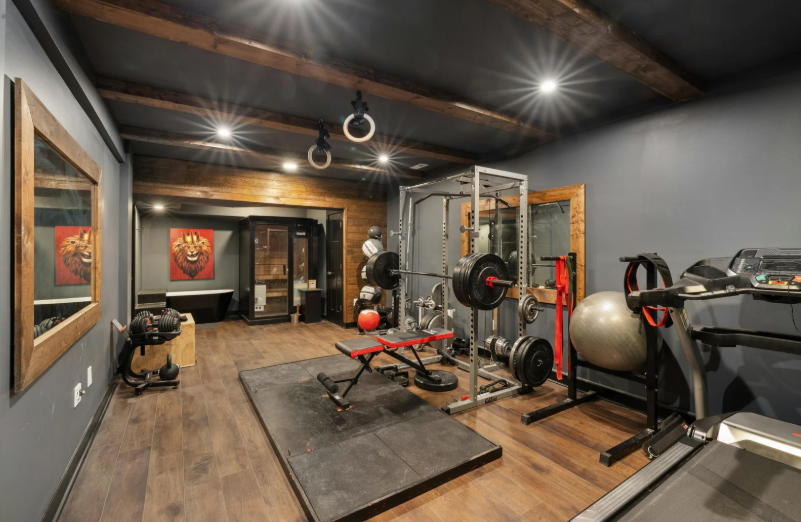
Selective Custom vs Distributed Standard in the Advanced Home Gym
There comes a point in every advanced home gym when the question is no longer what to add, but where to intervene effectively. The setup already exists and works overall, yet specific limitations begin to emerge: uncomfortable movements, slow transitions, equipment that no longer matches your level. This is where the most concrete doubt arises: improve the standard across the board or concentrate everything on a critical point.
The issue is not only technical, but also strategic. A poorly distributed investment risks changing nothing. An overly targeted intervention can create imbalance within the system. Understanding the trade-off between selective custom and distributed standard means making clearer decisions, avoiding both dispersion and unnecessary perfectionism.
Two design approaches compared
What a well-distributed standard means
Distributed standard refers to a logic in which all areas of the home gym are maintained at a medium-high level, without extreme peaks. The goal is to ensure consistency, continuity, and the absence of obvious weak points. Every element works properly, even if none represents a radical performance leap.
This approach is often adopted to avoid imbalance and maintain a solid overall experience. The advantage lies in operational stability: every exercise can be performed without forced adjustments. However, when specific limitations emerge, standard solutions may become insufficient exactly where a sharper upgrade is needed.
What a selective custom intervention implies
Selective custom means concentrating resources on a single critical area: a rack, flooring, storage, or layout. It is not about transforming the entire space, but about intervening where the limitation is real and measurable.
This type of choice aims to achieve a targeted functional leap. If the problem is correctly identified, the impact can be immediate and significant. The risk, however, is intervening without a broader vision, creating a setup that is uneven or difficult to integrate into the training flow.
When distributed standard really works
Overall consistency and continuity of use
Distributed standard works when the home gym does not present evident bottlenecks. In these cases, improving everything uniformly allows you to maintain operational continuity without introducing complexity. The training flow remains smooth, predictable, and repeatable.
This approach is particularly effective when the goal is to consolidate an already solid base. It avoids discontinuity and reduces the risk of design errors. The priority becomes system coherence, not the performance of a single area.
Limits of standard when bottlenecks emerge
The limitation appears when one part of the setup slows down or compromises the entire training session. In these cases, distributing resources across the whole space does not solve the problem. You continue improving what already works, leaving unchanged what truly limits you.
This creates a form of invisible inefficiency: the setup seems to improve, but the perceived result remains the same. This is the clearest signal that distributed standard has reached its operational limit.
When selective custom becomes strategic
Identifying a real critical area
A critical area is a point in the setup that concretely limits the training flow. It may be an unstable rack, poorly organized space, or inadequate flooring. It is not a vague perception, but a recurring and observable limitation.
Intervening on this point with a custom solution means acting on the cause, not the surroundings. The result is often noticeable improvement from the very first sessions, as a structural constraint is removed.
Impact on training flow
The real evaluation parameter is the training flow. An effective custom intervention reduces downtime, improves safety, and makes transitions between exercises more natural. It is not just about equipment, but about the overall experience.
When flow improves, the quality of work increases as well. This makes selective custom a powerful tool, but only if applied with precision and without unnecessarily extending it to other areas.
Opposing risks: dispersion vs imbalance
Investing everywhere without solving the problem
Distributing the budget evenly may seem like a cautious choice, but it often leads to a dispersive outcome. Everything improves marginally, without achieving a real qualitative leap.
This approach is driven by loss aversion: mistakes are avoided on a single point, but meaningful improvement is sacrificed. The risk is remaining in a comfort zone that does not evolve.
Over-investing in a single area
On the opposite end, an excessive intervention on a single area can create imbalance. One element becomes excellent, while the rest of the setup lags behind.
This generates operational discontinuity: the improved element does not integrate perfectly with the rest. The result may be less effective than expected, despite the high investment.
Concrete examples of choice
Case of a critical area solved with custom
A typical example is disorganized storage that slows down every session. Intervening with a custom solution allows you to optimize space and access to equipment, immediately improving flow.
In this case, distributed improvement would not have had the same impact. The problem was localized, and the solution had to be equally focused.
Case of a balanced setup with standard
In a well-organized home gym without evident weak points, maintaining a high standard across all areas is often the most rational choice. Each element contributes consistently to the experience.
Here, the value lies not in peak performance, but in the continuity and reliability of the system. Targeted intervention would not bring proportional benefits.
How to choose consciously
Practical decision criteria
The decision depends on a simple question: is there a point that truly limits your training? If the answer is yes, selective custom makes sense. If the answer is no, distributed standard remains the most coherent solution.
Observing your training over time helps identify recurring patterns. This is where the difference between perception and actual data emerges.
Protecting the investment over time
Every choice should also be evaluated with a long-term perspective. A well-executed targeted intervention tends to last over time because it solves a structural problem. A distributed standard, on the other hand, maintains flexibility and adaptability.
The real optimization is not choosing rigidly between the two models, but understanding when to apply them. This is what allows you to protect your investment and evolve your home gym without waste.
The technical advantage of a targeted choice
Choosing between selective custom and distributed standard is not an ideological matter, but an operational one. Every setup evolves, and priorities change with it. Being able to read your space and intervene correctly allows you to get the most out of every investment, without chasing total transformations when they are not needed.
Comments (0)