
Trolley
You have no items in your shopping cart

 Budgets
 Dumbers
 Discs
Discs
 Benches
 Racks and Rigs
 Weights Holders
 Isotonic machines
 Calisthenics
 Cardio
 Kettlebells
 Flooring
 Gym Set
 Accessories
 Combat
 ARTI MARZIALI
 CONTAINER GYM
 Tug-Of-War
 Used Gym Equipment
 PILATES MACCHINARI
 GINNASTICA ARTISTICA
 CAMPI DA PADEL
 Prodotti in Pronta Consegna
 Informazioni
 IRONMAN
 Gift Card
- Donatif
- General information
- 0 I like it
- 1409 Views
- 0 comments
- gym flooring, safety flooring, gym safety, shock-absorbing materials
Mini Bands for Glutes: 7 Effective Exercises Explained
Mini bands for glutes are one of the simplest tools to incorporate into a home workout, gym routine, or pre-run activation session. They take up very little space, require no heavy weights, and help improve movement awareness—the ability to truly feel the glutes working during an exercise. This is important because many lower-body movements are often performed by compensating with the quadriceps, lower back, or hip flexors, especially when technique is not yet fully developed.
A good workout with glute bands does not promise instant transformations, but it can improve control, stability, and overall training quality. To achieve meaningful benefits, it is important to choose appropriate exercises, maintain constant tension on the band, and use a resistance level that matches your abilities. Light mini band loops are often best for learning movement patterns, while medium or stronger bands can be introduced once technique remains solid even under fatigue.
How to Use Mini Bands to Train Your Glutes
Band Position and Constant Tension
The mini band can be placed above the knees, below the knees, or around the ankles depending on the exercise and your level of control. Positioning it above the knees is usually the most accessible option because it allows you to better feel hip abduction while maintaining stability. The main rule is to keep continuous elastic tension throughout the movement, avoiding any slack during the return phase. When tension disappears, glute engagement often becomes less effective as well.
For beginners, starting with a lighter resistance helps focus on movement quality rather than effort. A band that is too strong can lead to shortened ranges of motion, a rigid lower back, or knees collapsing inward. The goal is not to aggressively stretch the band but to control it throughout the exercise. This approach makes mini band glute exercises more effective, even when used as activation work before squats, lunges, or running.
Breathing, Posture, and Tempo
When performing mini band exercises, it is best to avoid fast and uncontrolled repetitions. An ideal tempo is steady: open, pause briefly, then return slowly. This rhythm helps improve awareness of the gluteus medius, gluteus maximus, and the stabilizing muscles around the hips. Breathing also plays a role; exhaling during the effort phase helps maintain core engagement and pelvic stability.
Posture should remain natural without excessive tension in the shoulders or lower back. If discomfort develops in the lumbar area, the issue is often technical compensation rather than the band itself. Reducing resistance, shortening the range of motion, or slowing down the exercise can immediately improve execution quality. The primary focus should always be muscular control, not simply completing more repetitions.
7 Mini Band Exercises for Glutes
Mini Band Squat
The mini band squat is performed by placing the band above the knees and standing with feet approximately shoulder-width apart. During the descent, the knees should track over the feet without collapsing inward. The band provides instant feedback: if tension decreases, hip control is likely being lost. This exercise is highly effective for learning how to engage the glutes during a compound lower-body movement.
To maximize effectiveness, descend under control and avoid bouncing at the bottom. There is no need to squat deeper than your ability to maintain a neutral spine and stable pelvis. Beginners can focus on a small number of high-quality repetitions, while more advanced trainees can add a two-second pause at the bottom position. In this way, the mini band squat becomes a technical exercise rather than simply a conditioning drill.
Mini Band Glute Bridge
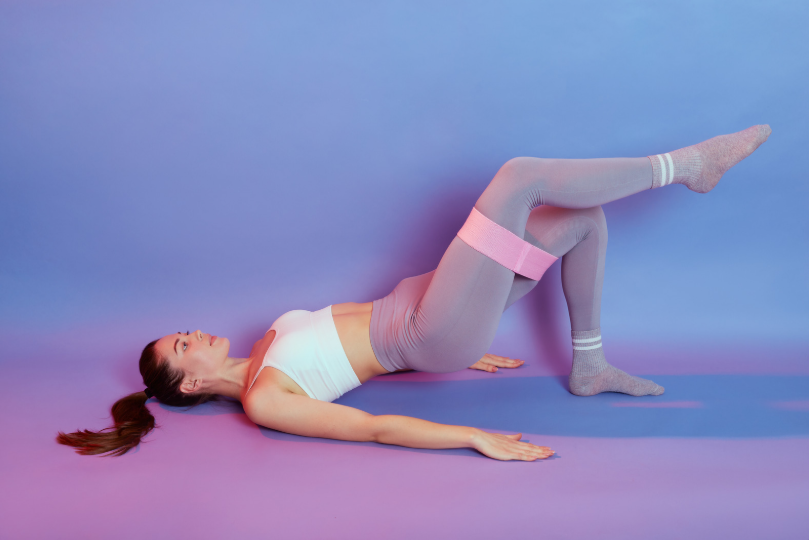
The glute bridge is one of the best exercises for directly targeting the gluteus maximus. Begin lying on your back with knees bent, feet flat on the floor, and the mini band positioned above the knees. As the hips rise, avoid overextending the lower back while gently pressing the knees outward. The band's resistance helps prevent the movement from becoming passive.
At the top position, pause briefly and squeeze the glutes without relying on excessive lumbar extension. If you mainly feel the hamstrings or lower back, your feet may be too far from your body or your range of motion may be excessive. A more controlled variation includes slower repetitions and short pauses at the top. This exercise works well both as activation work and as a central component of a mini band workout.
Lateral Band Walk
The lateral band walk primarily targets the gluteus medius, a key muscle for pelvic stability and knee control. The band can be placed above the knees for an easier version or around the ankles for increased difficulty. Start in a slight squat position, keep the torso stable, and take small lateral steps. The key is not to drag the trailing foot but to control every movement.
This exercise is especially valuable for runners and athletes because it mimics the lateral stabilization demands placed on the hips during movement. There is no need to exaggerate step width; often, smaller and more controlled steps create better glute activation. The band should remain under constant tension while the pelvis stays stable. When used correctly, the lateral mini band walk enhances both warm-up quality and movement awareness.
Mini Band Clamshell
The clamshell is performed lying on one side with knees bent and the mini band positioned above the knees. The movement involves opening the top knee while keeping the feet together and the pelvis stable. Although simple in appearance, it is highly effective for isolating the gluteus medius without stressing the lower back. The challenge is resisting the temptation to rotate the torso backward to artificially increase range of motion.
Good execution requires patience and control. The opening range should match your hip mobility without forcing the movement. If the pelvis shifts, reduce the range of motion or switch to a lighter band. The clamshell is particularly useful on days focused on glute activation and movement quality without excessive lower-body fatigue.
Quadruped Kickback
The mini band kickback is performed on all fours, with the band positioned around the thighs or feet depending on the variation. In the beginner-friendly version, the band sits above the knees while one leg drives backward with the knee bent. The torso remains stable, the core stays engaged, and the hands support the body evenly. The movement should never become a lower-back arch.
The correct sensation is a controlled glute contraction rather than a forceful swing of the leg. Focus on moderate range of motion and a slow return while maintaining tension throughout. Resistance can be increased later, but only if pelvic stability remains intact. This is an excellent exercise for anyone looking for targeted glute band exercises that fit easily into a home workout routine.
Standing Hip Abductions
Standing hip abductions are performed with the mini band positioned above the ankles or knees while one leg moves laterally away from the body. The supporting foot remains stable and the movement originates from the hip rather than the foot. This exercise requires very little space and can easily be included in a short warm-up routine. Difficulty increases significantly when the band is moved closer to the ankles.
To avoid compensations, lightly hold onto a wall or stable object for support. This allows greater focus on the lateral glutes without balance becoming the limiting factor. The moving leg does not need to rise excessively high; beyond a certain point, other muscles may take over and pelvic alignment may be lost. With appropriate resistance, mini band hip abductions help improve both stability and lateral control.
Monster Walk
The monster walk is a controlled forward and backward walking pattern performed while maintaining constant tension on the mini band. Start in a semi-squat position with active feet and knees gently pushed outward. Steps are short and diagonal while maintaining alignment between the hips, knees, and feet. Compared to the lateral walk, this variation is more dynamic and demands greater postural control.
The most productive version is not necessarily the hardest one, but the one in which pelvic stability is maintained throughout the entire set. If the knees collapse inward, the band is likely too strong or fatigue has become excessive. Monster walks are often most effective after simpler activation exercises when the glutes are already engaged. In a complete routine, they help make a mini band workout more varied and functional.
Resistance, Progression, and Choosing the Right Band
When to Use a Light, Medium, or Heavy Band
The ideal resistance depends on the exercise, technical ability, and training objective. A light band is generally best for clamshells, hip abductions, and activation drills where the goal is to feel the target muscles without sacrificing control. Medium resistance often works well for squats, glute bridges, and lateral walks. Heavy bands require greater attention because they can negatively affect posture if introduced too soon.
A set of light and medium resistance bands offers enough variety to adapt the workload to different stages of a workout. Not every exercise requires the same level of tension; a resistance that feels perfect during a glute bridge may be excessive during a clamshell. The smartest progression is not immediately moving to the strongest band, but maintaining technical quality while increasing repetitions, pauses, or time under tension.
Simple Ways to Increase Training Stimulus
Difficulty can be increased in several ways: extending contraction time, adding sets, slowing the eccentric phase, or changing band placement. Moving the band from the knees to the ankles increases the challenge of many exercises, although it also requires more stability. Adding an isometric hold at peak tension is another effective strategy that does not require additional equipment.
Progression should always be gradual, especially for those seeking aesthetic improvements but lacking extensive training experience. If technique begins to deteriorate, resistance should be reduced. A useful guideline is finishing a set with noticeable effort while still maintaining alignment and control. Following this principle allows mini band loops to remain a versatile training tool suitable for both beginners and experienced users.
How to Build a More Controlled Workout
A Beginner-Friendly Exercise Sequence
A simple routine can begin with floor-based exercises such as glute bridges and clamshells before progressing to standing movements like lateral walks and squats. This sequence activates the glutes before asking them to stabilize the body in weight-bearing positions. For beginners, a small number of carefully executed sets is usually sufficient. The goal is not to turn every exercise into an endurance challenge but to prioritize movement quality.
A balanced routine may include glute bridges, clamshells, lateral walks, and mini band squats, while more dynamic exercises can be introduced later. Repetition ranges can vary according to individual ability, but the final sensation should be one of controlled muscular work rather than total exhaustion. Runners and athletes can use this sequence as activation work, while those pursuing aesthetic goals can perform it two or three times per week with appropriate recovery.
The Importance of Technique Before Intensity
When using mini bands, it is easy to assume that more resistance automatically means better results. In reality, especially when training the glutes, execution quality plays a far greater role. Short, rigid, or compensated movements reduce exercise effectiveness and make it harder to feel the intended muscles working. For this reason, it is worth paying attention to knee alignment, pelvic position, and spinal posture during the first few training sessions.
Mini bands for glutes are most effective when used consistently, progressively, and with proper technique. They do not replace every form of lower-body training, but they can intelligently complement bodyweight workouts, strength training, and athletic preparation. Choosing the right resistance, maintaining continuous tension, and respecting your current ability level creates a sustainable approach to training. This is where the real benefit lies: improved control, better body awareness, and more precise glute training.
Comments (0)