
Trolley
You have no items in your shopping cart

 Budgets
 Dumbers
 Discs
Discs
 Benches
 Racks and Rigs
 Weights Holders
 Isotonic machines
 Calisthenics
 Cardio
 Kettlebells
 Flooring
 Gym Set
 Accessories
 Combat
 ARTI MARZIALI
 CONTAINER GYM
 Tug-Of-War
 Used Gym Equipment
 PILATES MACCHINARI
 GINNASTICA ARTISTICA
 CAMPI DA PADEL
 Prodotti in Pronta Consegna
 Informazioni
 IRONMAN
 Gift Card
- Donatif
- General information
- 0 I like it
- 5264 Views
- 0 comments
READING TIME: 9 MINUTES ➤➤
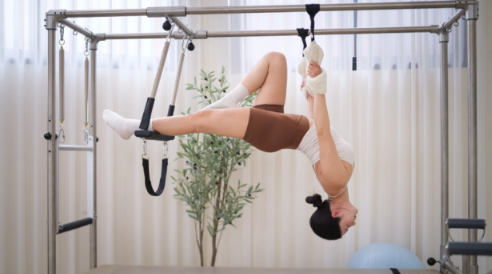
When Pilates practice reaches a certain level, simple exercise is no longer enough. One enters a new dimension in which the body is asked to respond with motor intelligence, three-dimensional precision, and advanced awareness. In this article we explore the heart of advanced Pilates: dynamic stability, 3D progressions, and motor control that transforms movement into mastery.
- Why advanced Pilates requires a new level of awareness
- The body as an intelligent system: foundations of motor control
- Three-dimensional progressions: criteria and goals
- Anti-rotation and core control: practical applications
- Scapula, pelvis and spine: the axis of lumbopelvic control
- Building an advanced Pilates class with 3D progressions
Why advanced Pilates requires a new level of awareness
The leap between basic and advanced practice
Many Pilates practitioners, after consolidating the fundamentals, reach a crossroads: continue with a safe and repetitive routine or move to the next level and face new challenges. Advanced Pilates is not simply a “harder” version of basic practice, but a space where motor intelligence is called upon to express its full complexity. Movements become more articulated, transitions more fluid, and coordination demands a higher level of attention.
Goals and mindset of the experienced practitioner
Those who approach advanced Pilates are not just seeking aesthetic benefits or general well-being. The intention is deeper: to develop a body capable of responding with precision to stimuli, improve dynamic stability, and achieve complete control even in complex movements. It becomes a mental challenge before a physical one, where every exercise is an opportunity to explore new motor patterns.
The body as an intelligent system: foundations of motor control
From sagittal plane to three-dimensional movement
One of the most common limitations in traditional Pilates practice is the predominance of movement on a single plane: the sagittal plane. Advanced Pilates breaks this pattern by integrating the three planes of movement: sagittal, frontal, and transverse. 3D motor control requires the body to stabilize and move fluidly in all directions, with particular emphasis on rotations, anti-rotations, and complex transitions.
Neuromuscular control strategies in Pilates
The three-dimensional approach demands a re-education of habitual movement patterns. Muscle activation must be anticipatory, postural control constant, and the synergy between muscular chains refined and deep. Strategies include the use of small equipment to challenge stability, asymmetrical variations, and sequences that stimulate adaptive motor capacity.
Three-dimensional progressions: criteria and goals
How to build advanced sequences with 3D logic
Designing a 3D progression starts from a key principle: every movement must have a functional intention. One begins with familiar gestures and gradually introduces variations that modify the axis, load, or direction of movement. The use of levers, instabilities, and dynamic coordination allows the body to learn new motor patterns that are more complex but also more efficient.
The role of breathing and motor timing
Breathing is never secondary. In advanced progressions, respiratory timing becomes a tool for control and integration. Inhale during expansion, exhale during stabilization: each breathing phase should correspond to a biomechanical action, amplifying the effectiveness of the exercise and the quality of body alignment.
Anti-rotation and core control: practical applications
Dynamic stability and asymmetrical challenges
One of the main goals in advanced Pilates is the ability to stabilize under stress. Anti-rotation situations—where the body resists a force trying to rotate it—are fundamental for building a truly functional core. Exercises such as unilateral push plank variations, elastic band movements, or unstable ball work create environments where the center of the body must constantly manage dynamic perturbations.
Advanced exercises to activate the deep core
Activation of the deep core—including the transverse abdominis, multifidus, and pelvic floor—cannot be left to chance. It requires precise, slow movements that challenge balance and intersegmental control. Variations of teaser, controlled roll-overs, and cross-pattern exercises demand effective neuromuscular integration and a high level of awareness.
Scapula, pelvis and spine: the axis of lumbopelvic control
Connecting the center: biomechanics of segmental control
In advanced Pilates, the relationship between the scapulae, pelvis, and spine is key to efficient posture. Scapulolumbopelvic control requires each segment to contribute harmoniously to movement while avoiding compensation and rigidity. Exercises must strengthen the connections between deep stabilizing muscles and joint surfaces, promoting both fluidity and stability.
Transitions and stability in motion
Transitions are not merely passages from one exercise to another; they are real tests of stability and control. Maintaining precision during changes of direction, moving from supine to quadruped positions, or from seated to standing, represents a challenge suited only for practitioners who have achieved a high motor level. Every fluid transition becomes an opportunity to refine three-dimensional coordination.
Building an advanced Pilates class with 3D progressions
Logical sequences and movement flow
An effective advanced Pilates class is built on a balance between challenge and sustainability. Sequences must flow, integrating static and dynamic work, moments of stabilization and exploration. The coherence between motor objectives, muscular activation, and breathing creates a movement “symphony” that stimulates and regenerates at the same time.
Adaptations for instructors and advanced practitioners
Every body is different, and each practitioner follows a unique path. Advanced instructors must be able to read signals, adapt exercises, and offer variations that maintain the objective while respecting individual limits. The use of small equipment, alternating difficulty levels, and constant attention to movement quality make each class unique, intense, and transformative.
Comments (0)