
Trolley
You have no items in your shopping cart

 Budgets
 Dumbers
 Discs
Discs
 Benches
 Racks and Rigs
 Weights Holders
 Isotonic machines
 Calisthenics
 Cardio
 Kettlebells
 Flooring
 Gym Set
 Accessories
 Combat
 ARTI MARZIALI
 CONTAINER GYM
 Tug-Of-War
 Used Gym Equipment
 PILATES MACCHINARI
 GINNASTICA ARTISTICA
 CAMPI DA PADEL
 Prodotti in Pronta Consegna
 Informazioni
 IRONMAN
 Gift Card
- Donatif
- General information
- 0 I like it
- 3441 Views
- 0 comments
READING TIME: 7 MINUTES ➤➤
Pilates for swimmers: scapular stability and body alignment in the water
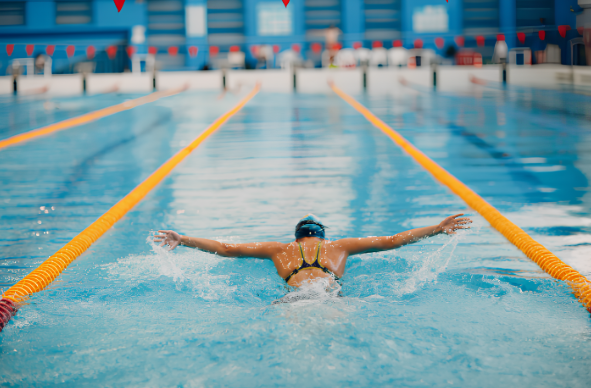
Aligning the shoulders and core is essential for every swimmer who wants a smooth and efficient stroke. But how can this technical precision be developed outside the water? Pilates, often underestimated, is actually a valuable ally for anyone spending time in the pool. In this article we explore the importance of scapular control, core stability, and functional strength to turn dry-land training into a real advantage in the water.
- Why Pilates helps swimmers swim better
- Scapular stability: the hidden key to a smooth stroke
- Rotator cuff: protection and performance for swimmers’ shoulders
- Anti-rotational core and postural control: the invisible engine
- Transferring strength from the mat to the pool: real integration
Why Pilates helps swimmers swim better
A dry-land discipline for water performance
Pilates is much more than a simple wellness workout. For swimmers, it represents a true school of motor control, postural awareness, and muscular precision. Repeating technical movements in swimming requires a stable and coordinated body—two qualities that Pilates trains with great attention to detail. Every exercise on the mat prepares the neuromuscular system to respond more effectively to stimuli in the pool, reducing energy loss and improving stroke quality.
Specific benefits of Pilates for swimmers
Anyone who swims knows how important movement efficiency is. Pilates works on symmetry, muscle chain length, and core stability. This results in greater efficiency in the water, with longer, more stable, and less energy-consuming strokes. In addition, the deep strengthening of the abdominals, back, and shoulders reduces the incidence of injuries commonly experienced by master swimmers and triathletes, making Pilates an ideal complement to pool training.
Scapular stability: the hidden key to a smooth stroke
What “scapular control” means and why it matters
In swimming, each stroke cycle involves the scapula in a complex movement of gliding, rotation, and elevation. The ability to manage this alignment with precision determines the quality of movement along the arm. Effective scapular control prevents compensations, wasted energy, and joint overload. Especially in master swimmers—where thoracic mobility is often limited—Pilates offers a unique opportunity to regain freedom and stability in this crucial area.
How to train scapular stability with targeted exercises
Pilates exercises that involve body support in quadruped positions or dynamic planks are ideal for developing scapular stability. Side-lying movements with minimal load also stimulate the activation of stabilizing muscles such as the lower trapezius, serratus anterior, and rhomboids. When practiced with awareness and consistency, these patterns improve the fine coordination between scapula and arm, creating the foundation for a stronger and smoother stroke.
Rotator cuff: protection and performance for swimmers’ shoulders
Why the rotator cuff is crucial in swimming
The rotator cuff is a group of muscles that stabilizes the humerus within the shoulder joint. In swimmers, these muscles are constantly under stress, particularly during phases such as the catch and pull underwater. Insufficient activation or imbalance within the rotator cuff can lead to chronic inflammation or, in more severe cases, injury. For this reason, it is essential to include targeted exercises that strengthen and support this area.
Effective exercises to strengthen the cuff and prevent injuries
Pilates incorporates slow, controlled movements—often using small equipment or resistance bands—that are perfect for selectively activating the rotator cuff muscles. External rotation work, controlled abduction, and isometric movements are valuable tools for those seeking both performance and injury prevention. Heavy loads are not necessary—precision is what makes Pilates so effective in both rehabilitation and prevention.
Anti-rotational core and postural control: the invisible engine
Stabilize to transmit force
Every swimming movement begins and ends in the core. This functional center is not only responsible for maintaining hydrodynamic alignment, but also serves as the starting point for transmitting force between arms and legs. Training an anti-rotational core reduces lateral oscillations and wasted movement during swimming, improving the overall efficiency of the stroke. Pilates works precisely in this direction, emphasizing control and stability rather than simply explosive strength.
How Pilates improves anti-rotational control in swimming
Through exercises such as the “dead bug,” “leg pull,” or “swimming,” Pilates teaches the body to resist rotational forces while maintaining spinal stability. This type of work translates into a more stable swimmer, with cleaner horizontal alignment and less energy dispersion. The connection between the core and the arms becomes smoother, supporting every phase of the stroke with stability and precision.
Transferring strength from the mat to the pool: real integration
The link between dry-land exercises and water performance
The real value of Pilates for swimmers appears when dry-land exercises translate into better performance in the pool. This only happens when there is a functional transfer between the two environments. For example, an exercise that trains scapular stability has little value if it does not translate into better control during the recovery phase of the stroke. Pilates, thanks to its focus on alignment and awareness, creates exactly this continuity.
From awareness to technical movement: improving the stroke
The final step is the most subtle: bringing the awareness developed on the mat into the water. A stable core, a controlled scapula, and a shoulder protected by a strong rotator cuff all combine to improve the quality of stroke technique. For master swimmers and triathletes, this integration between body and movement can make the difference between a tiring swim and a stroke that feels fluid, powerful, and effortless.
Comments (0)