
Trolley
You have no items in your shopping cart

 Budgets
 Dumbers
 Discs
Discs
 Benches
 Racks and Rigs
 Weights Holders
 Isotonic machines
 Calisthenics
 Cardio
 Kettlebells
 Flooring
 Gym Set
 Accessories
 Combat
 ARTI MARZIALI
 CONTAINER GYM
 Tug-Of-War
 Used Gym Equipment
 PILATES MACCHINARI
 GINNASTICA ARTISTICA
 CAMPI DA PADEL
 Prodotti in Pronta Consegna
 Informazioni
 IRONMAN
 Gift Card
- Donatif
- General information
- 0 I like it
- 2657 Views
- 0 comments
- stress reduction, improved self-esteem, physical and mental well-being, gym training
READING TIME: 9 MINUTES ➤➤
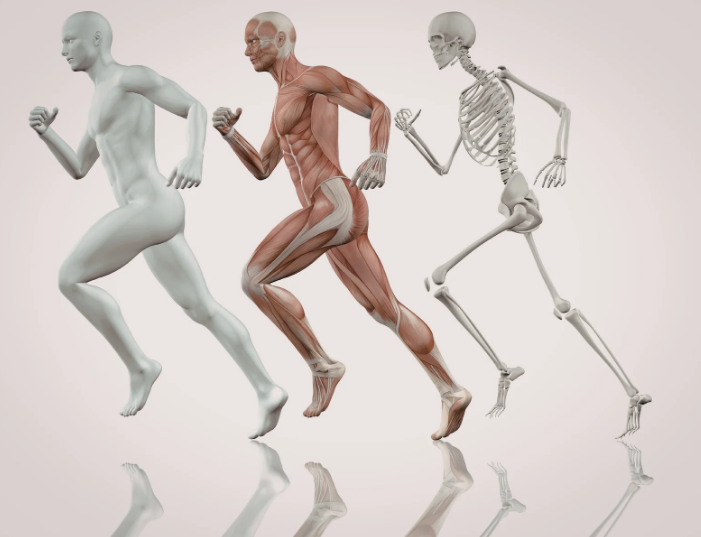
When people think about running, the first image that comes to mind is usually an activity that mainly involves the legs. In reality, the running movement is much more complex and activates a coordinated system of muscles that work together to generate propulsion, stability, and body control. Understanding which muscles are involved in running not only helps improve training but also explains why this activity has such a visible impact on physical fitness.
From a physiological perspective, running activates a complete muscular chain. With every step, muscle groups in the legs, the core, and even the upper body are involved. This synergy explains why running and the body are so closely connected: running does not only stimulate cardiovascular endurance but also produces muscular adaptations that, over time, help shape the body.
- The leg muscles activated during running
- The core muscles that stabilize running
- Upper body muscles involved in running
- Running and muscular strength
The leg muscles activated during running
The main work during running is obviously performed by the lower limbs. The leg muscles involved in running are responsible for propulsion, shock absorption, and the continuity of movement. Every step results from a coordinated sequence of muscle contractions that allow the body to move forward while maintaining balance and energy efficiency.
This activation does not involve just a single muscle but an entire kinetic chain. Quadriceps, glutes, and calves work together to generate strength and stability. It is precisely this cooperation between muscle groups that makes running a complete activity from a biomechanical perspective.
Quadriceps and control during the landing phase
The quadriceps are among the most engaged muscles in running. Located at the front of the thigh, their main role is to extend the knee and control the landing phase when the foot hits the ground. As the foot makes contact with the surface, the quadriceps stabilize the joint and absorb part of the impact.
This function becomes particularly important during long runs or downhill running, where eccentric load increases. Well-trained quadriceps therefore help improve movement stability and reduce the risk of joint overload.
Glutes and propulsion
The glute muscles are one of the main engines of running. The gluteus maximus is responsible for hip extension and generates a significant portion of the force that propels the body forward. When discussing running efficiency, athletes often refer to the ability to properly activate these muscles.
Effective glute activation improves stride power and helps distribute load more evenly across the joints. For this reason, many training programs include specific exercises aimed at strengthening this area, making the running motion more efficient.
Calves and elastic return during the stride
The calf muscles, mainly composed of the gastrocnemius and soleus, play a crucial role in the final phase of the stride. These muscles allow the foot to push off the ground and contribute to the elastic return of the movement.
During running, the calves store elastic energy when the foot contacts the ground and release it during the push-off phase. This mechanism improves movement efficiency and helps maintain a steady pace with reduced energy expenditure.
The core muscles that stabilize running
Often underestimated, the core muscles in running play a key role in stabilizing the movement. The abdominal and lower back muscles constantly work to keep the pelvis stable and ensure that the force produced by the legs is effectively transferred throughout the body.
Weak core muscles can compromise running technique and increase the risk of compensatory movements. For this reason, running coaches frequently emphasize the importance of building a strong and responsive core.
Abdominals and pelvic stability
The abdominal muscles help stabilize the pelvis during running. Every step generates forces that tend to rotate or tilt the torso, and the abdominals work continuously to maintain the body in a balanced position.
This stability improves movement efficiency and reduces energy dispersion. In other words, a strong core allows the legs to work more effectively and generate more powerful propulsion.
Lower back muscles and running posture
The lower back muscles contribute to maintaining a correct running posture. They support the spine and prevent the torso from collapsing forward or backward during movement.
Stable posture is not only an aesthetic factor; it directly affects running economy. When the torso is properly aligned, the body can better utilize the force generated by the legs and reduce stress on the joints.
Upper body muscles involved in running
Another often overlooked aspect of running is the involvement of the upper body. Although it does not directly generate propulsion, the muscles of the shoulders, arms, and back contribute to coordination and rhythm during the run.
Running and upper body muscles are connected through the swinging movement of the arms. This movement helps balance the body and makes the stride smoother and more efficient.
Shoulders and arms in running rhythm
The arms move alternately with the legs and help maintain the rhythm of the run. The shoulder muscles and biceps control this movement and stabilize the upper body.
When coordination between arms and legs is effective, the running motion becomes more natural and less energy-demanding. This is one reason why running technique training often includes exercises focused on shoulder mobility and arm control.
Back muscles and movement coordination
The back muscles act as a connection between the upper and lower body. They contribute to stabilizing the torso and coordinating overall movement.
An active back helps keep the chest open and promotes more effective breathing during running. This aspect also indirectly contributes to performance and endurance over time.
Running and muscular strength: what really happens to your muscles
A common question concerns the relationship between running and muscular strength. Running does not produce the same adaptations as weight training, but it still stimulates a specific type of strength related to muscular endurance.
Over time, muscles become more efficient at producing repeated force. This means they improve their ability to sustain prolonged effort while maintaining good movement quality even after many kilometers.
Muscular endurance and physiological adaptations
From a physiological perspective, running primarily stimulates muscle fibers that are resistant to fatigue. These fibers are designed to work for extended periods and efficiently utilize oxygen.
Consistent training improves the oxidative capacity of muscles and increases metabolic efficiency. In practice, the body learns to use available energy more effectively during activity.
How running shapes the body over time
Over the long term, running contributes to developing a leaner and more functional physique. Muscles become more toned, metabolism improves, and body composition tends to shift toward a higher percentage of lean mass.
This explains why many people notice visible changes in their bodies after months of regular training. Understanding which muscles work during running helps interpret these changes and use running as a tool to improve physical fitness and performance.
Comments (0)