
Trolley
You have no items in your shopping cart

 Budgets
 Dumbers
 Discs
Discs
 Benches
 Racks and Rigs
 Weights Holders
 Isotonic machines
 Calisthenics
 Cardio
 Kettlebells
 Flooring
 Gym Set
 Accessories
 Combat
 ARTI MARZIALI
 CONTAINER GYM
 Tug-Of-War
 Used Gym Equipment
 PILATES MACCHINARI
 GINNASTICA ARTISTICA
 CAMPI DA PADEL
 Prodotti in Pronta Consegna
 Informazioni
 IRONMAN
 Gift Card
- Donatif
- General information
- 0 I like it
- 1400 Views
- 0 comments
- stress reduction, improved self-esteem, physical and mental well-being, gym training
READING TIME: 4 MINUTES ➤➤
The functional recovery of the shoulder represents one of the most complex challenges in musculoskeletal rehabilitation, especially when the goal is to prevent relapses and ensure a safe return to sports or daily activities. In this context, the use of low-impact isotonic machines proves to be an extremely effective solution for combining muscle isolation and joint protection.
Modern technologies applied to medical fitness, such as the RFA series, allow precise work on the involved muscle groups, offering full control of movement and significantly reducing the risk of execution errors. This approach is particularly suitable for physiotherapists and injured athletes in recovery, where every detail can make the difference between complete healing and a new injury.
- The role of machines in shoulder rehabilitation
- Why choose isotonic machines for the rotator cuff
- Rehabilitation lat machine: correct use
- Medical shoulder press and chest machines
- A complete strategy to prevent relapses
The role of machines in shoulder rehabilitation
Shoulder rehabilitation machines are designed to guide movement along biomechanically correct paths, minimizing stress on joint structures. This is especially important in the early stages of recovery, when stability is still compromised and the risk of compensatory movements is high.
Using dedicated equipment also allows for progressive and controlled training, adapting the load to the patient’s actual capabilities. This makes it possible to stimulate muscles without overloading the joint, creating the ideal conditions for effective and long-lasting recovery.
Muscle isolation and movement control
One of the main advantages of isotonic machines is the ability to achieve precise muscle isolation. This means activating specific muscle groups without excessively involving surrounding structures, reducing the risk of compensatory movements.
Movement control is equally important: machines guide execution, ensuring proper muscle activation even in individuals with reduced proprioception or impaired coordination. This aspect is crucial for a complete and safe recovery.
Joint protection in rehabilitation protocols
Joint protection is a key element in shoulder rehabilitation. Machines reduce shear and compressive forces, allowing safe training even in the presence of inflammation or recent injuries.
Additionally, the ability to limit the range of motion helps avoid critical positions, protecting delicate structures such as the rotator cuff and associated tendons.
Why choose isotonic machines for the rotator cuff
Isotonic machines are a strategic choice for rotator cuff recovery, thanks to their ability to provide constant and controlled resistance throughout the entire movement.
This type of equipment allows safe training of deep and stabilizing muscles, which are often difficult to activate correctly with bodyweight or free weight exercises.
Advantages over free exercises
Unlike traditional exercises, machines reduce the need for active stabilization, allowing the patient to focus exclusively on correct movement execution. This translates into greater effectiveness in muscle work.
Moreover, the ability to precisely adjust the load makes machines ideal for a progressive approach, which is essential in rehabilitation.
Reduced risk of compensations
Compensatory movements are one of the main obstacles to full recovery. Guided machines help prevent them by keeping movement within safe and controlled parameters.
This is particularly important to avoid overload on other joints and reduce the risk of developing new issues.
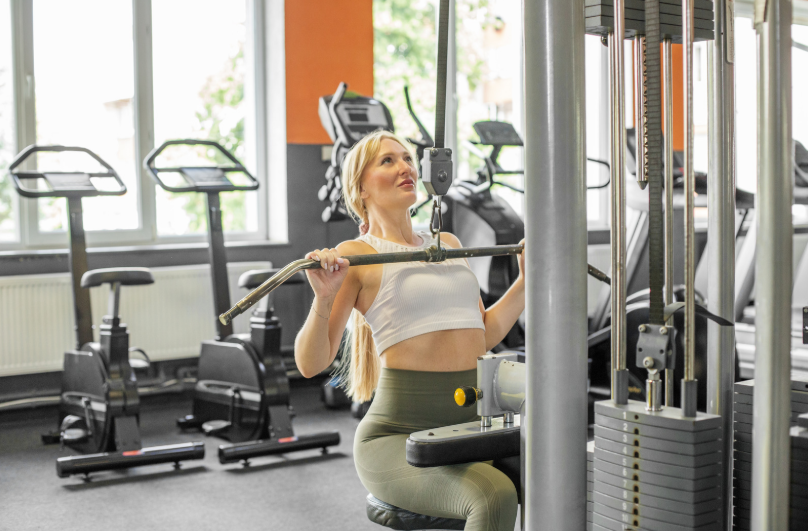
Rehabilitation lat machine: correct use
The rehabilitation lat machine is an extremely useful tool for shoulder recovery, as it allows you to work on the back muscles without excessively stressing the joint.
When used correctly, it helps improve scapular stability and supports the functional recovery of the entire upper limb.
Controlled activation of the back muscles
Proper use of the lat machine involves slow and controlled movements, with particular attention to the eccentric phase. This promotes optimal muscle activation and reduces the risk of injury.
Maintaining correct posture during execution is essential, avoiding compensations in the lumbar or cervical regions.
Mistakes to avoid during execution
Common mistakes include using excessive loads and performing movements too quickly, which can compromise exercise effectiveness and increase the risk of injury.
Another frequent error is losing control during the return phase, which can create unnecessary stress on the joint.
Medical shoulder press and chest machines
The medical shoulder press and chest machines are essential tools for progressive shoulder strengthening, especially in the advanced stages of rehabilitation.
These machines allow safe training while maintaining high control over movement and adapting intensity to the patient’s specific needs.
Stabilization and progressive strengthening
Stabilization is a key component of functional recovery. Machines enable gradual strength development, improving tissue resilience and neuromuscular coordination.
This approach reduces the risk of overload and promotes complete and long-lasting recovery.
Load and range of motion adjustment
The ability to adjust both load and range of motion allows training to be tailored to the patient’s condition.
This is particularly useful to avoid excessive stress and ensure effective yet safe training.
A complete strategy to prevent relapses in shoulder rehabilitation
An effective rehabilitation strategy must include not only targeted exercises but also careful management of loads and recovery times. The goal is to prevent relapses and ensure stable long-term recovery.
The use of isotonic machines plays a central role in this process, thanks to their ability to provide safety and precision.
Load progression and monitoring
Progression must be gradual and continuously monitored, adapting the program to the patient’s responses. This helps avoid overload and optimize results.
Continuous monitoring is essential to identify signs of fatigue or stress and intervene promptly.
Integration with other therapeutic protocols
To achieve optimal results, it is important to integrate machine-based training with other rehabilitation techniques, such as manual therapy and proprioceptive exercises.
This synergy allows all aspects of recovery to be addressed, improving functionality and significantly reducing the risk of recurrence.
Comments (0)