
Trolley
You have no items in your shopping cart

 Budgets
 Dumbers
 Discs
Discs
 Benches
 Racks and Rigs
 Weights Holders
 Isotonic machines
 Calisthenics
 Cardio
 Kettlebells
 Flooring
 Gym Set
 Accessories
 Combat
 ARTI MARZIALI
 CONTAINER GYM
 Tug-Of-War
 Used Gym Equipment
 PILATES MACCHINARI
 GINNASTICA ARTISTICA
 CAMPI DA PADEL
 Prodotti in Pronta Consegna
 Informazioni
 IRONMAN
 Gift Card
- Donatif
- General information
- 0 I like it
- 1181 Views
- 0 comments
- gym flooring, safety flooring, gym safety, shock-absorbing materials
READING TIME: 5 MINUTES ➤➤
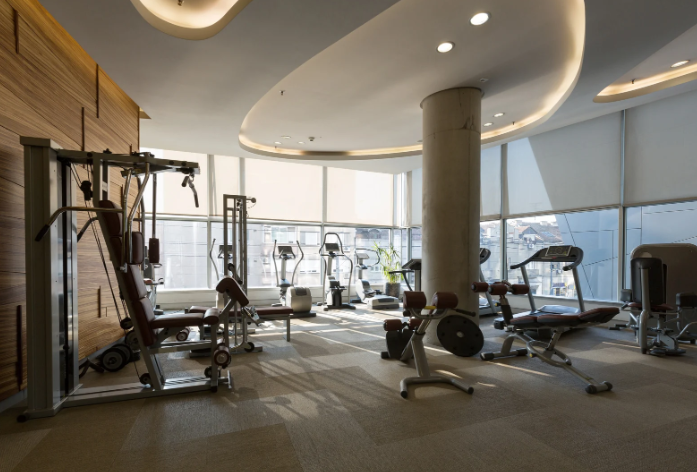
Condo Gym: Is Refurbished Equipment Really a Risk or a Resource?
Within a condominium gym, choosing equipment is never a neutral decision. It’s not just about budget or available space, but about a delicate balance between perceived quality, user expectations, and management responsibility. In this context, the topic of refurbished equipment often triggers an instinctive reaction: distrust. It is seen as a possible compromise, something that could expose the project to criticism or issues.
However, this view does not always reflect reality. When analyzed carefully, refurbished equipment can shift from a perceived risk to a concrete resource, especially in shared environments where usage is distributed and less intensive than in commercial gyms. The key lies in understanding when it makes sense to adopt it and when it is better to avoid it.
- Why refurbished equipment creates distrust
- New vs refurbished
- When refurbished works
- Real limits
- Making an informed choice
Why refurbished equipment creates distrust in shared spaces
In a condominium setting, perception matters as much—if not more—than technical reality. Refurbished equipment carries a cultural stigma: it is often associated with something used, less safe, or less reliable. This is especially true when users lack the tools to properly evaluate the real quality of the equipment.
As a result, even a perfectly overhauled machine may be perceived as inferior simply because it is not new. In a shared space, where decisions must be justifiable, this perception becomes a critical factor that can influence overall acceptance of the project.
The weight of perception in perceived quality
In a shared environment, quality is not only technical but also symbolic. New equipment communicates care, investment, and attention, while refurbished equipment requires a more structured narrative to be understood and accepted. This does not mean it is the wrong choice, but it must be managed with greater awareness.
The real risk is not technical but relational: a choice perceived as “cost-saving” can create resistance even when it is rationally valid. This is where the ability to provide context and explanation becomes essential.
The fear of condominium disputes
Those managing a condo gym often fear that refurbished equipment could become a source of friction. In the event of malfunctions or issues, responsibility is easily attributed to the initial choice, reinforcing the idea that new equipment would have been the safer option.
This concern is understandable but should be put into perspective: not all equipment carries the same level of risk, and not every situation requires premium solutions. The key is to avoid generalizations.
New vs refurbished: what really changes in a condominium context
The comparison between new and refurbished equipment must be grounded in practical terms. New equipment offers maximum predictability, full warranties, and no usage history. Refurbished equipment, on the other hand, introduces a variable: its past. However, this does not automatically mean lower quality.
In a condominium gym, where usage is generally lighter and more distributed, this difference may have far less impact than in high-intensity professional environments.
Concrete differences between new and refurbished equipment
The real differences mainly concern remaining lifespan, warranty coverage, and aesthetic perception. From a functional standpoint, properly refurbished equipment can deliver performance comparable to new machines, especially for non-intensive use.
The key point is understanding that value is not absolute but contextual. In a condominium, the goal is not peak performance but a balance between cost, functionality, and reliability.
The role of usage intensity in decision-making
Usage intensity is one of the most underestimated factors. In a condominium gym, usage tends to be intermittent rather than continuous. This makes refurbished equipment far more sustainable than it might initially seem.
Where machines are not under constant stress, even equipment with a prior usage history can ensure adequate longevity without compromising the user experience.
When refurbished equipment stops being a risk
Refurbished equipment stops being a risk when it is selected carefully. Not all categories of equipment are equally suitable, and ignoring this distinction is the most common mistake.
There are areas where refurbished equipment is not only acceptable but also strategically advantageous, particularly in terms of budget optimization.
The most suitable equipment categories
Equipment less subject to critical wear or heavy mechanical stress is the most suitable. In these cases, refurbished options maintain good reliability over time and significantly reduce perceived risk.
Selection should follow a functional logic, rather than a generalized approach that treats all equipment the same.
Cardio and light machines: why they work better
Refurbished cardio equipment and light multifunction machines are concrete examples of defensible choices. These types of equipment have more predictable usage patterns and structures better suited to refurbishment.
In a condominium setting, these solutions allow for variety and functionality without excessive risk, maintaining a solid balance between cost and perception.
The real limits of refurbished equipment in shared gyms
Not all refurbished equipment is suitable. Ignoring its limits means exposing yourself to real—not just perceived—problems. Some categories, especially those subject to high mechanical stress, may prove less reliable over time.
Recognizing these critical areas is essential to avoid mistakes that could compromise the entire project.
Where refurbished equipment can create issues
High-intensity equipment or machines with components prone to rapid wear are less suitable. In these cases, the risk of breakdown increases and may result in service disruptions that are difficult to manage in a shared environment.
The wrong choice is not refurbished equipment itself, but its use in the wrong context.
Maintenance and long-term management
Another critical aspect is maintenance. Refurbished equipment requires slightly more attention, especially in the initial phase. However, in a well-managed condominium environment, this does not necessarily represent an obstacle.
Conscious management allows potential issues to be kept under control, preventing them from becoming structural problems.
How to make refurbished equipment a defensible choice
The difference between risk and resource lies in the ability to justify the choice. Carefully selected refurbished equipment, used in the right categories and supported by clear communication, can become a fully sustainable solution.
This is not about persuading, but about making the decision-making process transparent, reducing uncertainty and increasing trust.
Practical selection criteria
The criteria should be simple yet rigorous: equipment category, expected usage intensity, and refurbishment quality. This approach turns a seemingly risky choice into a rational and controlled decision.
Selectivity is the real strength: not everything, only what makes sense.
Communication and trust management
Finally, communication plays a fundamental role. Explaining why refurbished equipment was chosen, in which areas, and based on which criteria reduces distrust and strengthens the perception of control.
In this way, refurbished equipment is no longer seen as a compromise but becomes a conscious choice, aligned with the real needs of a condominium gym.
Comments (0)