
Trolley
You have no items in your shopping cart

 Budgets
 Dumbers
 Discs
Discs
 Benches
 Racks and Rigs
 Weights Holders
 Isotonic machines
 Calisthenics
 Cardio
 Kettlebells
 Flooring
 Gym Set
 Accessories
 Combat
 ARTI MARZIALI
 CONTAINER GYM
 Tug-Of-War
 Used Gym Equipment
 PILATES MACCHINARI
 GINNASTICA ARTISTICA
 CAMPI DA PADEL
 Prodotti in Pronta Consegna
 Informazioni
 IRONMAN
 Gift Card
- Donatif
- General information
- 0 I like it
- 2536 Views
- 0 comments
- stress reduction, improved self-esteem, physical and mental well-being, gym training
READING TIME: 5 MINUTES ➤➤
Training on an unsuitable surface changes more things than it may seem. In streetlifting, performance does not depend only on the bar, parallel bars, or added weight: contact with the ground also plays a role in the quality of execution. When the floor slips, bounces, or disperses stability, the movement loses precision and the body begins to compensate in inefficient ways.
The term streetlifting flooring refers to a base designed to support technical exercises and progressive loads without compromising grip, posture, and comfort. For those who train in a home gym, are over 35, or share spaces with others, choosing the right rubber training mat means creating an environment that is more organized, safer, and more consistent with the way they train.
Why streetlifting flooring affects movement quality
Grip and force transmission in weighted movements
Grip training is not only about hands and grip strength. The relationship between footwear and surface also matters in force transmission, especially when an exercise requires constant tension and a stable position. In weighted dips, for example, a surface that is too smooth or too soft alters the perception of support and reduces safety during the start, pause, and upward phase.
A technical training surface works differently. It provides controlled traction, limits foot movement, and gives a more solid feeling under load. This alone does not transform the movement, but it helps make it more repeatable. For those seeking precision, the floor stops being just a covering and becomes an active part of the stabilization chain.
Base stability and technical consistency between repetitions
In streetlifting, the quality of a set also depends on what happens between repetitions. If the surface compresses too much or responds inconsistently, the athlete tends to adjust posture, weight distribution, and core tension. These adjustments may be small, but over time they make the movement less efficient and less fluid.
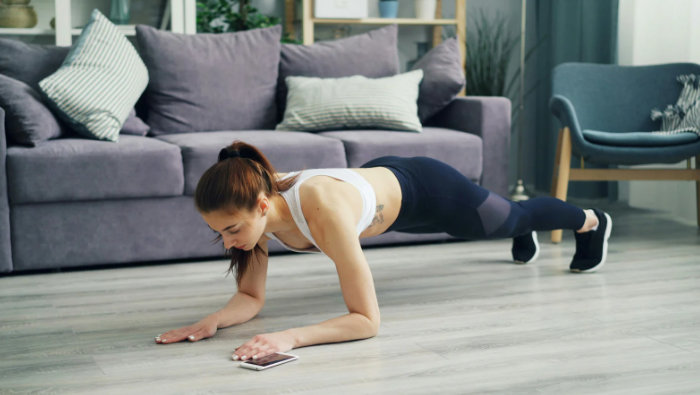
A good home gym floor must provide consistent stability, not generic softness. The difference becomes noticeable especially during weighted exercises and isometric holds such as a weighted plank. When the base is uniform, the body receives clearer feedback, reduces unnecessary compensations, and maintains a more reliable relationship with the equipment used every day.
When the wrong surface compromises safety and comfort
Slipping, compression, and micro-instability under load
An unsuitable surface does not always cause an obvious mistake. More often it introduces small instabilities that gradually worsen the training experience. This becomes evident when the foot searches for traction, the support shifts slightly, or the rubber compresses excessively. The result is a less precise movement and a reduced sense of control.
Safety also means predictability of contact. A rubber gym mat designed for technical training helps limit slipping and excessive deformation. This aspect is important not only for those lifting heavy loads but also for people who train consistently. Even moderate volumes repeated over time require a reliable base to avoid turning every session into a constant process of adjustment.
Noise, vibrations, and impact in shared spaces
Anyone training in an apartment, a garage connected to the house, or a multifunctional room knows the issue well. Noise does not come only from direct impacts but also from vibrations transmitted through the underlying floor. A rigid, uncovered surface amplifies steps, drops, and movements, making training harder to manage in shared environments.
A streetlifting floor with good shock absorption helps reduce acoustic impact while protecting the existing surface. Here the bias of control and the optimized environment come into play: when the training area is quieter, more organized, and more stable, it becomes easier to integrate workouts into daily routines. The overall perception is greater comfort and fewer obstacles in everyday life.
How to choose a rubber mat suitable for streetlifting
Density, thickness, and rubber response
The term technical mat does not refer to a soft exercise pad, but to a surface with density and structure suitable for controlled movements and progressive loads. Three main factors should be considered: rubber density, thickness, and the ability to maintain a stable response over time. Rubber that is too soft may feel comfortable at first but is less suitable for movements that require precision.
Thickness should be evaluated according to the environment and the intended use. Greater thickness may improve insulation, but it does not always guarantee better movement quality. For streetlifting, balance is essential: enough material to reduce noise and protect the existing floor, but also a solid response that does not make the foot feel unstable. The key factor is the combination of stability, traction, and consistent support.
Format, installation, and compatibility with the home gym
The final result does not depend only on the material. Format and installation also play an important role. Tiles, rolls, or interlocking modules should create a uniform surface with stable joints and minimal risk of lifting. In a compact home gym, a well-defined training area improves visual order and makes the space dedicated to dips, pull-ups, and weighted bodyweight training easier to organize.
For those sharing the room with other household functions, the best solution is often the one that simplifies daily management. A home gym floor that is easy to clean, resistant to wear, and compatible with the available space prevents constant adjustments. In this context, true professionalism is not about aesthetics but about making the training space work reliably every time it is used.
The practical advantage of a surface designed for dips, pull-ups, and weighted plank
More organized, repeatable, and professional training
When the base is appropriate, the entire training session feels more consistent. Equipment remains more stable, foot placement becomes predictable, and the perception of the space changes. This is particularly relevant for people over 35, who often focus not only on performance but also on long-term movement sustainability. Training well also means reducing unnecessary distractions around the exercise.
A technical surface communicates professionalism because it organizes the environment and improves its practical use. There is no need to turn a home into a complex gym facility. It is enough to eliminate elements that make training uncertain: slipping, noise, floor wear, and perceived instability. In this sense, the mat becomes an intelligent simplification rather than an accessory.
Why the floor becomes part of the equipment
When it influences grip, acoustic insulation, and stability, the floor is no longer a neutral background. It becomes a functional component of training, just like a properly installed bar or a balanced weight. This is why talking about streetlifting flooring makes sense: it describes a base designed to support a specific type of movement and training frequency.
Choosing a training surface suitable for streetlifting helps protect technical execution and makes the environment easier to control. Dips, pull-ups, and weighted plank require consistency, not random compromises. When the floor responds properly, training becomes more stable, quieter, and easier to integrate into everyday routines. This is where a technical mat truly makes the difference.
Comments (0)