
Trolley
You have no items in your shopping cart

 Budgets
 Dumbers
 Discs
Discs
 Benches
 Racks and Rigs
 Weights Holders
 Isotonic machines
 Calisthenics
 Cardio
 Kettlebells
 Flooring
 Gym Set
 Accessories
 Combat
 ARTI MARZIALI
 CONTAINER GYM
 Tug-Of-War
 Used Gym Equipment
 PILATES MACCHINARI
 GINNASTICA ARTISTICA
 CAMPI DA PADEL
 Prodotti in Pronta Consegna
 Informazioni
 IRONMAN
 Gift Card
- Donatif
- Sports products
- 0 I like it
- 1756 Views
- 0 comments
- stress reduction, improved self-esteem, physical and mental well-being, gym training
READING TIME: 5 MINUTES ➤➤
What minimal equipment do you really need to work out at home if you want to lose weight
When it comes to working out at home, one of the most common beliefs is that you need a large amount of equipment to achieve real results. In reality, especially if your goal is weight loss, this idea is not only wrong, but it can also lead you to make unnecessary and unsustainable purchases over time. The real difference is not made by the tools, but by your ability to use them consistently.
Understanding what the minimum equipment truly needed is means protecting your investment, avoiding waste, and building an effective training system even in small spaces such as an apartment or a condo setting. This article is designed to provide clarity and help you move from an endless list of options to a setup that is essential, functional, and sustainable.
- Why the problem is not how much equipment you have but how you use it
- Essential equipment to lose weight at home
- Useful but not essential equipment
- Equipment you can postpone or avoid
- A practical example of a minimal home setup
- How to choose without wasting money
Why the problem is not how much equipment you have but how you use it
The first mistake to avoid is thinking that weight loss depends on the amount of equipment available. In reality, losing weight is mainly linked to consistency, calorie expenditure, and workout quality, not to an endless variety of tools. Having too much often leads to using less, while having the right tools leads to using them better.
Many people build a home gym based on initial enthusiasm, buying equipment that eventually goes unused. This happens because there is no clear sense of priority. To lose weight, the body needs simple but repeated stimuli: functional movements, cardiovascular work, and a minimum level of resistance. Everything else is secondary.
The myth of the fully equipped home gym
The idea of replicating a full gym at home is one of the main causes of wasted money. Not only does it require more space and a higher budget, but it also creates a psychological barrier: the more complex the setup, the harder it becomes to actually get started. A simple environment reduces friction and encourages action.
A minimal setup, on the other hand, allows you to focus on what truly matters: moving consistently. And it is precisely this simplicity that increases the likelihood of achieving real results over time.
Weight loss: what the body really needs
To lose weight, the body needs a combination of activities that include continuous movement, muscle activation, and progression. This does not require complex equipment, but rather versatile tools that can adapt to different exercises.
From this perspective, choosing equipment should meet three key criteria: ease of use, frequency of use, and the ability to cover multiple functions. If a piece of equipment does not meet these requirements, it is unlikely to be useful in the long term.
Essential equipment to lose weight at home
An effective minimal setup is based on a few elements, but chosen with intention. Essential tools are those that allow you to train consistently, without complications and without taking up too much space.
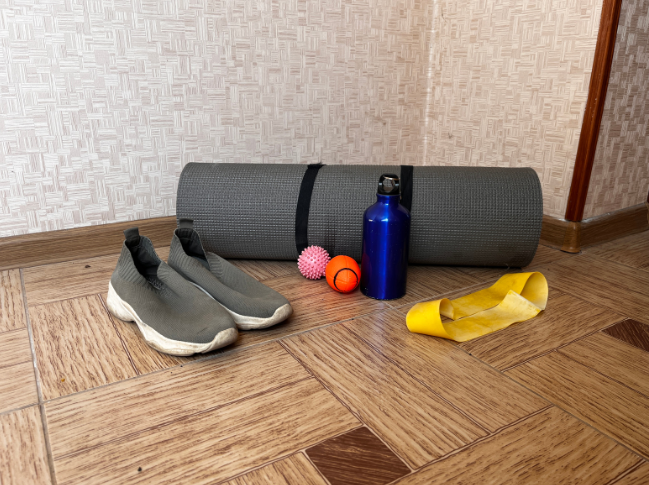
Among these, the exercise mat stands out as the foundation for any bodyweight workout, from core exercises to stretching. It is simple, affordable, and used in almost every session.
Tools you will actually use every week
Dumbbells, either light or adjustable, are another key element. They allow you to add resistance to your exercises and increase calorie burn, easily adapting to your fitness level. Their versatility makes them central to any program.
Resistance bands complete the setup. They take up very little space but offer a wide variety of exercises. They are ideal for those who want to train progressively without immediately investing in bulky equipment.
Why fewer tools increase consistency
Reducing the number of tools means reducing the number of decisions you have to make every time you train. This has a direct impact on consistency, which is the real driver of weight loss.
A simple environment makes training more mentally accessible. You don’t have to choose between ten options, you just need to start. And it is this immediacy that makes the difference in the long run.
Useful but not essential equipment
Once your training habit is established, you can consider adding complementary tools. These are not essential, but they can improve your experience and increase variety.
A compact exercise bike, for example, is a good option to include low-impact cardio, especially in condo environments where noise can be an issue.
When it makes sense to add it
These tools become useful when training is already a stable routine. Adding them too early risks turning them into unused items.
It is important that every new purchase responds to a real need, not a momentary impulse. Only in this way can you maintain consistency in your journey.
The risk of premature purchases
Buying too much and too soon often leads to the opposite effect: decision overload and loss of motivation. The more options you have, the less likely you are to take action.
For this reason, it is always better to start with the minimum and add only when necessary.
Equipment you can postpone or avoid
There are many pieces of equipment that seem useful but, in practice, do not significantly contribute to weight loss. They are often chosen for aesthetic reasons or imitation, rather than real utility.
Bulky or overly specific machines limit usage and reduce training flexibility. They also take up valuable space, especially in a home environment.
What seems useful but isn’t
Highly specialized or complex tools tend to be used less. This makes them an inefficient investment, especially for beginners.
Simplicity, once again, is a competitive advantage: fewer barriers, more action.
Common mistakes in fitness purchases
The most common mistake is buying based on enthusiasm rather than strategy. This leads to creating an inconsistent and ineffective setup.
A more rational approach, based on priorities and actual usage, allows you to build an effective system over time.
A practical example of a minimal home setup
A practical example of a minimal setup for home weight loss includes just a few well-chosen elements. The mat serves as the base, while dumbbells and resistance bands allow you to build complete workouts.
At a later stage, you can add a compact exercise bike to integrate cardiovascular work in a simple and sustainable way.
Basic setup for beginners
For beginners, this configuration is more than enough to achieve results. Nothing more is needed to start creating a calorie deficit and improving physical fitness.
The key is to use these tools consistently, building a simple but effective routine.
Adaptation for small spaces (condo living)
In condo settings, choosing compact and quiet equipment is essential. Resistance bands and dumbbells take up little space and do not create disturbance.
This makes it possible to train consistently even in limited environments, without compromising workout quality.
How to choose without wasting money
Choosing equipment should always follow a clear logic: function, space, and frequency of use. If a piece of equipment does not meet these criteria, it is likely not a good choice.
This approach helps you avoid impulsive purchases and build a setup that is consistent with your goals.
Priorities: function, space, frequency
Every piece of equipment should have a clear function and be used frequently. Otherwise, it simply becomes clutter.
Operational simplicity is a real advantage: less complexity means more action.
Build over time instead of buying everything at once
An effective setup is built over time, not in a single purchase. This allows you to adapt to your real needs and improve progressively.
Investing gradually is the best strategy to avoid waste and maintain control over your training journey.
Comments (0)