
Trolley
You have no items in your shopping cart

 Budgets
 Dumbers
 Discs
Discs
 Benches
 Racks and Rigs
 Weights Holders
 Isotonic machines
 Calisthenics
 Cardio
 Kettlebells
 Flooring
 Gym Set
 Accessories
 Combat
 ARTI MARZIALI
 CONTAINER GYM
 Tug-Of-War
 Used Gym Equipment
 PILATES MACCHINARI
 GINNASTICA ARTISTICA
 CAMPI DA PADEL
 Prodotti in Pronta Consegna
 Informazioni
 IRONMAN
 Gift Card
- Donatif
- Sports products
- 0 I like it
- 1687 Views
- 0 comments
- stress reduction, improved self-esteem, physical and mental well-being, gym training
READING TIME: 5 MINUTES ➤➤
Elliptical Trainer in an Apartment: Minimum Space Guide to Avoid Clutter
Home elliptical dimensions do not simply mean checking the measurement listed in the technical specifications. In an apartment, what really matters is understanding how much free space remains while the machine is being used, how much margin is needed to safely get on and off, and how the equipment coexists with sofas, tables, doors, and everyday walkways. This is exactly where the most common doubt arises: is a good elliptical trainer really too bulky for a normal living area?
In most cases, the answer is less dramatic than many people think. The real mistake is not buying an elliptical trainer, but evaluating it only as a static object placed on the floor. A well-designed model, with balanced proportions and a compact structure, can integrate neatly into a home environment—especially when the evaluation starts from a technical reading of real measurements rather than a vague perception of bulk. The myth that an entire room is required often comes from inaccurate planning.
How much space an elliptical trainer really needs at home
Why the declared dimensions do not match the real usage area
Elliptical trainer space requirements are a broader concept than the simple base footprint. Commercial specifications indicate the machine’s length, width, and height, but they do not describe everything that happens during movement. The user steps onto the pedals, holds the moving arms, extends their stride, and moves in a continuous trajectory. For this reason, the area that truly needs to be considered is always larger than the machine’s perimeter.
A useful analysis distinguishes between structural footprint and functional space. The first helps determine whether the equipment physically fits inside the room. The second determines whether the machine can actually be used without hitting furniture or creating a crowded feeling. In a well-organized apartment, the difference between a good choice and a poor one often comes down to these details rather than a few centimeters on paper.
The difference between static footprint and perceived space
Compact elliptical dimensions and perceived bulk are not always the same. A piece of equipment may be relatively short but appear intrusive if positioned along the main walkway or directly in front of a window. Conversely, a slightly larger machine may appear more discreet when properly oriented and placed in an area with sufficient visual depth.
People who use their living room as a mixed space for relaxation and training must also evaluate visual impact. The perception of order changes when the sides of the machine remain free, when the main passageway is uninterrupted, and when the elliptical does not occupy the geometric center of the room. In practice, bulk is greatly reduced when the placement follows domestic logic rather than purely athletic considerations.
How to calculate the minimum space without sacrificing your living area
Side, front, and rear clearances to consider
To properly evaluate home elliptical dimensions, it is better to think in terms of an operational area rather than a single technical rectangle. You need lateral space for elbows and mounting, front clearance to avoid a sense of confinement, and rear space to allow the body’s movement trajectory to breathe. This is not merely a visual guideline—it is a matter of comfort and safety.
In many apartments, a simple approach works well: measure the base of the machine and add a realistic usage margin around it. This quickly shows whether the elliptical will remain functional or become an object people constantly walk around. When discussing minimum space, the goal is not to fill all available room but to preserve a clear area that keeps movement around the equipment fluid.
Walkways, openings, and furniture: the constraints that shape the layout
An elliptical trainer in an apartment means dealing with doors, tables, cabinets, rugs, radiators, and light points. These elements are often overlooked but influence usability more than total square footage. A room that appears large may still be unsuitable if the only available wall coincides with a door swing, a mandatory corridor, or a deep piece of furniture that closes the visual perspective.
For this reason, it is better to start from fixed constraints and only then evaluate the equipment model. First identify the point where the machine can exist without interrupting the daily routine; then choose an elliptical consistent with that space. This reversed perspective reduces purchasing risk and helps interpret compact models more clearly, including those designed for advanced home gym environments.
Compact elliptical trainers and professional structure can coexist
When a compact model is the right choice
A compact professional elliptical trainer is not a contradiction, provided that compactness is not achieved by sacrificing stability, fluidity, or build quality. For advanced home gym users, reduced dimensions make sense when they simplify placement without turning the workout into a compromise. The structure must remain solid, the movement smooth, and the support stable.
In a living room with limited space, the main advantage of a compact model is not only reduced size. It also allows easier placement along a wall, in a study, or within a hybrid training area without altering the language of the furniture. Here practicality becomes a real advantage: less visual clutter, fewer interruptions to daily life, and a greater likelihood that the equipment will actually be used consistently.
What to look for in a compact professional elliptical
When evaluating a compact machine, the technical sheet should always be read together with the structural design logic. A short structure that lacks stability rarely provides a satisfying result. On the other hand, a well-proportioned model with a robust frame and balanced geometry can feel far more professional even in limited spaces. The real question is not just “how big it is,” but how the dimensions are distributed.
This is why it is useful to observe the relationship between the base, pedal position, overall height, and arm movement structure. A well-engineered design concentrates bulk where it is necessary while keeping the surrounding area visually clean. When choosing compact Donatif models, the key criterion is exactly this: verifying whether the reduction in size is supported by a structure designed for serious, stable use within an advanced home environment.
How to read technical specifications without mistakes
Base length, stride, height, and stability
A technical sheet should never be read superficially. The base length indicates how much floor space the frame occupies, but on its own it does not predict the real user experience. Width also affects freedom of movement, while height must be compared with ceiling clearance and the user’s position during elliptical motion. In low or heavily furnished interiors, this verification becomes essential.
Another decisive element is perceived stride quality, meaning how naturally the movement develops. There is no need to enter complex technicalities: a good elliptical distributes motion naturally without requiring disproportionate space. In this perspective, base stability remains a key indicator. A balanced machine integrates more easily into the room because it operates without unnecessary oscillations or a sense of instability.
Why the usage position matters more than simple placement
Real dimensions of a professional elliptical also mean imagining the machine while a real person is using it. The distance from the wall, for instance, should not be defined only to avoid contact with the frame, but to leave breathing space for the movement and allow comfortable mounting. The same applies to the side from which the user accesses the machine and the direction of their view within the room.
Many mistakes arise from a purely geometric approach. The machine fits, so everything seems fine. Later, however, people realize that the path to the balcony is uncomfortable, that nearby furniture restricts access, or that the room constantly feels occupied. The usage position—more than the simple placement point—is what determines whether an elliptical trainer truly fits inside an apartment.
Where to place an elliptical trainer in an apartment to reduce visual impact
Living room, study, and home gym area: practical differences
There is no single placement that works for everyone. In a living room the main objective is reducing visual impact, so the elliptical is usually positioned along a side area rather than in the center of a walkway. In a study, continuity of use matters more because the room tolerates a technical presence more easily. In a small home gym zone, functionality can take priority as long as movement around the equipment remains simple.
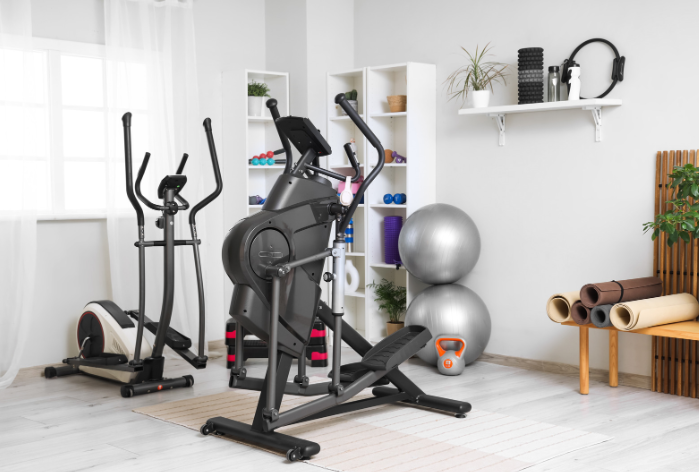
Where to place an elliptical trainer at home also depends on lighting, electrical outlets, ventilation, and perceived noise. A machine positioned near a free wall integrates better into the visual structure of the room. It does not look “parked” but integrated. This improves the daily quality of the environment and helps maintain a clear sense of order even when available space is limited.
How to integrate the machine with furniture without a gym-like effect
The fear of turning a living room into a gym usually comes from poor layout rather than from the equipment itself. To reduce visual impact, it helps to avoid unnecessary diagonal placements, keep walkways clear, and maintain coherence between the machine and the main furniture pieces. An orderly composition communicates control, while a random placement immediately amplifies the sense of clutter.
When the elliptical interacts harmoniously with the proportions of the room, the overall environment remains balanced. This is where spatial visualization becomes crucial: it is not only about measuring but also about imagining volumes, access paths, and perspectives. A compact model placed with precision can coexist with the living area without disrupting its function. In other words, the equipment stops being an obstacle and becomes an orderly technical presence within a lived-in home.
The myth of bulk: why you don’t need an entire room
Good planning is worth more than a few centimeters less
The most common belief is that a good elliptical trainer requires a dedicated room. In reality, what most homes need is simply better planning. Measuring the available wall space, considering usage margins, and selecting a machine consistent with the environment solves far more problems than obsessively searching for the smallest possible model. Compactness alone is not enough.
Risk reduction means exactly this: avoiding purchases driven by fear of bulk and replacing them with a clearer technical evaluation. When the operational area is designed properly, even high-quality equipment can coexist with a living room without compromising domestic comfort. The mistake is not placing an elliptical in an apartment—the mistake is doing so without a clear spatial strategy.
How to evaluate compact Donatif models more consciously
For those seeking a serious solution that still integrates well into a home environment, the most useful step is comparing the technical sheet with the actual room. Compact Donatif models should be read from this perspective: not as shortcuts, but as design responses to domestic spaces that require balance, order, and structural solidity. Their value lies in combining credible structure with more manageable presence.
An advanced home gym user does not simply look for a machine that fits inside a room. They want equipment that allows consistent training, harmony with the surrounding furniture, and a lasting perception of quality. For this reason, the real question is not “how much space it occupies,” but “how much space it truly needs to be used well.” Starting from this perspective makes the choice easier and removes the sense that bulk is an unavoidable obstacle.
Comments (0)