
Trolley
You have no items in your shopping cart

 Budgets
 Dumbers
 Discs
Discs
 Benches
 Racks and Rigs
 Weights Holders
 Isotonic machines
 Calisthenics
 Cardio
 Kettlebells
 Flooring
 Gym Set
 Accessories
 Combat
 ARTI MARZIALI
 CONTAINER GYM
 Tug-Of-War
 Used Gym Equipment
 PILATES MACCHINARI
 GINNASTICA ARTISTICA
 CAMPI DA PADEL
 Prodotti in Pronta Consegna
 Informazioni
 IRONMAN
 Gift Card
- Donatif
- Sports products
- 0 I like it
- 2084 Views
- 0 comments
- stress reduction, improved self-esteem, physical and mental well-being, gym training
READING TIME: 5 MINUTES ➤➤
Formats, modules and layering: how to set up a coherent technical installation
In the context of professional sports flooring, the choice of format cannot be reduced to a simple aesthetic consideration. Every decision related to modules, rolls or interlocking tile systems directly impacts the technical performance, durability and safety of the facility. For installers and designers, this means approaching installation as a truly engineered system.
An effective design requires the ability to connect format, layering and subfloor, avoiding errors that could compromise the functionality of the entire fitness space. It is within this framework that a coherent technical installation is developed, ensuring operational continuity and risk reduction over time.
- Format and performance
- System layering
- Subfloor compatibility
- Format and intended use
- Informed technical choice
Format is not just aesthetics: why it affects flooring performance
In the fitness sector, the idea that the flooring format is a secondary choice, mainly linked to visual impact, is still widespread. In reality, each format introduces technical variables that influence stability, load distribution and the system’s elastic response. Ignoring this aspect means exposing the project to operational issues even in the short term.
The selection of the format must therefore start from a concrete evaluation of functional requirements. Only through a technical approach is it possible to ensure a surface that responds consistently to the stresses typical of a professional sports environment.
Technical differences between modules, rolls and puzzle systems
Roll flooring provides surface continuity and is ideal for large areas where minimizing joints is essential. On the other hand, modular systems offer greater flexibility in installation and maintenance, allowing targeted interventions without affecting the entire surface.
Puzzle formats introduce an additional level of adaptability, making them particularly suitable for temporary or multifunctional environments. However, they require careful evaluation of long-term stability, especially under heavy loads or high traffic conditions.
Relationship between format and actual space usage
Each fitness environment has specific operational characteristics that must be considered when choosing the format. Areas dedicated to weightlifting, functional training or cardio require different technical responses, which directly affect the flooring configuration.
A conscious design approach takes these variables into account, avoiding standardized solutions and instead favoring a context-based format selection capable of ensuring performance and safety over time.
Sports flooring layering: how to build a coherent system
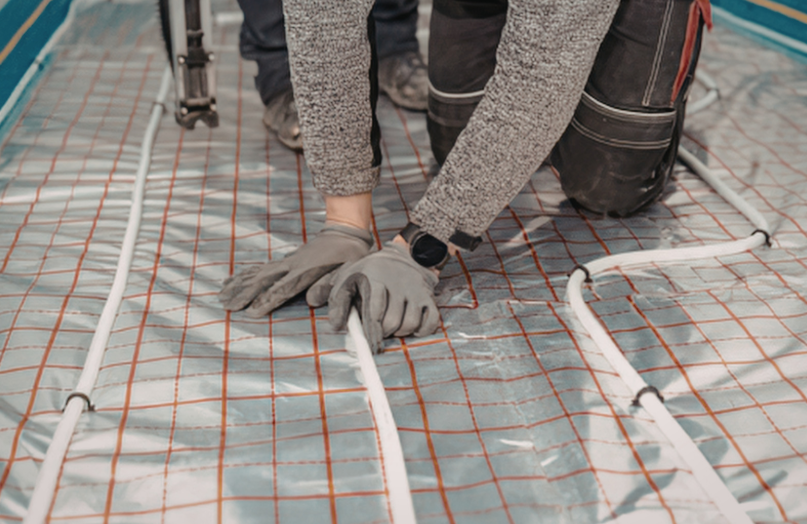
The layering of sports flooring represents the set of layers that make up the system, each with a specific function. It is not simply about stacking materials, but about building a structure capable of working as an integrated whole.
Each layer contributes to overall stability, impact absorption and long-term resistance. An incorrect layering design can compromise even the best surface material.
Functional layers and their technical role
The flooring system may include elements such as a vapor barrier, resilient layer and finishing surface. Each of these components must be selected based on environmental conditions and expected stresses.
The correct combination of layers makes it possible to achieve a high-performance system, capable of ensuring comfort, safety and durability even in high-intensity environments.
Continuity, stability and system durability
A well-designed system ensures continuity between elements and reduces the risk of failures or deformations. This is particularly important in sports flooring, where technical precision is essential.
Durability depends not only on material quality but also on the coherence of the entire system. Proper layering therefore represents an investment in operational continuity and reduced maintenance costs.
Subfloor compatibility: the critical point in design
The compatibility between flooring and subfloor is one of the most critical aspects in design. An unsuitable base can compromise system stability, leading to problems from the very first stages of use.
For this reason, it is essential to carefully analyze the characteristics of the substrate before installation, evaluating flatness, moisture and mechanical resistance.
Types of subfloors and technical implications
Installation on a traditional screed requires different checks compared to an existing floor. Each substrate presents specific issues that must be addressed through appropriate technical solutions.
A thorough assessment of the base helps prevent problems such as detachment, deformation or premature wear, ensuring a solid foundation for the entire system.
Common mistakes in substrate evaluation
One of the most frequent mistakes is underestimating subfloor conditions. Installation is often carried out without proper checks, increasing the risk of subsequent corrective interventions.
A professional approach instead requires accurate inspections and, when necessary, subfloor preparation work, which is essential to ensure effective and long-lasting installation.
Format and intended use: how to choose from a design perspective
The choice of format must be guided by the intended use of the fitness space. There is no universal solution, but rather configurations that respond to specific needs.
A careful analysis of the context makes it possible to identify the most suitable format, optimizing technical performance and reducing operational risks.
Fitness environments and different load conditions
Weightlifting areas require flooring with high load resistance, while cardio zones prioritize comfort and surface continuity.
These differences clearly show how format selection must always be based on technical evaluation, avoiding generic or standardized approaches.
Application scenarios and choosing the right format
Each application scenario presents specific variables that influence format selection. The ability to correctly interpret these variables is a key skill for designers.
A coherent choice allows for a high-performance system, minimizing issues related to daily use.
From superficial choice to informed technical design
Moving from a superficial approach to an informed technical design means reducing the margin of error and increasing control over the final result. This approach is essential in professional contexts, where every detail impacts service quality.
The ability to integrate format, layering and subfloor compatibility is a key factor in ensuring safety and operational continuity.
Operational and maintenance risks
An incorrect choice can lead to installation issues, premature wear or maintenance difficulties. These aspects have a direct impact on costs and facility management.
Preventing such issues through accurate design is essential to avoid corrective interventions and ensure consistent performance over time.
Advantages of a coherent and controlled installation
A well-designed technical installation offers significant advantages in terms of stability, safety and durability. This results in greater reliability of the facility and a better experience for the end user.
Investing in a coherent design therefore means building the foundation for an efficient system, capable of meeting the needs of the fitness sector in a structured and professional way.
Comments (0)