
Trolley
You have no items in your shopping cart

 Budgets
 Dumbers
 Discs
Discs
 Benches
 Racks and Rigs
 Weights Holders
 Isotonic machines
 Calisthenics
 Cardio
 Kettlebells
 Flooring
 Gym Set
 Accessories
 Combat
 ARTI MARZIALI
 CONTAINER GYM
 Tug-Of-War
 Used Gym Equipment
 PILATES MACCHINARI
 GINNASTICA ARTISTICA
 CAMPI DA PADEL
 Prodotti in Pronta Consegna
 Informazioni
 IRONMAN
 Gift Card
- Donatif
- Sports products
- 0 I like it
- 2171 Views
- 0 comments
- stress reduction, improved self-esteem, physical and mental well-being, gym training
READING TIME: 5 MINUTES ➤➤
Post-ACL Exercises: Why Leg Extension Is Not a Taboo
In the recovery process following an anterior cruciate ligament reconstruction, few exercises are as controversial as the Leg Extension. For many years, it has been portrayed as a movement to avoid almost entirely, especially in the early stages of strength training, because it was automatically considered dangerous for the knee. In reality, the issue is far more nuanced: the problem is not the exercise itself, but how it is dosed, at which stage of recovery it is introduced, and how well load is controlled during execution.
For an advanced athlete training in a home gym or for those managing a fitness facility, this shift in perspective is crucial. The Leg Extension should not be seen as a taboo, but rather as a tool to be used with awareness within a well-structured progression. The latest evidence and clinical guidelines show that open kinetic chain work can play an important role in post-operative quadriceps strengthening, provided that timing, range, and intensity are properly managed.
- Why Leg Extension has been demonized for years
- What the literature really says about open chain training
- When Leg Extension can be introduced without becoming a risk
- Proper execution: setup, range of motion, and load management
- Knee stability and quadriceps strength: the real focus
- The role of machine ergonomics in safer, more controlled training
Why Leg Extension has been demonized for years
The distrust toward the Leg Extension comes from a real biomechanical consideration, but one that has often been oversimplified. In the final portion of knee extension, especially between approximately 40 and 0 degrees, the quadriceps significantly increases its force demand. This can result in greater anterior tibial translation and increased stress on the ACL or graft during the post-surgical phase. The same concern applies when the load is too high, when the movement is performed aggressively, or when the patient enters a less favorable range too early without adequate joint tolerance.
The critical point, however, is not that the Leg Extension is “forbidden,” but that it has long been taken out of context. In many environments, the idea spread that any open kinetic chain work was inferior or inherently harmful compared to closed chain exercises. This created a false dichotomy, as if squats, leg press, and lunges were always sufficient on their own. In reality, completely removing targeted knee extension work can delay recovery of the quadriceps, which remains one of the most important factors for function, symmetry, and return to performance.
What the literature really says about open chain training
Aspetar guidelines for ACL rehabilitation indicate that open chain work can be introduced within a limited range of motion, typically between 90° and 45° of knee flexion, starting from the fourth week, without compromising knee stability, provided anterior knee pain and load progression are carefully monitored. These recommendations also highlight that combining closed and open chain exercises can lead to better quadriceps strength recovery and an earlier return to sport, without increasing joint laxity compared to closed chain training alone.
Even clinical literature that takes a cautious approach to Leg Extension does not conclude that it should be eliminated. On the contrary, it emphasizes that the exercise can be used safely when structured properly: moderate resistance, controlled range of motion, and attention to phases where joint stress is higher. This is the real shift in perspective: Leg Extension is neither inherently safe nor inherently dangerous. It is a technical tool, and like any tool, its effects depend on dosage, timing, and execution.
When Leg Extension can be introduced without becoming a risk
In post-ACL recovery, timing is essential. Introducing loaded knee extension too early, especially through a full range and with maximal intent, can be counterproductive. However, a controlled progression is a different scenario, where the exercise is introduced once the knee tolerates load well, swelling is under control, extension has been restored, and the individual already has a sufficient base of activation and strength to avoid compensations. In this context, Leg Extension becomes valuable because it allows more direct work on the post-operative quadriceps, which often remains underdeveloped when trained only indirectly.
This shifts the key question from “can it be done?” to “under what conditions can it be done well?”. If the knee becomes irritated, if patellofemoral pain appears, if control is lost near full extension, or if heavy loads are pursued too early for the sake of muscle sensation, the exercise should be scaled back. Conversely, with a thoughtful progression and a more favorable initial range, the machine can provide a targeted stimulus that other movements may not deliver as precisely. Here, technical clarity matters more than slogans: the taboo does not help, load control does.
Proper execution: setup, range of motion, and load management
Proper execution starts with setup. The seat must allow stable positioning of the pelvis and back, preventing the body from using momentum to overcome the most difficult part of the movement. The machine’s axis should align with the knee joint, the pad should be correctly positioned on the leg, and the movement should remain smooth and controlled. In early stages, the most sensitive portion is often near full extension, which is why many guidelines recommend starting with a limited range, such as 90°-45°, avoiding aggressive lockout under heavy load.
Load management comes before ego and even before chasing maximal muscle sensation. In post-ACL recovery, the right load is one that allows consistent movement quality, controlled speed, and no adverse response in the hours following training. The key is not only how many repetitions are completed, but how they are performed. Gradual progression, intelligent pauses, avoiding uncontrolled failure, and monitoring knee response are far more productive than immediately chasing high numbers. A well-dosed Leg Extension builds strength; a reckless one reinforces the very myths that surround it.
Knee stability and quadriceps strength: the real focus
Talking about knee stability without addressing the quadriceps means missing the core issue. After ACL reconstruction, quadriceps strength deficits can persist for a long time, affecting function, movement quality, jumping, deceleration, and confidence in performance. Stability is not determined by a single exercise, but by the system’s ability to tolerate load, absorb forces, and control movement across progressively more demanding tasks. In this context, Leg Extension does not replace other exercises, but can fill an important gap when a more targeted knee extension stimulus is needed.
The myth to debunk is this: protecting the knee does not mean training the quadriceps less. Often, the opposite is true. A quadriceps that fails to recover strength and symmetry leaves the knee with less functional support and makes it harder to build a complete progression. The useful distinction is not between “good” and “bad” exercises, but between exercises applied with clinical reasoning and movements used without criteria. In the first case, Leg Extension is a resource; in the second, it becomes an easy scapegoat for poorly managed loading.
The role of machine ergonomics in safer, more controlled training
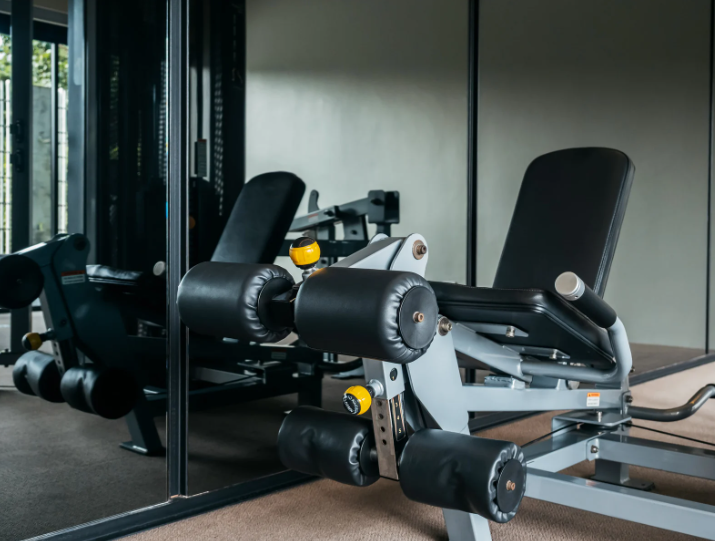
When discussing safe muscle isolation, machine ergonomics is not a minor detail. A well-designed Leg Extension machine allows for proper adjustments, helping users find a setup that minimizes compensation and improves movement quality. In the Donatif CLP series, the Sitting Leg Extender highlights features such as a padded and adjustable seat, stable structure, controlled motion, and customizable free-weight loading. These characteristics do not replace clinical reasoning, but they support more precise execution when the goal is to isolate the quadriceps effectively.
For an advanced home gym athlete or a professional setting up a training facility, this becomes highly practical. A well-adjustable machine makes it easier to match individual anthropometry and build a gradual progression over time. In a post-rehabilitation context, the difference between equipment that is simply “hard” and equipment that is truly useful lies here. Not in extreme performance claims, but in the ability to train with technique, consistency, and control. This is why Leg Extension should no longer be treated as an ideological taboo: when biomechanics, progression, and equipment work together, the focus returns to where it belongs—smarter quadriceps strengthening and long-term knee stability.
Comments (0)