
Trolley
You have no items in your shopping cart

 Budgets
 Dumbers
 Discs
Discs
 Benches
 Racks and Rigs
 Weights Holders
 Isotonic machines
 Calisthenics
 Cardio
 Kettlebells
 Flooring
 Gym Set
 Accessories
 Combat
 ARTI MARZIALI
 CONTAINER GYM
 Tug-Of-War
 Used Gym Equipment
 PILATES MACCHINARI
 GINNASTICA ARTISTICA
 CAMPI DA PADEL
 Prodotti in Pronta Consegna
 Informazioni
 IRONMAN
 Gift Card
- Donatif
- Sports products
- 0 I like it
- 1531 Views
- 0 comments
- stress reduction, improved self-esteem, physical and mental well-being, gym training
READING TIME: 5 MINUTES ➤➤
Standard vs Custom in a Home Gym: When Spending More Actually Makes Sense
Setting up a home gym almost always leads to the same question: is it worth investing in a custom solution, or is it better to optimize standard equipment? The answer isn’t immediate, because the comparison is not just about the initial price, but above all about real performance within a domestic space.
Many users start from a simple assumption: standard costs less. And that’s often true—but only on the surface. Once you consider daily use, space management, and practicality, differences emerge that completely change the value of the investment. This is where the concept of effective cost becomes crucial.
Read also:
The real comparison: initial cost vs effective cost
Why standard always seems more convenient
Standard equipment refers to products designed to fit a wide variety of spaces. This leads to lower costs, immediate availability, and a perception of simplicity in the decision-making process. In a home setting, especially at entry level, this solution feels natural because it reduces perceived risk and allows you to get started quickly.
The issue is that this comparison almost always stops at the purchase price. It doesn’t take into account factors like actual footprint, ease of use, and organization. A low-cost standard setup that is poorly distributed in the space can create clutter, restrict movement, and reduce how often you train. In these cases, the initial savings lose value over time.
When the real cost appears in daily use
The effective cost is the relationship between how much you spend and how much you can actually use efficiently. It’s not just about the product, but about how equipment interacts with the home environment. If a bench is hard to move or a rack limits other movements, the issue is no longer price—it’s performance.
In a small room, even a few centimeters can turn into wasted or unusable space. This leads to constant compromises that reduce workout quality. In this scenario, a slightly more expensive but better-integrated solution can end up being more cost-effective in the long run.
Well-managed standard: how effective can it be?
Organization, selection, and combination of elements
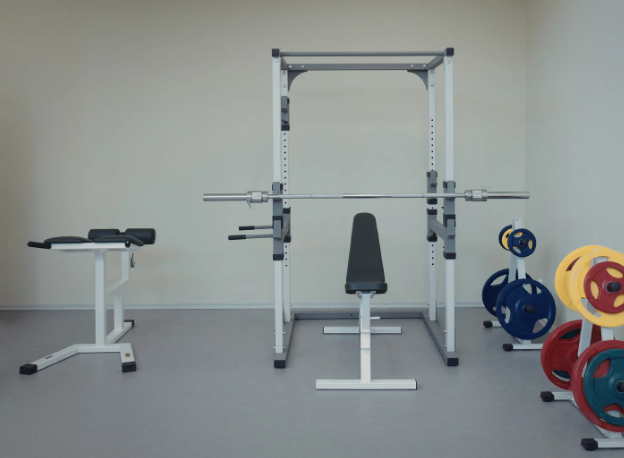
A well-organized standard setup can deliver results very close to more advanced solutions. The difference lies not in the individual product, but in how everything works together. Compact racks, foldable benches, and proper flooring management can create a functional space without structural changes.
The key is avoiding isolated purchases and thinking in terms of a system. When each element is chosen based on the available space, standard solutions become extremely efficient. In many cases, this approach completely eliminates the need for custom work.
Where standard fully meets the need
Standard solutions work particularly well when the space is regular and free of major constraints. Rectangular rooms, standard ceiling heights, and the absence of obstacles allow you to maximize equipment designed for home use.
In these cases, investing in custom solutions can become an unnecessary extra cost. The risk is paying for an adjustment that doesn’t significantly improve usability or organization. Here, the budget is often better allocated toward quality and accessories.
Targeted custom: when it prevents waste
Cases where a few centimeters change everything
Custom solutions make sense when the space has specific constraints: niches, low ceilings, columns, or irregular walls. In these situations, standard equipment can be inefficient or even unusable.
Even a small modification—such as adjusting height or depth—can recover valuable space and make the environment more functional. In this case, the additional cost is not an extra, but a way to avoid structural waste that would impact daily use.
Small interventions with high practical impact
Custom doesn’t have to mean a complex project. Often, it involves targeted micro-adjustments: modified brackets, specific mounting solutions, or integrations with the existing space. These interventions directly improve usability.
The value becomes clear when they enhance accessibility and reduce friction in everyday use. If a piece of equipment becomes easier to use or integrate into the space, the likelihood of consistent use increases. This is where custom truly becomes worthwhile.
Where most mistakes happen
Overestimating the value of custom
A common mistake is assuming that custom automatically means better. In reality, if there’s no concrete problem to solve, custom adds no value. It can even complicate management and increase costs without delivering real benefits.
This often happens when decisions are based on aesthetics or theory rather than practicality. The result is a more expensive solution that doesn’t improve the daily experience. In these cases, well-chosen standard equipment remains the most rational choice.
Underestimating the limits of standard
On the other hand, many users try to force standard solutions into any context. This leads to constant compromises, such as unused space or equipment that’s difficult to integrate. The problem isn’t the product, but the lack of adaptation.
When space has clear constraints, ignoring them leads to a false economy. You save upfront but lose in comfort, organization, and usability. Over time, this reduces the overall effectiveness of the setup.
How to decide rationally in a home environment
Evaluate space, usage, and frequency
The decision should start from three elements: available space, frequency of use, and type of training. If the space is regular and usage is flexible, standard solutions are often enough. But if every centimeter matters, the situation changes.
A concrete analysis of the room helps identify real constraints. When these constraints affect daily use, a custom solution becomes a form of optimization rather than an extra cost.
Distributed budget vs concentrated budget
Another key aspect is how the budget is allocated. Investing everything in a single custom element can reduce the overall quality of the setup. On the other hand, distributing the budget across multiple well-chosen standard elements can improve the overall experience.
The best choice is the one that maximizes the practical performance of the space. In many cases, this means combining well-managed standard solutions with targeted custom adjustments. It’s not about choosing extremes, but about finding the point where cost becomes truly effective.
The tangible advantage of an informed choice
Understanding when custom is necessary—and when it isn’t—helps avoid both overspending and false savings. The result is a space that truly works, without hidden compromises.
If you’re evaluating how to structure your home gym, analyzing the space first and then the available solutions is the most effective way to protect your budget and achieve real long-term performance.
Comments (0)