
Trolley
You have no items in your shopping cart

 Budgets
 Dumbers
 Discs
Discs
 Benches
 Racks and Rigs
 Weights Holders
 Isotonic machines
 Calisthenics
 Cardio
 Kettlebells
 Flooring
 Gym Set
 Accessories
 Combat
 ARTI MARZIALI
 CONTAINER GYM
 Tug-Of-War
 Used Gym Equipment
 PILATES MACCHINARI
 GINNASTICA ARTISTICA
 CAMPI DA PADEL
 Prodotti in Pronta Consegna
 Informazioni
 IRONMAN
 Gift Card
- Donatif
- Sports products
- 0 I like it
- 2877 Views
- 0 comments
- gym flooring, safety flooring, gym safety, shock-absorbing materials
READING TIME: 5 MINUTES ➤➤
Resistance Bands and Mobility: Exercises for Shoulders and Back
Stiffness in the shoulders and back is a common condition among people who spend many hours sitting, work at a computer, or perform repetitive activities without balancing them with movement and joint mobility exercises. In many cases, this sensation is not only related to muscle weakness, but also to a reduced ability of the joints to move smoothly and in a controlled manner. Resistance bands are a simple and accessible tool for working on these aspects progressively.
Exercises with resistance bands allow guided movements that are less stressful compared to other forms of training. The gradual resistance helps improve movement awareness, supports posture control, and makes it possible to work on mobility without overloading joints and muscles. For those worried about worsening existing tension or discomfort, this approach is often perceived as safer and easier to manage.
Why a sedentary lifestyle causes shoulder and back stiffness
The effects of prolonged postures
Remaining seated for many hours tends to reduce the natural movement of the thoracic spine and shoulder blades. Over time, compensations may develop that limit shoulder mobility and increase the sensation of tension in the upper back. This situation is common among office workers, students, and people who frequently use smartphones or digital devices.
When the body maintains the same position for long periods, some muscle groups remain constantly contracted while others become less active. The shoulders tend to round forward and the thoracic spine loses extension. In this context, controlled exercises with shoulder mobility resistance bands can help restore range of motion without requiring abrupt gestures or heavy loads.
The role of joint mobility in daily well-being
Mobility is not only about flexibility, but also about the ability of joints and muscles to work together in a coordinated way. Good mobility allows daily movements to be performed with less stiffness and with a more balanced distribution of muscular tension. Even simple actions such as raising the arms or rotating the torso can become smoother.
Training mobility with resistance bands also helps improve body awareness. The progressive resistance of the band makes it easier to perceive shoulder blade positioning and movement control. This aspect is especially useful for people who tend to become stiff during sedentary work or long periods of inactivity.
Why resistance bands are useful for mobility
Progressive resistance and movement control
Resistance bands generate gradual resistance that increases during movement. This allows exercises to be performed in a more controlled way compared to traditional weights. In shoulder and back mobility work, control is important because it allows training without sudden movements that could increase tension or discomfort.
From a biomechanical perspective, resistance bands help keep stabilizing muscles active throughout the movement. In particular, shoulder blade movement becomes more coordinated and the body learns to distribute forces more effectively. Resistance band shoulder exercises are therefore useful not only for moving more, but also for improving movement quality.
Differences between long bands and handled bands
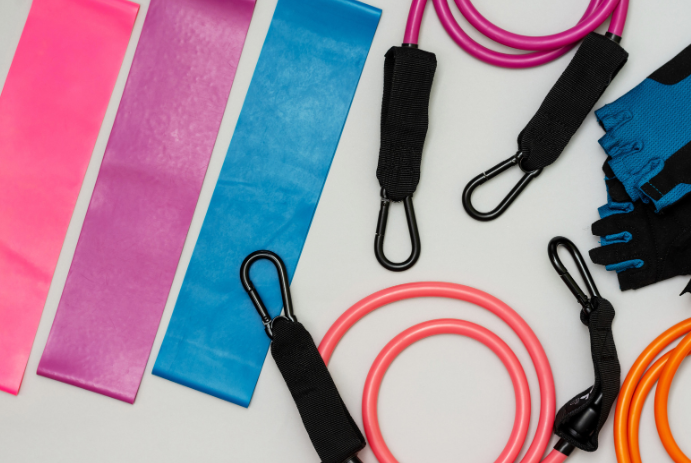
Long resistance bands are often used for mobility exercises because they allow wide and adaptable movement patterns. They can be attached to a support or used freely for opening movements, pulling exercises, and thoracic mobility work. Handled bands, on the other hand, offer a more stable grip and are practical for those who prefer greater control.
For beginners, it is generally helpful to start with light or medium resistance. A band that is too stiff may lead to unwanted compensations and limit movement fluidity. The choice of equipment should support slow, controlled, and progressive movements without creating excessive tension.
Exercises with resistance bands to improve shoulder mobility
Scapular openings with a resistance band
Scapular opening exercises help counteract the tendency of the shoulders to round forward. The exercise consists of keeping the arms extended in front of the body and slowly opening the band while bringing the shoulder blades into a more stable position. The movement should be gradual and without momentum.
This exercise promotes activation of the upper back and improves scapular control. For many people, it represents a good starting point because it allows posture work without requiring advanced mobility. Regular breathing also helps reduce the sensation of stiffness.
External rotations for the rotator cuff
External rotations are often used to improve shoulder control and engage the rotator cuff. The resistance band creates moderate tension that helps maintain movement stability. During execution, it is important to avoid compensating with the torso or neck.
This type of exercise can be useful for those who experience tension in the front of the shoulder or spend many hours working at a computer. Controlled work supports better joint stability and can help make arm movements feel more natural in everyday activities.
Overhead mobility and scapular control
Overhead movements involve raising the arms above the head while maintaining control and fluidity. By using a long resistance band, it is possible to guide the movement without forcing the joint. This exercise requires attention to shoulder blade positioning and thoracic spine mobility.
Many shoulder limitations actually stem from reduced thoracic extension. Working simultaneously on the shoulder blades and back allows movement to be distributed more effectively and helps reduce compensations. Resistance band back mobility exercises are especially useful in this context.
Exercises with resistance bands for back and thoracic mobility
Assisted thoracic extensions
Thoracic extensions help restore movement in the middle part of the back, which is often stiff in sedentary individuals. Using a resistance band as support makes it possible to guide the chest-opening movement while maintaining moderate and controlled intensity.
This exercise can improve posture awareness and support deeper breathing. Thoracic mobility also affects shoulder freedom of movement. Gradual and consistent work tends to be more effective than intense and sporadic movements.
Light rowing for postural activation
The resistance band row, performed with light resistance, helps reactivate the back muscles and improve shoulder blade control. The movement should be slow, with particular attention to the return phase, avoiding jerking or lower back compensations.
From a postural perspective, this movement helps rebalance the work between the front and back of the torso. For people who spend long hours sitting, including light pulling exercises can help reduce the sensation of closed and rounded shoulders.
Controlled movements to reduce thoracic stiffness
Slow rotational and opening movements of the torso with a resistance band allow work on thoracic spine coordination. The elastic resistance provides useful feedback for controlling movement trajectory and maintaining regular breathing.
Progression should always respect the individual’s mobility level. Forcing range of motion may increase muscular tension instead of reducing it. Regular and moderate practice tends to produce more stable results over time.
How to perform exercises safely
Common beginner mistakes
One of the most common mistakes is using resistance bands that are too stiff in the hope of achieving faster results. Excessive resistance reduces movement quality and often leads to neck or lower back compensations. In mobility work, it is preferable to prioritize control and fluidity.
Another common mistake involves execution speed. Movements that are too fast prevent proper awareness of shoulder blade and thoracic spine work. Performing exercises slowly instead helps develop greater body awareness and reduces the risk of incorrect movements.
How to manage tension and discomfort during movement
A mild sensation of muscular tension can be normal during mobility exercises, while sharp pain or blocked movements are signals that should not be ignored. In the presence of persistent discomfort, it is useful to reduce intensity or temporarily stop the exercise.
Breathing plays an important role in tension management. Inhaling and exhaling regularly helps the body relax during movement and supports better muscular coordination. For many people, this approach makes exercises feel more tolerable and less stressful.
How to create a simple home routine
Exercise frequency and progression
Improving mobility does not require long or particularly intense sessions. A short but consistent routine can be more effective over time. Even ten or fifteen minutes per day can help keep shoulders and back active.
Progression should happen gradually, increasing movement control first and only later increasing band resistance. This approach helps build confidence and reduces the fear of worsening existing stiffness or tension.
Which resistance bands to choose for beginners
Long resistance bands are often the most versatile solution for mobility and posture exercises. They allow wide movements and can be used for both light pulling exercises and scapular opening work. Versions with handles are practical for those who prefer a more stable grip.
For home mobility training, light or intermediate resistance is generally sufficient. The main goal is not to increase load, but to improve movement quality, control, and joint comfort over time.
Comments (0)