
Trolley
You have no items in your shopping cart

 Budgets
 Dumbers
 Discs
Discs
 Benches
 Racks and Rigs
 Weights Holders
 Isotonic machines
 Calisthenics
 Cardio
 Kettlebells
 Flooring
 Gym Set
 Accessories
 Combat
 ARTI MARZIALI
 CONTAINER GYM
 Tug-Of-War
 Used Gym Equipment
 PILATES MACCHINARI
 GINNASTICA ARTISTICA
 CAMPI DA PADEL
 Prodotti in Pronta Consegna
 Informazioni
 IRONMAN
 Gift Card
- Donatif
- Sports products
- 0 I like it
- 1846 Views
- 0 comments
- stress reduction, improved self-esteem, physical and mental well-being, gym training
READING TIME: 5 MINUTES ➤➤
Flat, adjustable or foldable bench: which one really makes sense for your setup
Choosing a training bench is one of those steps that many people underestimate when building a home gym or a PT studio. Yet, it is a decision that directly impacts training quality, progression, and safety. It’s not just about the type, but about the alignment between equipment, available space, and real goals.
People often assume there is a “best overall” solution, but the reality is different: each bench serves specific needs. Understanding which one truly fits your setup means avoiding common mistakes such as buying a bulky structure or, on the contrary, one that becomes too limiting over time.
- Why choosing a bench is more strategic than it seems
- Flat bench: simplicity, stability, and operational limits
- Adjustable bench: real versatility or structural compromise?
- Foldable bench: smart solution or fallback choice?
- Space, exercises, and goals: how to align your choice with your setup
- How to avoid a wrong choice: practical decision criteria
Why choosing a bench is more strategic than it seems
The bench is one of the most used pieces of equipment in any training environment, yet it is often chosen superficially. In reality, it represents a structural base on which you build a large part of your exercises, influencing stability, comfort, and long-term progression potential.
A misaligned choice can lead to two opposite issues: a bench that is too limiting and reduces exercise variety, or one that is too complex and bulky, ending up being underused. In both cases, the outcome is the same: an inefficient investment and difficulty maintaining consistency.
The myth of the “most complete” bench
One of the most common mistakes is believing that the adjustable bench is always the best choice. This mindset comes from a natural bias toward versatility but fails to consider the real usage context. More features do not automatically mean more value.
In many cases, a simpler but more stable structure can be more effective in the long run, especially if the goal is to focus on fundamental exercises with progressive loads. Completeness must always be evaluated in relation to actual use.
The real impact on training and progression
The quality of your bench directly affects your ability to express strength safely. An unstable or poorly built structure can limit performance and increase perceived risk, leading you to unconsciously reduce loads.
At the same time, a bench that is too bulky or difficult to manage within your space can reduce how often you use it. In both cases, it becomes a barrier to progression, showing clearly how this choice is far from secondary.
Flat bench: simplicity, stability, and operational limits
When it is the most logical choice
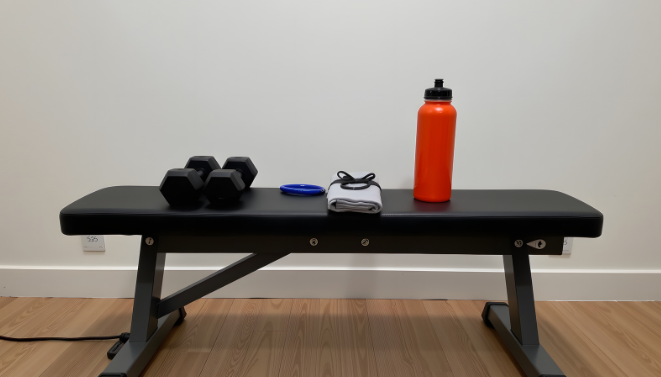
The flat bench represents the most essential and often the most solid solution. Its simple structure ensures high stability, making it ideal for fundamental exercises such as flat bench press with barbells or dumbbells.
It is particularly suitable for those who focus on a few key exercises and want a reliable base. In advanced home gym setups, it can be the most efficient choice when space is sufficient and the goal is maximum stability under load.
Where it becomes limiting
The main limitation of a flat bench is clear: the lack of adjustments. This significantly reduces the variety of exercises you can perform, especially if you want to work at different angles or inclines.
Over time, it can feel restrictive for those seeking a more complete or multidimensional workout. In these cases, simplicity turns into an operational constraint.
Adjustable bench: real versatility or structural compromise?
Concrete advantages in training
The adjustable bench offers greater versatility, allowing you to train at different angles and expand your range of exercises. This makes it particularly appealing for those looking for a single solution for a complete workout.
In settings such as PT studios or well-equipped home gyms, it often represents a good balance between versatility and functionality, adapting to different goals and users.
Trade-offs in stability and space
However, this versatility comes with compromises. The presence of joints and adjustment mechanisms can reduce the feeling of solidity compared to a flat bench, especially under heavy loads.
Additionally, it generally takes up more space, making layout management more complex. For this reason, the choice must be carefully evaluated based on real usage conditions.
Foldable bench: smart solution or fallback choice?
When it truly makes sense
The foldable bench is designed to solve a specific need: optimizing space. In home environments where every square meter matters, it can be an extremely practical solution.
It is ideal for those training in shared or temporary spaces, where the ability to quickly store equipment becomes crucial for maintaining consistency.
Structural limitations to consider
The main limitation concerns stability and robustness. To allow folding, the structure is often less solid than other types, making it less suitable for heavy loads.
This doesn’t make it a wrong choice, but rather a specific solution for certain scenarios. The risk is using it outside its intended context, expecting performance it cannot deliver.
Space, exercises, and goals: how to align your choice with your setup
Compact home gym vs dedicated space
The first real decision factor is space. In a compact home gym, managing footprint is often the priority, making a foldable or compact adjustable bench more sensible.
In a dedicated space, on the other hand, you can prioritize stability and solidity, opting for a flat bench or a higher-end adjustable model. The difference lies in how freely you can organize your environment.
Training style and frequency
Those who train frequently and focus on fundamental lifts will benefit more from a stable structure that is always ready to use. In this case, simplicity becomes a real advantage.
On the other hand, those seeking variety or working with different clients may need more flexibility. In this scenario, adjustability becomes useful, but must always be balanced with stability and practicality.
How to avoid a wrong choice: practical decision criteria
Stability, structure, and real load capacity
One of the most important criteria is structural quality. The declared load capacity, frame solidity, and perceived stability during use are essential elements for ensuring safety and performance.
Investing in a solid base means protecting your entire training system, avoiding future limitations and increasing confidence during execution.
Footprint, practicality, and consistency of use
A bench that looks perfect on paper but is inconvenient to manage in your space risks being used less than expected. Practicality is often underestimated but becomes decisive over time.
The best choice is the one that allows you to train consistently, without logistical barriers. In this sense, true optimization is not technical but functional: choosing what you will actually use in your real context.
Comments (0)