
Trolley
You have no items in your shopping cart

 Budgets
 Dumbers
 Discs
Discs
 Benches
 Racks and Rigs
 Weights Holders
 Isotonic machines
 Calisthenics
 Cardio
 Kettlebells
 Flooring
 Gym Set
 Accessories
 Combat
 ARTI MARZIALI
 CONTAINER GYM
 Tug-Of-War
 Used Gym Equipment
 PILATES MACCHINARI
 GINNASTICA ARTISTICA
 CAMPI DA PADEL
 Prodotti in Pronta Consegna
 Informazioni
 IRONMAN
 Gift Card
- Donatif
- Sports products
- 0 I like it
- 1235 Views
- 0 comments
- gym flooring, safety flooring, gym safety, shock-absorbing materials
READING TIME: 5 MINUTES ➤➤
Bands and Mobility: Exercises for Shoulders and Back
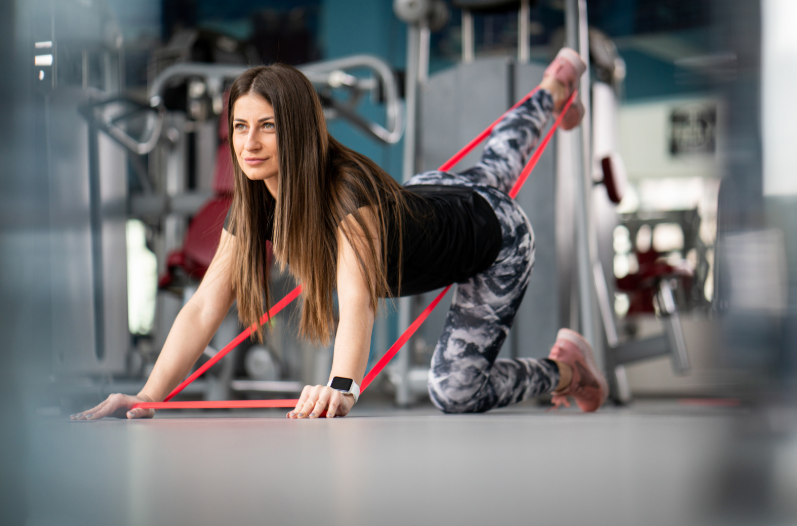
Resistance bands for shoulder and back mobility are a simple, compact tool ideal for people who spend many hours sitting. Heavy loads or aggressive movements are not necessary: the goal is to gradually restore control, awareness, and range of motion, especially when the shoulders tend to roll forward and the upper back becomes stiff after long periods at a desk.
This article presents practical exercises using long resistance bands, designed for beginners and people training at home. The information provided is educational and does not replace professional medical advice: in cases of acute pain, tingling, loss of strength, recent injury, or persistent symptoms, consulting a qualified professional is recommended. Effective training means seeking relief, safety, and control, not forcing movements in an attempt to “unlock” the body immediately.
Why shoulders and back become stiff with a sedentary lifestyle
Shoulder and back stiffness often develops from a combination of prolonged posture, limited movement, and underuse of the muscles that stabilize the shoulder blades and upper back. When working many hours at a computer, the shoulders tend to move forward, the chest closes, and the neck compensates. In this context, resistance band shoulder exercises can help because they provide light and controllable resistance.
The goal is not to “pull harder,” but to retrain the body to move more efficiently. Resistance bands improve awareness of movement direction because tension increases progressively and encourages slower execution. This is especially useful for people afraid of worsening discomfort with incorrect exercises: a light band offers immediate feedback without forcing the body to handle excessive load.
The role of shoulder blades, thoracic mobility, and breathing
The shoulder blades are not simply “back bones”: they are involved in many shoulder movements and influence the feeling of arm freedom. If the upper back remains stiff, the shoulder may try to compensate with movement patterns that create unnecessary tension. For this reason, an effective routine works on thoracic mobility, scapular control, and breathing together.
During exercises, calm breathing helps avoid tension in the neck and upper trapezius. A practical rule is to exhale during pulling or opening movements and inhale while returning to the starting position. There is no need to hold your breath. Movements should remain smooth, controlled, and free of increasing pain.
How to use resistance bands without forcing movement
When starting, choosing a light or medium-light resistance band is usually best. Excessive resistance often leads to compensation through the neck, lower back, or elevated shoulders. In mobility exercises, movement quality matters more than band tension. The body should perceive a clear stimulus, not a struggle against the equipment.
Before each exercise, check three points: stable feet, relaxed chest, and shoulders away from the ears. If you feel sharp pain, loss of control, or discomfort increasing during the movement, stop immediately. Mild muscular tension is normal; sharp pain should never be ignored.
Light resistance, control, and neutral posture
Neutral posture does not mean remaining rigid. It means maintaining a stable position with an elongated spine, slightly active core, and neck aligned instead of pushed forward. This allows the shoulders to move without unnecessary compensations. With resistance bands, neutral posture is especially important because the band constantly pulls in a specific direction.
Each repetition should last a few seconds. Start slowly, move only within a controllable range, and return without letting the band snap back. This detail is essential: the return phase is part of the exercise, not a pause. Training this way develops both mobility and control at the same time.
Resistance band exercises for shoulder mobility
Shoulder exercises should be simple, repeatable, and easy to adjust. In the beginning, a few well-executed movements are enough. You can perform them in front of a mirror or record yourself to check that the shoulders are not rising toward the ears and that the torso is not rotating to compensate.
A basic routine may include external rotations and light opening movements. These exercises help activate the rotator cuff, the posterior shoulder muscles, and the upper back. They should not be performed as maximal strength exercises, but as controlled movements focused on restoring healthy motion patterns.
External rotations with the elbow close to the body
Anchor the band to a stable point around elbow height or hold it with the opposite hand. Bend the elbow approximately 90 degrees and keep it close to the torso, possibly placing a small towel between the elbow and ribs. Slowly rotate the forearm outward without moving the elbow. This exercise works on shoulder stability and the control of deep stabilizing muscles.
Perform a small number of slow repetitions while keeping the wrist neutral and the neck relaxed. If you only feel the upper trapezius working or if the shoulder rises upward, the resistance is likely too high. Reduce the tension, shorten the range of motion, and maintain a clean movement pattern. The correct sensation is controlled work in the back and side of the shoulder.
Light opening movements for rounded shoulders
Hold the resistance band in front of the chest with both hands, arms almost extended but not locked. Slowly open the arms while bringing the band toward the chest, as if gently drawing the shoulder blades together. There is no need to maximize the range of motion. The goal is to activate the upper back without creating neck tension.
This exercise is especially useful for people who spend many hours sitting and feel their shoulders collapsing forward. The movement helps counteract the rounded posture commonly associated with desk work, but it should remain smooth and controlled. If the chest pushes excessively forward or the lower back arches too much, reduce the movement range.
Resistance band exercises for back mobility
Back mobility with resistance bands mainly involves improving the movement and control of the shoulder blades, lats, and upper torso. It is not necessary to transform the routine into a heavy workout. For beginners, the best approach is one that creates a sensation of openness and lightness rather than excessive fatigue.
Back exercises are particularly beneficial when stiffness comes from prolonged sitting. Resistance bands create progressive tension that is easy to adapt to individual strength levels. Once again, the same principle applies: moderate resistance and precise execution are better than using a band that is too strong.
Slow resistance band row for scapular control
Sit or stand with the resistance band anchored in front of you. Hold the ends and pull the elbows backward while keeping them close to the torso. Before bending the arms significantly, think about moving the shoulder blades slightly backward and downward. This transforms the resistance band row into a posture-control exercise rather than simply a pulling movement.
Return slowly to the starting position without losing tension suddenly. If the shoulders collapse forward during the return phase, slow down even more. The movement should remain symmetrical, with the chest open but relaxed. Proper execution creates the feeling of using the back muscles rather than relying only on the arms.
Pull apart for the upper back
The pull apart is performed by holding the resistance band in front of the body with the hands positioned at shoulder width or slightly wider. From there, open the band by moving the hands outward while keeping the arms approximately at chest height. The movement is small but highly effective for activating the muscles between the shoulder blades.
Avoid pushing the head forward while opening the band. This is a common compensation, especially among people working long hours at a computer. Keep the gaze forward and imagine lengthening the neck. If the exercise becomes too difficult, reduce the range of motion or use a lighter band.
Practical progression for beginners and home trainers
An initial routine may last only a few minutes and still be effective when performed consistently. For example, you can select two shoulder exercises and two back exercises, performing one or two light sets of each. Progression should remain gradual: first improve control, then increase volume, and only afterward consider using a stronger band.
For people seeking less pain and greater mobility, consistency matters more than intensity. A short routine performed correctly several times per week is often more sustainable than long sessions done only when stiffness becomes severe. The body responds better to clear and repeated stimuli, especially when sedentary habits are part of everyday life.
When to increase resistance or repetitions
You can slightly increase repetitions when the exercise remains technically clean from beginning to end. This means no compensations appear, pain does not increase, and you maintain control during the return phase. If the final repetitions involve elevated shoulders, neck tension, or excessive lower back arching, progression should be postponed.
Band tension should only increase when the lighter version no longer provides a meaningful stimulus. Even then, progression must remain gradual. For mobility training, a stronger band is not automatically better. The best tool is the one that allows movements to stay precise, repeatable, and safe.
Which resistance bands to choose when starting
For the exercises described above, long resistance bands are highly versatile because they allow pulling, opening, rotational movements, and exercises anchored to a door or stable support. Bands with handles may be more comfortable for people who prefer a firmer grip, especially during rows and light pulling exercises. The best choice depends on exercise style and hand comfort.
For beginner home trainers, having at least two resistance levels is useful: one lighter band for shoulders and rotation exercises, and one slightly stronger for back work and rowing movements. This makes the routine adaptable without unnecessary strain. Resistance bands take little space, integrate easily into tutorials, and allow training both at home and in office environments with a cautious, progressive, and controlled approach.
The most important factor remains listening to your body. Resistance bands can help improve mobility, posture, and movement awareness, but they should never become a test of strength. When used progressively, they become a practical tool for building a sustainable routine and reducing the stiffness commonly associated with sedentary lifestyles.
Comments (0)