
Trolley
You have no items in your shopping cart

 Budgets
 Dumbers
 Discs
Discs
 Benches
 Racks and Rigs
 Weights Holders
 Isotonic machines
 Calisthenics
 Cardio
 Kettlebells
 Flooring
 Gym Set
 Accessories
 Combat
 ARTI MARZIALI
 CONTAINER GYM
 Tug-Of-War
 Used Gym Equipment
 PILATES MACCHINARI
 GINNASTICA ARTISTICA
 CAMPI DA PADEL
 Prodotti in Pronta Consegna
 Informazioni
 IRONMAN
 Gift Card
- Donatif
- Sports products
- 0 I like it
- 1835 Views
- 0 comments
- stress reduction, improved self-esteem, physical and mental well-being, gym training
TEMPO DI LETTURA: 5 MINUTI ➤➤
Essential Equipment to Start Streetlifting at Home: What You Really Need
Setting up a small home streetlifting area often leads to a simple mistake: buying too much, too soon. Beginners see dozens of accessories, complex structures and bulky solutions, but in practice effective training starts with just a few well-chosen elements. In this context, the real difference is not the quantity of equipment, but its ability to support fundamental exercises such as pull-ups, dips and progressive loading.
For beginners, or for anyone building a streetlifting home gym, the most effective strategy is to reduce options and focus on what truly matters. A stable pull-up bar, compact parallettes, a dip belt, a training mat, and a small amount of organized space are enough to create a serious foundation. It is an orderly, sustainable approach and much closer to real training practice than it might seem.
Where to start when you want to train properly without filling your home
Why equipment selection matters more than quantity in home streetlifting
In streetlifting, the value of equipment depends on a simple question: does it allow you to perform the movements that truly matter? For those training at home, this perspective prevents purchases driven by initial enthusiasm. The discipline revolves around pull-ups and dips, and then around the ability to make them progressively more demanding. Anything that does not improve these two core movements risks taking up space, budget and attention without adding real technical value.
For this reason, a streetlifting starter kit should not be seen as a minimal or limited version of training, but rather as a smart selection. In a room, a garage or a shared workout area, having a few stable and coherent elements creates continuity. You enter the space, start training and get to work. This simplicity reduces mental overload and makes it easier to turn training into a habit, which for beginners is often more valuable than any secondary accessory.
The right criteria to distinguish what is necessary from what is superfluous
The most useful approach is to divide purchases into three categories: essential equipment, accessories that improve progression, and elements that can wait. The first group includes the pull-up bar and parallettes or a dip station. The second includes the dip belt and the training mat. The third category contains overly complex structures, specialized accessories or solutions designed more to complete a full gym than to start a functional home training setup.
This selection aligns well with the psychological drivers mentioned in the brief: simplification, clarity, and aversion to chaos. A home gym user is not only looking for performance, but also for an environment that is easy to understand and manage. Knowing that five well-chosen items are enough to start building real strength reduces uncertainty and makes purchasing decisions more rational.
The pull-up bar as the technical foundation of your setup
Which characteristics make a pull-up bar useful even in the long term
The pull-up bar is the first piece of equipment that defines your streetlifting area. It must do more than simply support bodyweight. It needs to provide perceptible stability, reliable grip and enough space for clean movement patterns. An unstable bar alters technique, creates compensations and reduces confidence. For beginners this detail is crucial, because technique is developed in the early weeks, when each repetition matters more than overall volume.
In a home environment it is best to choose a solution that remains useful even after the initial phase. A solid bar, compatible with a dedicated structure or with a properly positioned wall mount, allows you to maintain the same technical base when weighted training begins. The right choice is not the most feature-rich option, but the one that supports the transition from bodyweight pull-ups to progressively heavier work.
Where to install it and why stability changes the quality of training
The position of the bar directly affects the training experience. In a small streetlifting home gym, the ideal placement allows freedom of movement, enough overhead clearance and no lateral obstacles. When installation is cramped into an awkward space, training becomes less fluid. The issue is not just logistical: less comfort often means less frequency, and frequency is the real currency of technical learning.
Stability is not a psychological detail but a practical requirement. A firm structure clarifies scapular engagement, pulling mechanics and body control. Even beginners immediately feel the difference between a solid support and a temporary solution. From a BOFU perspective, this is one of the key points: the pull-up bar is not just another piece of equipment, but the center of the setup on which much of the training quality depends.
Parallettes and dip stations: the second pillar of the basic kit
Why compact parallettes are enough for many beginners
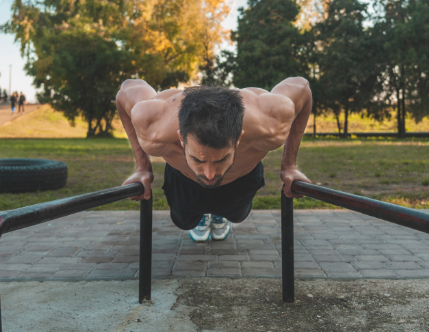
After the pull-up bar, the next piece of equipment that truly makes sense to buy is parallettes or a well-designed dip station. For many home users, compact parallettes are already sufficient, as they allow dips, support holds, control work and some complementary variations without requiring too much space. A common mistake is assuming that a large structure is immediately necessary. In reality, if the base is stable and the height is correct, meaningful training can begin right away.
Parallettes belong in the essential kit because they complete the technical foundation of streetlifting. Pull-ups and dips together cover the central movements of the discipline. A pair of well-chosen tools allows you to build simple, repeatable and effective training sessions. For home athletes this means avoiding overly complex setups and focusing more time on the exercises that truly develop strength and control.
When choosing a more stable structure makes sense
There are situations where a more robust structure makes sense from the beginning. This can happen when the practitioner already has decent motor control, weighs above average, or knows they will soon introduce additional weight. In these cases, a more solid dip station provides a better sense of continuity and reduces the limitations of the setup.
For beginners training at home, the key question is simple: how much real stability do I need to train consistently? If the answer is “enough to move without hesitation,” then the purchase is probably close to the right one. Reducing choice works exactly like this: not chasing every option, but selecting the structure that makes dips reliable, safe and repeatable within your available space.
Dip belt and training mat: the two accessories that give meaning to the setup
The dip belt as the transition from general training to measurable strength
The dip belt is not the very first purchase, but it is the first accessory that transforms a home setup into a progression-oriented training base. When pull-ups and dips start to become manageable at bodyweight, introducing external load allows strength development to be measured more clearly. For this reason, the dip belt belongs in a well-planned essential kit, even if it is not used from the first day.
From a practical perspective, the dip belt prevents the home setup from remaining limited to the beginner phase. Athletes who buy equipment carefully want tools that remain useful over time. The belt adds progression without complicating the environment. It takes little space, is used when needed, and supports the transition toward more specific streetlifting training.
The training mat for order, protection and perceived stability
The training mat is often underestimated because it does not directly produce repetitions, but in a home streetlifting area it makes a significant difference. It protects the floor, defines the training area and creates a sense of order that improves everyday usability. In an apartment, garage or shared room, having a dedicated surface helps establish clear boundaries for the workout space.
There is also a less obvious benefit: a defined surface improves the perception of stability in the entire setup. When the training zone is clear and organized, each piece of equipment naturally finds its place and the overall experience feels more solid. For entry-level athletes this matters a lot, because a tidy home gym encourages regular use.
How to build a simple, organized and ready-to-use home streetlifting area
The logic of five pieces of equipment that reduce indecision and unnecessary purchases
If the goal is to start without filling your home with equipment, the most sensible combination remains this: pull-up bar, parallettes or dip station, dip belt, training mat and a properly organized training space. The fifth element is not an additional tool but the minimal design of the area itself. It prevents the setup from becoming a random collection of disconnected pieces.
This structure has a clear advantage: it removes noise from decision making. Instead of comparing dozens of different products, the user can focus on a short and understandable list. This dynamic is particularly effective at the BOFU stage, where the user does not need more options but a clear direction. With these five tools you can start building real strength anywhere, as long as the selection remains functional rather than decorative.
Which combination makes the most sense for a beginner home gym
For beginners, the priority is building a setup that allows continuity rather than spectacle. A reliable pull-up bar and stable parallettes form the core of the system. The dip belt enters later as progression, while the mat keeps the area organized and practical. This combination works because it supports technical development without requiring a full gym environment.
Self-taught athletes benefit especially from a coherent setup. When each piece of equipment serves a clear function, routines become easier to establish. Less time is spent deciding what to use, more time is dedicated to the core exercises, and progress becomes easier to monitor.
An essential setup can already become a serious training base
When a few tools are enough to build real strength
An essential home setup is not a compromise. If the pull-up bar and parallettes are solid, if the dip belt is introduced at the right moment, and if the space remains organized, training can become very serious. Streetlifting rewards execution quality and consistent progression, not the accumulation of machines and accessories.
This is where the true advantage of minimalism appears: sustainability. At home, what works best is what remains simple to use, simple to maintain and simple to repeat. When the environment does not create resistance, consistency grows almost naturally.
How to progress without turning your home into a cluttered gym
After the initial kit, the most sensible evolution is to add only what solves a real limitation that emerges during training. If the issue is progression, load is introduced. If stability becomes the problem, the structure can be upgraded. If organization becomes difficult, the space can be optimized.
A well-designed home streetlifting area is built exactly like this: a few tools, clear functions and room for growth. A pull-up bar, parallettes, dip belt and training mat cover what is needed to begin credibly. Everything else can come later, when it is truly justified.
Comments (0)