
Trolley
You have no items in your shopping cart

 Budgets
 Dumbers
 Discs
Discs
 Benches
 Racks and Rigs
 Weights Holders
 Isotonic machines
 Calisthenics
 Cardio
 Kettlebells
 Flooring
 Gym Set
 Accessories
 Combat
 ARTI MARZIALI
 CONTAINER GYM
 Tug-Of-War
 Used Gym Equipment
 PILATES MACCHINARI
 GINNASTICA ARTISTICA
 CAMPI DA PADEL
 Prodotti in Pronta Consegna
 Informazioni
 IRONMAN
 Gift Card
- Donatif
- Sports products
- 0 I like it
- 1312 Views
- 0 comments
- stress reduction, improved self-esteem, physical and mental well-being, gym training
READING TIME: 5 MINUTES ➤➤
Rubber Gym Flooring 1, 2, 3 or 4 cm: What Thickness Do You Really Need?
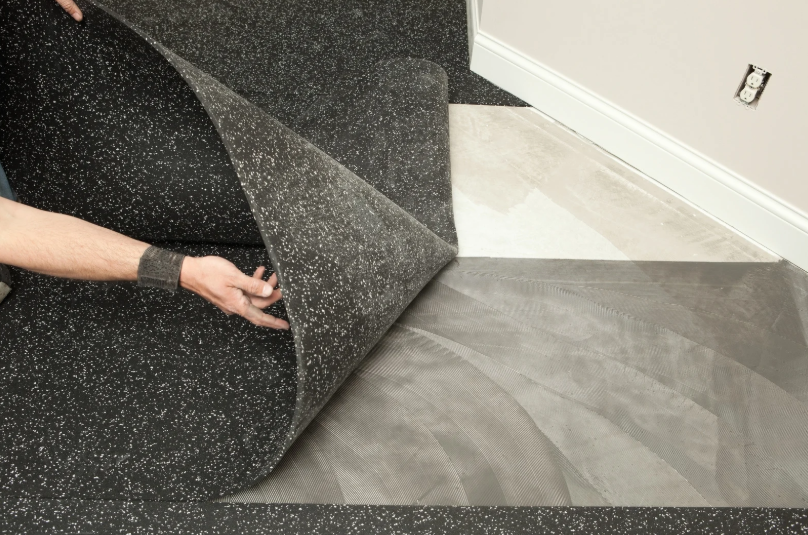
Choosing the thickness of rubber gym flooring is one of the most critical decisions when designing an advanced home gym or a personal training studio. It is not simply an aesthetic or budget preference, but a technical choice that directly impacts safety, performance, and long-term durability. Understanding what thickness you really need means avoiding costly mistakes and building a setup that truly matches your training style.
Many users feel stuck when faced with what seems like a simple but actually complex decision: 1, 2, 3 or 4 cm? The answer is not universal, as it depends on specific variables such as loads used, training frequency, impact level, and environment. In this guide, we analyze the technical criteria needed to move from a random choice to a structured and informed decision.
- Why thickness is a decisive technical factor
- How thickness changes based on training type
- Practical differences between 1, 2, 3 and 4 cm
- Impact on noise and vibrations
- Decision framework for choosing the right thickness
Why thickness is a decisive technical factor
The thickness of rubber flooring determines the surface’s ability to absorb impact, distribute loads, and protect both the subfloor and equipment. It is not just about comfort, but about managing the forces generated during training, especially when using barbells and free weights.
A floor that is too thin may fail to dissipate impact energy effectively, leading over time to structural damage or increased perceived noise. On the other hand, excessive thickness can be unnecessary or even counterproductive, reducing stability and movement precision.
The role of thickness in protection and stability
Each additional centimeter increases impact absorption capacity, but also changes the elastic response of the surface. This directly affects stability during exercises such as squats, deadlifts, or presses, where an overly soft base can compromise performance.
The correct choice is therefore a balance between protection and firmness, calibrated on real usage rather than generic or overly cautious assumptions.
The most common mistake: thinking thicker is always better
One of the most widespread misconceptions is that increasing thickness automatically improves quality. In reality, this approach often leads to oversizing the solution, increasing costs without delivering real benefits.
Thickness must be proportional to usage: choosing 4 cm for light training adds no real value, but only increases complexity and unnecessary expense.
How thickness changes based on training type
Bodyweight training and light loads
In functional training, mobility work, or bodyweight exercises, the stress on the floor is limited. In these cases, a thinner solution is often sufficient to provide basic comfort and protection.
The priority becomes stability and practicality rather than high-impact absorption. Excess thickness would be unnecessary.
Training with free weights and barbells
When introducing barbells and progressive loads, the scenario changes significantly. The floor must handle concentrated and repeated loads, often exceeding body weight.
In this case, a medium thickness represents the ideal balance between protection and stability, avoiding both excessive rigidity and unwanted deformation.
High-impact training and controlled drops
In training scenarios involving drops, Olympic lifting, or intensive use, the floor is exposed to high dynamic impacts. Here, thickness becomes a critical factor.
An appropriate surface must dissipate energy, reduce vibrations, and protect both equipment and the underlying structure, preventing long-term damage.
Practical differences between 1, 2, 3 and 4 cm flooring
When 1 cm is enough
A 1 cm thickness is suitable for light use, where there are no significant loads or impacts. It is a basic solution, designed for low mechanical stress environments.
Its main function is to provide a non-slip and slightly cushioned surface, without structural ambitions.
When to choose 2 cm
The 2 cm option is a versatile choice for intermediate-level home gyms. It allows for moderate loads while maintaining good stability.
It is often the best balance between cost, performance, and adaptability across different training styles.
When 3 cm is needed
At 3 cm, you enter a more technical range, designed for frequent use and heavier loads. Impact absorption becomes significantly more effective.
This is the right solution for those training seriously with free weights without risking damage to flooring or equipment.
When 4 cm makes sense
4 cm thickness is intended for high-impact environments where protection is the top priority. It is a specific choice, not a universal one.
Using it without real necessity leads to higher costs and reduced overall efficiency of the setup.
Impact on noise, vibrations and comfort
Acoustic absorption and isolation
Thickness directly affects noise reduction, especially in home environments. The greater the thickness, the higher the ability to dampen vibrations and transmitted sounds.
This aspect is crucial in shared spaces, where acoustic control becomes an integral part of the design process.
Subfloor protection and long-term durability
A properly selected floor protects the subfloor from cracks, deformation, and premature wear. The right thickness distributes loads effectively and reduces stress points.
This results in greater durability of the entire system, minimizing the need for corrective interventions over time.
Decision framework: how to choose the right thickness
Relationship between load, frequency and surface
Choosing the right thickness starts with an objective evaluation of three factors: load used, training frequency, and type of exercises performed. These elements define the level of stress the floor will endure.
Only by combining these parameters can you identify a solution that is consistent and not oversized.
Proportional choice: avoiding waste and mistakes
The goal is not to choose the maximum available, but the most appropriate. A proportional choice allows you to protect your investment while avoiding both overspending and underestimating your needs.
Moving from a “more is better” mindset to a technical approach means gaining control and confidence, turning uncertainty into a well-informed decision.
Comments (0)