
Trolley
You have no items in your shopping cart

 Budgets
 Dumbers
 Discs
Discs
 Benches
 Racks and Rigs
 Weights Holders
 Isotonic machines
 Calisthenics
 Cardio
 Kettlebells
 Flooring
 Gym Set
 Accessories
 Combat
 ARTI MARZIALI
 CONTAINER GYM
 Tug-Of-War
 Used Gym Equipment
 PILATES MACCHINARI
 GINNASTICA ARTISTICA
 CAMPI DA PADEL
 Prodotti in Pronta Consegna
 Informazioni
 IRONMAN
 Gift Card
- Donatif
- Sports products
- 0 I like it
- 5948 Views
- 0 comments
READING TIME: 9 MINUTES ➤➤
In the world of professional fitness, the choice of isotonic machines represents one of the most significant — and often underestimated — investments for the efficiency of a gym or a personal training studio. Not all isotonic machines are the same, and understanding the differences between weight stack machines and plate-loaded machines is essential to ensure a safe, progressive training experience aligned with the goals of advanced users. In this article we analyze in depth the advantages, disadvantages, and selection criteria for building a high-performance and perfectly balanced machine area.
- What isotonic machines are: definition and principles
- Types of isotonic machines: weight stack, plate-loaded and alternatives
- Comparison: weight stack vs plate-loaded — advantages and disadvantages
- Selection criteria for your fitness space (gym, center, studio)
- Implementation in professional environments and for advanced clients
- Final considerations and purchasing guidelines
What isotonic machines are: definition and principles
Isotonic machines are training equipment designed to provide constant resistance throughout the entire range of motion. Unlike isokinetic machines or elastic resistance systems, isotonic machines maintain a stable load, allowing precise control of movement. They are ideal for strength training, rehabilitation, and progressive muscle development.
These machines rely on levers, pulleys, and mechanical resistance systems to guide the user along precise movement paths. The major advantage lies in the safety and standardization of the exercise: the user does not need to balance the load and can focus entirely on execution. This aspect is essential not only for beginners but also for advanced athletes who want to work on specific joint ranges or under controlled conditions.
Types of isotonic machines: weight stack, plate-loaded and alternatives
Weight stack machines
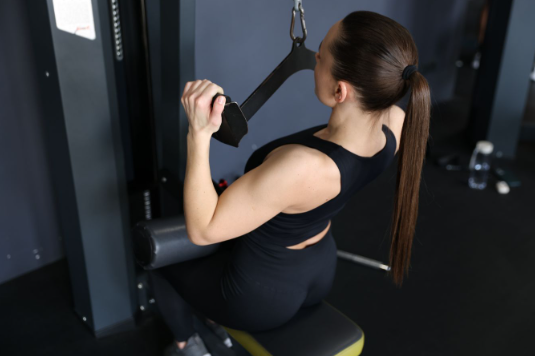
Weight stack isotonic machines are the most common in commercial gyms. They use a system of plates connected by a cable and selected through an adjustment pin. This system allows quick load selection and immediate use, minimizing the number of adjustments required. They are ideal for high-traffic environments such as public gyms thanks to their practicality and long-term reliability.
Additionally, the weight stack provides immediate feedback on the training intensity and may allow micro-increments if the manufacturer includes fractional plates. Maintenance is relatively simple and safety is high, making them a preferred choice for facilities where injury risk control is a priority.
Plate-loaded machines (pistons, magnetic plates, hydraulic, pneumatic)
Plate-loaded isotonic machines include a wide range of technologies: from traditional plate systems to hydraulic or pneumatic pistons and even newer magnetic resistance systems. In these models, the user manually loads the weight, which allows greater customization but also requires a higher level of operational management.
These machines are appreciated for their similarity to barbell training, offering a more “natural” resistance and greater activation of stabilizing muscles. They are particularly suitable in personal training or athletic preparation settings, where the goal is to replicate functional movements in a controlled environment.
Comparison: weight stack vs plate-loaded — advantages and disadvantages
Advantages of weight stack machines
The main advantage of weight stack machines is speed of use: selecting the load takes only a few seconds. This aspect supports user turnover in crowded gyms and makes the machine accessible even to less experienced users. In addition, the guided path reduces the risk of technical mistakes and allows exercises to be performed safely.
From a management perspective, weight stack machines are easier to maintain and require less supervision. They are often more compact and can be arranged efficiently, making them ideal for optimized spaces.
Disadvantages of weight stack machines
The main limitation is the lack of proprioceptive stimulation. The fixed path may reduce secondary muscle activation and limit exercise variety. In addition, the maximum load is constrained by the internal structure and is difficult to expand beyond a certain threshold.
From the perspective of advanced users or athletes, weight stack machines may feel “too simple” or insufficiently challenging, especially when the goal is training closer to free or functional movements.
Advantages of plate-loaded machines
Plate-loaded machines allow greater muscle involvement and a less constrained path that is closer to natural movement. They are often used for advanced training or by athletes seeking a more realistic stimulus similar to barbell exercises.
They also offer greater modularity: plates can be combined, angles adjusted, and exercises adapted according to specific needs. This makes them extremely versatile tools for personalized training.
Disadvantages of plate-loaded machines
They require more preparation time before performing the exercise and may be complex for inexperienced users. Manually loading plates also involves more logistical management and operational space.
From a maintenance standpoint, plate-loaded machines are more subject to mechanical wear and require attention when calibrating supports. Safety is also more dependent on correct execution, requiring greater supervision by trainers.
Selection criteria for your fitness space (gym, center, studio)
Space, modularity, and scalability
One of the most important factors in choosing isotonic machines is space optimization. Weight stack machines are often designed to be compact and “stand alone,” easily integrated into circular layouts or open training zones. Plate-loaded versions, on the other hand, may require more space due to plate storage but offer greater configuration flexibility.
In dynamic environments — such as personal training studios or boutique gyms — the ability to configure equipment based on the type of training program offered becomes a strategic advantage. Choosing modular machines or those with adjustable lever systems can provide greater customization over time and allow adaptation to evolving client needs.
Purchase costs, maintenance, and reliability
Initial costs vary significantly: weight stack machines generally have a higher purchase price but require less maintenance over time and provide greater durability. They are built with stronger materials and designed to withstand intensive daily use cycles.
Plate-loaded machines are usually less expensive initially but may involve hidden costs related to plate wear, brackets, lever systems, and sliding mechanisms. Additionally, moving parts require more frequent checks of safety components. Long-term reliability also depends on usage intensity and proper maintenance.
Safety and ergonomics
Safety is a key factor, especially in environments with mixed user levels or limited supervision. Weight stack machines offer maximum passive protection: they are designed to limit incorrect movement paths and ensure a stable experience even for inexperienced users.
On the other hand, plate-loaded machines require greater attention to ergonomics: adjustments must be precise, loads well distributed, and biomechanics respected. In professional environments, however, this complexity can translate into added value for experienced clients seeking a more personalized training experience.
Implementation in professional environments and for advanced clients
Specialized training and advanced exercises
Advanced clients, including athletes, bodybuilders, or long-term gym members, require machines that allow greater exercise variety and more targeted muscle stimulation. In this context, plate-loaded or hybrid machines are almost mandatory to provide a challenging and comprehensive training experience.
The ability to work with specific angles, varied joint ranges, or unilateral movements is particularly appreciated in advanced training settings. Including these machines in a facility layout means offering a high perceived value service and building loyalty among demanding clients who pay attention to technical details.
Compatibility with circuits, supersets, and technical requirements
In facilities offering advanced formats — such as circuit training, supersets, or functional training protocols — isotonic machines must ensure fast transitions, simple adjustments, and adaptability to different strength levels. Weight stack machines excel in speed of use, while plate-loaded machines are better suited for more open-ended exercises.
In both cases, it is essential to guarantee biomechanical consistency and construction quality: well-balanced levers, smooth motion systems, and high-tolerance steel components. This not only improves the user experience but also reduces the risk of technical problems in the long term.
Final considerations and purchasing guidelines
The choice between weight stack isotonic machines and plate-loaded machines is not a matter of superiority but of functional goals. Each solution brings specific advantages that must be evaluated according to the facility, the type of clientele, and the technical offering of the center.
A fitness center focused on professional performance or personal training will likely need a well-balanced mix: weight stack machines for safety and accessibility, plate-loaded machines for advanced muscle stimulation. The ideal approach is to build a hybrid equipment line that allows progression and adaptability, ensuring versatility and long-term technical value.
Comments (0)