
Trolley
You have no items in your shopping cart

 Budgets
 Dumbers
 Discs
Discs
 Benches
 Racks and Rigs
 Weights Holders
 Isotonic machines
 Calisthenics
 Cardio
 Kettlebells
 Flooring
 Gym Set
 Accessories
 Combat
 ARTI MARZIALI
 CONTAINER GYM
 Tug-Of-War
 Used Gym Equipment
 PILATES MACCHINARI
 GINNASTICA ARTISTICA
 CAMPI DA PADEL
 Prodotti in Pronta Consegna
 Informazioni
 IRONMAN
 Gift Card
- Donatif
- Sports products
- 0 I like it
- 2191 Views
- 0 comments
- stress reduction, improved self-esteem, physical and mental well-being, gym training
READING TIME: 5 MINUTES ➤➤
Home Gym Flooring in House, Garage or Dedicated Room: What Changes
When designing a home gym, one of the most underestimated aspects is the context in which it will be installed. Many people start with the choice of material, convinced that buying good flooring is enough to achieve an effective result. In reality, where you train has a deep impact on performance, safety, and the durability of the entire setup.
Understanding how the ideal flooring changes between an apartment, garage, and dedicated room means moving from a generic choice to a truly functional configuration. This approach helps avoid common mistakes, improve the training experience, and protect both the environment and equipment over time.
- Why context truly affects flooring choice
- Home gym flooring in an apartment
- Home gym flooring in a garage
- Flooring for a dedicated training room
- Practical differences between the three scenarios
- How to choose the right setup for your space
Why context truly affects flooring choice
One of the most common mistakes is thinking that the perfect floor is universal. In reality, every environment presents specific constraints that directly influence the choice of materials and configuration. An apartment requires sound insulation and surface protection, while a garage must handle heavy loads and more variable environmental conditions.
Context defines priorities: noise reduction, stability, durability, or comfort. Ignoring these factors often leads to ineffective results, such as floors that are too rigid at home or too soft in high-load environments. The right choice always starts from the environment, not the product.
The most common mistake: thinking material alone is enough
Many users rely on setups seen online without considering their actual space. This leads to copying solutions designed for completely different contexts, often with disappointing results. High-density rubber flooring may be perfect in a garage but excessive or noisy in an apartment.
Material quality does not compensate for a context mistake. Even the best product can become ineffective if used inconsistently with the environment. This is where the difference between a functional home gym and an improvised one emerges.
How environment and usage change real needs
Every space imposes physical and functional constraints that must be translated into concrete decisions. In an apartment, the main issue is often noise transmitted to neighbors, while in a garage the focus is on resistance to impacts, humidity, and temperature fluctuations.
The type of training amplifies these differences. Weightlifting, functional training, or cardio all create different needs that combine with the environment, making careful evaluation essential before choosing flooring.
Home gym flooring in an apartment
Training in an apartment involves a series of limitations that cannot be ignored. The first critical factor is noise, followed by the need to protect often delicate surfaces such as parquet or tiles. In this context, flooring must be designed to absorb impacts and vibrations.
The main goal is to reduce sound transmission to lower floors while maintaining good stability during workouts. This balance is essential to avoid structural issues and coexistence problems.
Main constraints: noise, space, and delicate surfaces
Spaces in apartments are often limited, requiring modular and easy-to-manage solutions. Additionally, existing surfaces must be protected from scratches, impacts, and prolonged compression.
Sound insulation becomes a priority, especially when performing dynamic exercises or using weights. Ignoring this aspect can compromise the long-term sustainability of your training.
Most suitable materials and configurations
In this scenario, materials like EVA or low-to-medium density rubber offer an effective solution. They can be combined in multi-layer configurations to improve impact absorption without sacrificing comfort.
Platforms should be lightweight and modular, avoiding overly rigid or permanent solutions. Flexibility is key when adapting to shared and multifunctional spaces.
Home gym flooring in a garage
The garage offers more freedom compared to an apartment but introduces new variables. Surfaces are often rougher and must withstand heavy loads, repeated impacts, and less controlled environmental conditions.
Durability becomes the priority, both mechanically and over time. The floor must ensure stability even under heavy loads, preventing deformation or premature wear.
Resistance, loads, and environmental conditions
Temperature fluctuations, humidity, and dust are typical garage factors that influence material choice. Inadequate flooring can deteriorate quickly, compromising safety and performance.
Load management is crucial, especially for those using barbells and free weights. The floor must distribute impact without transferring it to the underlying structure.
Recommended setup for stability and durability
High-density rubber is often the most effective choice in this context. It can be combined with dedicated lifting platforms to create functional zones within the space.
The setup can be more structured and permanent, allowing for robust, performance-oriented configurations. This makes the garage ideal for more intense and technical training.
Flooring for a dedicated training room
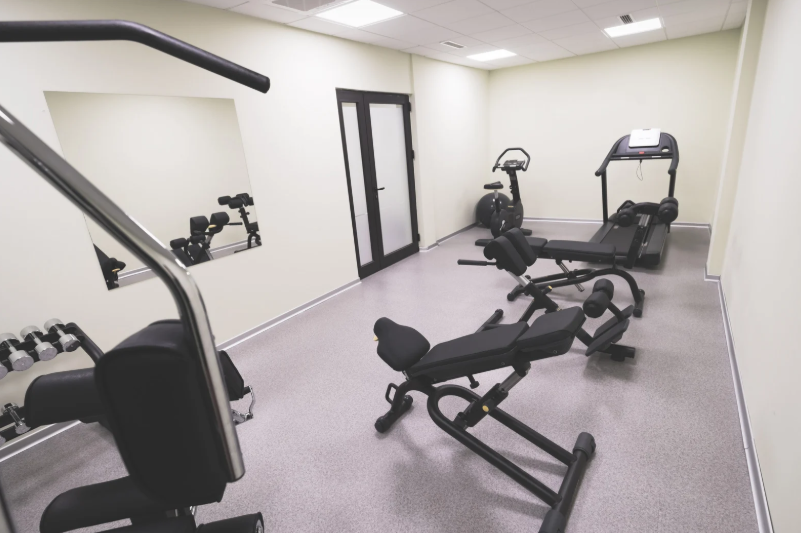
A dedicated room represents the most flexible context, allowing for complete and customized design. Here, comfort, aesthetics, and performance can be balanced without the typical constraints of other environments.
Design freedom allows optimization of every detail, from space layout to material selection. This makes a dedicated room the ideal solution for those seeking a complete experience.
Maximum design freedom
Without strict structural limitations, it is possible to create a highly personalized environment. Flooring can be selected based on training type without significant compromises.
Different solutions can be integrated, combining materials and thicknesses to achieve optimal performance in every area of the room.
How to optimize comfort and performance
The focus shifts to the training experience, with flooring that offers stability, absorption, and comfort in balance. This helps reduce fatigue and improve exercise quality.
Design becomes strategic, transforming the space into a truly functional and motivating environment.
Practical differences between the three scenarios
The main difference between apartment, garage, and dedicated room is not just in materials, but in design priorities. Each environment requires a different approach, reflected in flooring choice and overall configuration.
There is no universal solution, only configurations that are consistent with the context. Understanding these differences is essential to avoid mistakes and achieve concrete results.
What really changes in the choice
In an apartment, sound insulation dominates; in a garage, durability; in a dedicated room, the balance between comfort and performance. These variables guide every decision, from material to thickness.
Context defines the selection criteria, making any standardized approach ineffective.
Limits and advantages of each environment
Each scenario presents unavoidable trade-offs. Apartments limit intensity, garages require greater robustness, while dedicated rooms involve a more structured investment.
Understanding these limits allows you to turn them into advantages, designing a truly effective space.
How to choose the right setup for your space
The correct method always starts with analyzing the environment, followed by evaluating the type of training and finally selecting materials. This approach reduces uncertainty and leads to more informed decisions.
Moving from context to setup means building a functional home gym, avoiding waste and ineffective configurations.
A simple decision-making method to avoid mistakes
Identifying key constraints is the first step: noise, loads, available space. From there, priorities are defined and the most suitable solutions are selected.
The simplicity of the process reduces errors and improves the final result.
From environment to setup: the right approach
Once the context is understood, it becomes possible to build a consistent and high-performing configuration. This allows any space to be transformed into an effective home gym, regardless of its size.
The difference is not made by the product, but by how well the choice fits the environment.
Comments (0)