
Trolley
You have no items in your shopping cart

 Budgets
 Dumbers
 Discs
Discs
 Benches
 Racks and Rigs
 Weights Holders
 Isotonic machines
 Calisthenics
 Cardio
 Kettlebells
 Flooring
 Gym Set
 Accessories
 Combat
 ARTI MARZIALI
 CONTAINER GYM
 Tug-Of-War
 Used Gym Equipment
 PILATES MACCHINARI
 GINNASTICA ARTISTICA
 CAMPI DA PADEL
 Prodotti in Pronta Consegna
 Informazioni
 IRONMAN
 Gift Card
- Donatif
- Training and exercises
- 0 I like it
- 2500 Views
- 0 comments
- gym flooring, safety flooring, gym safety, shock-absorbing materials
READING TIME: 5 MINUTES ➤➤
Beginner Rowing Machine Program: Complete 8-Week Guide at Home
Starting to train with a rowing machine may seem more complicated than it actually is. Many beginners buy a home rowing machine with enthusiasm, but after the first few sessions doubts often arise about technique, workout duration, and the actual effectiveness of the program. Without a clear structure, the risk is training inconsistently or giving up after only a few weeks.
A progressive program helps build a sustainable habit while gradually improving endurance, coordination, and movement confidence. One of the biggest advantages of the rowing machine is that it engages most of the body’s muscles without placing excessive impact on the joints, making it especially appreciated by beginners and people who want to train comfortably at home.
- Why choose a rowing machine
- How to prepare before starting
- Weeks 1-2 program
- Weeks 3-4 program
- Weeks 5-6 program
- Weeks 7-8 program
- How to stay consistent
Why the rowing machine is ideal for beginners
The beginner rowing machine workout is an effective solution for anyone looking to improve their fitness without facing exercises that are too complex or intense right away. The smooth movement allows you to engage legs, back, arms, and core in a single session, helping improve cardiovascular endurance and overall coordination.
Another important aspect is effort management. With a rowing machine, you can gradually increase workout duration and intensity without overloading the joints. This makes the equipment particularly suitable for parents, sedentary adults, or people returning to exercise after a long break.
The benefits of a full-body low-impact workout
Many beginners look for an activity that is both effective and sustainable over time. The rowing machine allows complete workouts even in limited spaces and without the need for heavy loads. Unlike high-impact activities, the guided movement reduces stress on knees and ankles.
Training regularly with a rowing machine also helps improve breathing capacity and daily energy management. After a few weeks, it is common to feel more energetic and physically capable during everyday activities.
How to prepare before starting the program
Before beginning an 8-week rowing machine plan, it is essential to pay attention to equipment setup and basic technique. Correct adjustments make the movement more natural and help reduce the risk of muscle discomfort or poor posture.
The seat position should allow a smooth leg drive without forcing the knees. The handle grip should also remain relaxed, avoiding pulling only with the arms. The main effort should come from the legs and torso.
The basic technique to learn immediately
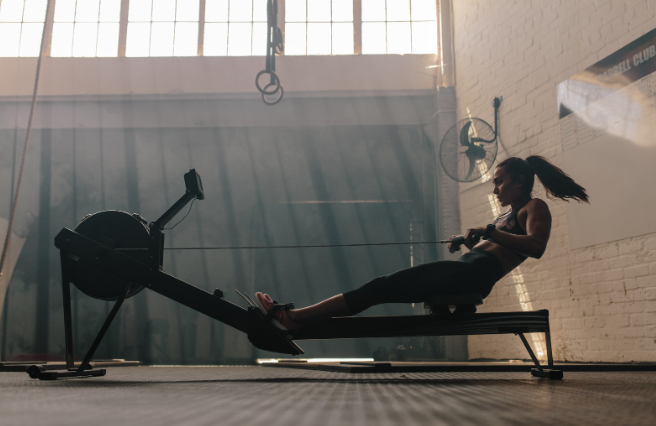
The rowing technique develops in four phases: catch position, leg drive, body swing, and arm pull. For beginners, it is important to perform the movement slowly, focusing more on coordination than speed.
One of the most common mistakes is rounding the back excessively or pulling too early with the arms. A controlled technique makes the workout more effective and helps support weekly progression without unnecessary fatigue.
Beginner rowing machine program: weeks 1-2
During the first two weeks, the main goal is to become familiar with the movement. Sessions should last between 15 and 20 minutes while maintaining a calm and sustainable pace. Training three times per week is enough to get started.
At this stage, it is useful to alternate short work intervals with recovery moments. For example, you can perform 2 minutes of easy rowing followed by 1 minute of active recovery. This approach helps the body adapt gradually without generating excessive fatigue.
Initial goal: building consistency
Many beginners believe long and demanding sessions are necessary to see results. In reality, during the first weeks the priority is consistency. Workouts that are too intense can negatively affect motivation and increase the likelihood of abandoning the program.
Focusing on short but regular sessions helps transform the rowing machine into a real weekly habit. This step is essential for building an effective and sustainable routine over time.
Beginner rowing machine program: weeks 3-4
From the third week onward, you can gradually increase workout duration, reaching sessions of 20-25 minutes. The body starts adapting better to the effort, and movement coordination becomes more natural.
At this stage, short intensity variations can also be introduced. For example, alternating 3 minutes at a moderate pace with 1 minute at a slightly higher intensity helps improve cardiovascular endurance without creating excessive strain.
How to improve endurance and coordination
Progression should remain gradual. Increasing speed or resistance too quickly can compromise movement quality. It is preferable to maintain controlled posture and steady breathing.
Tracking weekly progress can be extremely helpful. Even small improvements in session duration or movement fluidity represent clear signs of positive adaptation.
Beginner rowing machine program: weeks 5-6
During weeks five and six, the program enters a more dynamic phase. Sessions can reach 30 minutes while still maintaining at least one recovery day between more demanding workouts. At this point, many beginners start feeling more confident and motivated.
To avoid monotony, it is useful to introduce small variations in workout structure. Some days can focus on duration, while others emphasize rhythm consistency or short controlled intervals.
Adding variety to avoid boredom
One of the most common criticisms of rowing machines is repetition. In reality, changing pace, duration, or session goals can make training much more engaging and stimulating.
Using a fitness monitor or tracking app can also help maintain motivation. Seeing weekly improvements reinforces the perception of progress and consistency.
Beginner rowing machine program: weeks 7-8
The final two weeks are designed to consolidate the routine developed so far. Sessions can reach 30-35 minutes while maintaining sustainable intensity levels consistent with personal experience.
At this stage, it is important to avoid unrealistic comparisons with advanced users. The true purpose of the program is not achieving extreme results quickly, but building a solid and lasting foundation.
Monitoring progress realistically
Improvements may appear in different forms: better endurance, faster recovery, or improved movement control. Even the simple ability to maintain a consistent workout routine represents meaningful progress.
A gradual approach also helps reduce the risk of quitting. Feeling more confident using the rowing machine increases motivation and makes it easier to continue beyond the first eight weeks.
How to stay consistent after the first 8 weeks
After completing the initial program, the next step is turning the rowing machine into a stable part of your weekly routine. Scheduling fixed workout days and times helps reduce interruptions and makes consistency easier to maintain.
Many people find it useful to integrate small progressive goals, such as slightly increasing workout duration each month or tracking training frequency. This approach supports gradual improvement without unnecessary pressure.
Useful tools for monitoring improvements
Accessories such as heart rate monitors, digital displays, or dedicated apps can make the journey more engaging. Tracking sessions allows you to observe improvements more clearly over time.
With a structured program, manageable progression, and realistic expectations, the rowing machine can become a practical and sustainable solution for training at home. The key is not chasing immediate results, but building an effective routine that can be maintained long term.
Comments (0)