
Trolley
You have no items in your shopping cart

 Budgets
 Dumbers
 Discs
Discs
 Benches
 Racks and Rigs
 Weights Holders
 Isotonic machines
 Calisthenics
 Cardio
 Kettlebells
 Flooring
 Gym Set
 Accessories
 Combat
 ARTI MARZIALI
 CONTAINER GYM
 Tug-Of-War
 Used Gym Equipment
 PILATES MACCHINARI
 GINNASTICA ARTISTICA
 CAMPI DA PADEL
 Prodotti in Pronta Consegna
 Informazioni
 IRONMAN
 Gift Card
- Donatif
- Training and exercises
- 0 I like it
- 2308 Views
- 0 comments
- stress reduction, improved self-esteem, physical and mental well-being, gym training
READING TIME: 5 MINUTES ➤➤
ACL Rehabilitation in the Gym: A 5-Phase Recovery Protocol
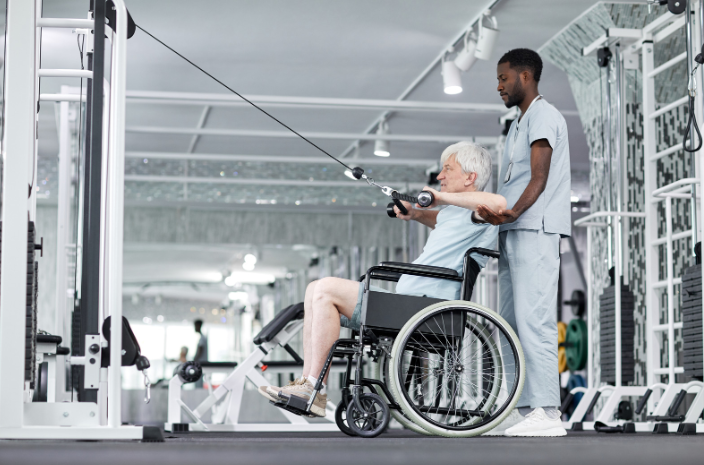
Facing an ACL rehabilitation in the gym journey means turning a delicate moment into a structured, measurable, and progressive program. After anterior cruciate ligament surgery, recovery is not just about protecting the joint, but about rebuilding motor control, strength, stability, and confidence in movement. In this phase, the gym is no longer just a place to train, but a technical environment where every exercise has a precise purpose: restoring knee function and preparing for a safe return to sport or full daily activity.
When properly structured, the use of racks, benches, and weights makes recovery more organized, progressive, and safe. Professional equipment allows precise load management, controlled movement angles, and the development of effective muscular stimulus without improvisation. For those looking for a clear guide on ACL exercises, this article outlines a five-step path, from post-surgery to return to play, focusing on the effectiveness of strength training in functional recovery and the smart use of gym equipment.
- The role of strength in functional recovery
- Initial reactivation and post-operative management
- Mobility recovery and neuromuscular control
- Progressive strengthening with equipment
- Advanced strength and dynamic stability
- Return to sport and movement performance
The role of strength in functional recovery
In the process of knee recovery after an ACL injury or reconstruction, strength is not optional—it is one of the core pillars of rehabilitation. The knee must be supported by muscles capable of absorbing load, controlling unwanted movement, and distributing forces efficiently during walking, running, direction changes, and landings. The quadriceps, hamstrings, glutes, and calf muscles all contribute to lower limb stability, and prolonged weakness can significantly delay recovery. That is why a well-designed ACL gym program goes beyond simply “moving the knee” and aims to restore true mechanical competence.
The gym environment offers a clear advantage: it allows a gradual transition from simple movements to more complex exercises while maintaining high execution quality. A bench supports controlled seated or unloaded work, a rack ensures safety in compound movements, and weights allow progressive overload—essential for rebuilding muscle mass and strength capacity. For advanced trainees, this approach reframes recovery not as a pause, but as a phase of building stronger foundations.
Initial reactivation and post-operative management
The first phase is the most delicate, as the goal is not traditional training but restoring basic movement prerequisites. The focus is on reducing pain and swelling, regaining full knee extension, and achieving muscle reactivation, particularly of the quadriceps. After surgery, instability and stiffness can create frustration and fear, but this is where real recovery begins. Key exercises include isometric quad contractions, straight leg raises, patellar mobilizations, assisted walking, and gradual weight-bearing progression following clinical guidance.
In the gym, this phase can be supported safely through controlled environments and stable surfaces. A bench allows supine or seated exercises that minimize compensation, while structured setups help maintain slow and controlled movement. The priority here is neuromuscular quality: the individual must relearn how to activate the knee, trust the joint, and regain extension without significant pain. Though less dynamic, this phase is critical, as early mistakes can negatively impact long-term recovery.
Mobility recovery and neuromuscular control
As the knee tolerates load better and pain decreases, the focus shifts to restoring range of motion and neuromuscular control. Mobility is not just flexibility—it is the ability to move efficiently without stiffness or compensations. This phase includes progressive knee flexion work, gait re-education, controlled step-ups and step-downs, and alignment training between hip, knee, and foot. The goal is to restore proper force distribution during everyday movements.
Proprioception also becomes essential—the ability to sense joint position and react to instability. Exercises include assisted single-leg balance, weight shifts, partial squats with support, and controlled movements on stable surfaces before progressing further. The rack can serve as a support reference, providing safety without removing responsibility from the movement. In a structured ACL rehab gym program, this phase bridges clinical recovery and real training, restoring confidence and movement fluidity.
Progressive strengthening with equipment
Once the initial phase is completed, the body is ready for more structured progressive strengthening. The focus is on key muscle groups: quadriceps, hamstrings, glutes, and core, with attention to execution and load management. Exercises such as bodyweight or lightly loaded squats, step-ups, assisted lunges, glute bridges, and simplified Romanian deadlifts are commonly introduced. The goal is not to rush load progression, but to build strength with precision, symmetry, and control.
This is where professional equipment becomes essential. A bench supports stabilization work, dumbbells allow gradual progression, and the rack provides a safe environment for more technical patterns. For experienced individuals, this phase enables the creation of a structured ACL gym workout plan with measurable progressions. Recovery does not benefit from shortcuts—it benefits from consistency, precision, and progressive overload applied at the right time.
Advanced strength and dynamic stability
With foundational strength restored, training evolves toward dynamic stability. The goal is not just strength, but the ability to maintain control under speed, fatigue, and directional changes. Exercises include deeper squats, reverse lunges, split squats, deadlift variations, and unilateral work that challenges balance and coordination. This phase reveals how solid the previous work has been.
The rack becomes central for safe compound lifts, while free weights enhance coordination and control. Additional focus is placed on landing mechanics, deceleration, and managing knee valgus—one of the key risk factors to monitor. A well-structured program at this stage increases confidence, reduces psychological barriers, and prepares the transition from recovery to performance.
Return to sport and movement performance
The final phase is not an abrupt return, but a structured transition toward sport or full performance. Returning to running, jumping, and changing direction requires not only strength, but reactivity, endurance, and confidence. This stage includes functional testing, movement analysis, and comparison between limbs. Linear running, controlled plyometrics, deceleration drills, lateral movements, and sport-specific progressions complete the process.
The gym remains essential even in this final stage. Training with Donatif racks, benches, and weights helps maintain strength, correct asymmetries, and support long-term joint health. The ultimate goal is not just to return to previous performance, but to do so with a stronger, more stable, and more aware body. In this sense, ACL rehabilitation in the gym is not just recovery—it is a complete reconstruction of movement confidence and physical capability.
Comments (0)