
Trolley
You have no items in your shopping cart

 Budgets
 Dumbers
 Discs
Discs
 Benches
 Racks and Rigs
 Weights Holders
 Isotonic machines
 Calisthenics
 Cardio
 Kettlebells
 Flooring
 Gym Set
 Accessories
 Combat
 ARTI MARZIALI
 CONTAINER GYM
 Tug-Of-War
 Used Gym Equipment
 PILATES MACCHINARI
 GINNASTICA ARTISTICA
 CAMPI DA PADEL
 Prodotti in Pronta Consegna
 Informazioni
 IRONMAN
 Gift Card
- Donatif
- Training and exercises
- 0 I like it
- 3633 Views
- 0 comments
READING TIME: 6 MINUTES ➤➤
Stretching the Lateral Chain of the Body: The Forgotten Stretch
When people think about stretching, they usually focus on exercises for the legs or the back, completely overlooking one fundamental area: the lateral chain of the body. Yet stretching this region—which involves the obliques, latissimus dorsi, and the lateral muscles of the torso—has a direct impact on posture, breathing, and movement efficiency. In this article, we explore why it is so important and how to incorporate lateral stretching into your routine.
Stretching the sides of the body is not simply an aesthetic or secondary practice; it is a genuine way of reconnecting with your mobility. Rediscovering lateral space helps release deep tension, promotes a more balanced posture, and unlocks a level of flexibility that is often neglected in conventional fitness routines. Let’s explore together how and why to dedicate time to oblique stretching and improving lateral flexibility.
- Why stretching the side of the body is essential
- Lateral stretching and mobility: what it really means
- Muscles involved in the lateral chain
- Lateral stretching exercises: a practical guide
- Practical benefits of lateral stretching
- Integrating lateral stretching into your routine
Why Stretching the Side of the Body Is Essential
The Role of the Lateral Chain in Posture and Movement
The body's lateral chain, which includes the muscles along the sides of the torso and hips, plays a crucial role in spinal stabilization and coordination between the upper and lower body. However, it is often neglected in traditional training programs. When this area becomes tight or lacks elasticity, trunk mobility is reduced, the natural curves of the spine may become altered, and both breathing and posture can be negatively affected.
In many cases, restrictions in lateral trunk mobility can create compensations in other regions, such as the lower back or neck, leading to chronic discomfort and fatigue. For this reason, stretching the lateral chain should not be considered an optional extra but rather an essential component of healthy and functional posture.
Effects on Balance, Stability, and Body Awareness
Working on lateral flexibility enhances the body's ability to orient itself in space, improving balance and stability during dynamic or asymmetrical movements. This is particularly beneficial in disciplines such as Pilates and yoga, but also in everyday athletic actions such as running, jumping, or even walking efficiently.
Stretching the sides of the body also has a direct effect on proprioception, the ability to perceive the body's position and movement. Opening the lateral aspect of the torso creates a sense of internal space that translates into feelings of lightness, fluidity, and greater movement awareness. It is a transformative experience that is often overlooked but can significantly change the way we move throughout daily life.
Lateral Stretching and Mobility: What It Really Means
Differences Between Static, Dynamic, and Functional Stretching
When discussing lateral stretching, it is important to consider different approaches: static, dynamic, and functional. Static stretching involves holding a position for a period of time and is useful for improving passive flexibility. Dynamic stretching incorporates controlled, progressive movement and is ideal for warm-ups or active recovery. Functional stretching integrates elongation into complex movement patterns, simulating real-life actions and improving coordination.
For lateral mobility, all three methods can play a valuable role. Static stretching helps release deep tension, dynamic stretching prepares the body for movement, and functional stretching enhances movement performance. The best approach depends on the individual's goals and level of body awareness.
Lateral Flexibility as an Indicator of Muscular Health
The ability to bend sideways without excessive effort or pain is an important indicator of the condition of the lateral muscles and the spine. Good oblique and back flexibility contributes to proper postural alignment and helps prevent overload in the lumbar and thoracic regions.
Reduced mobility along this plane of movement often goes unnoticed until symptoms such as stiffness or widespread discomfort appear. Working on lateral flexibility helps prevent these issues, encouraging a more balanced distribution of muscular tension and improving overall biomechanical efficiency.
Muscles Involved in the Lateral Chain
External and Internal Obliques: Function and Stretching
The external and internal obliques are essential muscles for trunk rotation and lateral flexion. As part of the core, they also act as stabilizers during complex movements and provide support for the internal organs. When not stretched regularly, they can become tight, reducing movement fluidity and contributing to lower-back discomfort.
Stretching the obliques requires precision and awareness. Movements such as standing or seated side bends combined with gentle trunk rotation are ideal for targeting these muscles. It is important to maintain elongation without forcing the position while breathing deeply to promote myofascial release and improve lateral flexibility.
The Latissimus Dorsi and Its Impact on Trunk Mobility
The latissimus dorsi is one of the largest muscles in the human body, connecting both to the spine and the arm. While commonly associated with pulling strength, it can also be a major limiter of trunk mobility when not properly stretched. Tight lats restrict thoracic expansion and hinder smooth movement in the lateral plane.
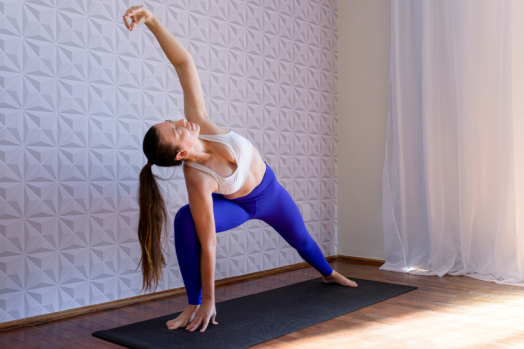
Stretching the latissimus dorsi is achieved through movements that combine side bending with arm extension, such as yoga poses where one arm reaches overhead while the torso bends sideways. These exercises not only improve mobility but also help decompress the spine, producing positive effects on posture.
Interaction with the Quadratus Lumborum and Stabilizing Muscles
The quadratus lumborum is a deep muscle connecting the lower ribs to the pelvis and plays a key role in lateral trunk stability. It is often responsible for lower-back stiffness and postural imbalances, particularly in sedentary individuals or those with poor movement habits. Although challenging to stretch, improving its flexibility can be extremely beneficial, especially for people suffering from recurring back pain.
The lateral chain also includes a variety of smaller stabilizing muscles that work together to maintain balance and symmetry throughout the body. Paying attention to these structures during stretching sessions helps improve not only mobility but also movement control and efficiency.
Lateral Stretching Exercises: A Practical Guide
Basic Movements for Beginners: Safety and Technique
For those new to lateral chain stretching, it is essential to begin with simple movements while focusing on posture and breathing. One effective exercise is the standing side bend, performed with the feet slightly apart and one arm reaching overhead. Holding the position for 20–30 seconds without forcing the stretch allows for a safe and gradual elongation of the obliques and latissimus dorsi.
Another beginner-friendly exercise involves sitting cross-legged and gently leaning the torso to one side. This movement helps develop awareness of tension patterns while improving lateral flexibility in a controlled manner. Listening to the body, avoiding sudden movements, and breathing deeply are key to facilitating muscular release.
Advanced Yoga and Pilates Variations for Greater Depth
Those with prior stretching experience can explore deeper variations inspired by yoga and Pilates. Poses such as Half Moon Pose (Ardha Chandrasana) and Triangle Pose (Trikonasana) are excellent for engaging the entire lateral chain. These exercises combine stretching, balance, and core activation, making them particularly effective.
In Pilates, movements such as the Side Bend performed on a mat or reformer allow practitioners to work deeply on lateral trunk mobility, neuromuscular control, and coordinated breathing. In all cases, mindful movement is what transforms a simple side bend into a meaningful practice for posture and structural balance.
Practical Benefits of Lateral Stretching
Improved Posture and Reduced Tension
Incorporating lateral stretching into your routine helps rebalance muscular tension, particularly for people who spend long hours sitting or maintaining asymmetrical positions. Stretching the obliques, latissimus dorsi, and lower-back muscles promotes spinal realignment and visibly improves posture. Individuals who practice these exercises regularly often notice greater chest openness and a more balanced relationship between the two sides of the body.
The reduction in tension is not only physical but also sensory. Many people experience a feeling of expanded breathing capacity and lightness immediately after practice. This is a direct result of lateral myofascial release, which creates internal space and restores fluidity to everyday movements.
Enhanced Thoracic Mobility and Breathing Capacity
One of the lesser-known yet most significant effects of lateral chain stretching involves improved thoracic mobility and breathing capacity. When the lateral muscles of the torso become tight, they restrict rib expansion during inhalation. Working on this area encourages deeper, fuller, and more conscious breathing, with positive effects on the nervous system as well.
This type of training is especially beneficial for yoga practitioners, singers, endurance athletes, and anyone looking to improve daily well-being. Stretching the sides of the body literally creates more space for breath and emotion, contributing to a more balanced and harmonious mind-body connection.
Integrating Lateral Stretching Into Your Routine
When to Do It: Before Training, After Training, or in Dedicated Sessions
One of the most common questions concerns the ideal time to perform lateral chain stretching. During a warm-up, brief dynamic side bends can activate the muscles and prepare the body for complex movements. After training, static stretching helps release tension and promote muscular recovery.
However, the greatest benefits are often achieved through dedicated sessions—even just 15 minutes long—focused exclusively on lateral mobility work. This approach allows for deeper body awareness, combining movement and breath while progressively improving lateral trunk mobility.
Strategies for Maintaining Consistency Over Time
As with any physical practice, consistency is the key to success. Incorporating two to three weekly sessions of oblique and latissimus dorsi stretching can make a significant difference in both posture and overall well-being. A useful strategy is to link stretching to a daily ritual, such as your morning routine or evening relaxation time, making it a natural part of your schedule.
Using guided videos, fitness apps, or attending yoga and Pilates classes that include targeted exercises can also help maintain motivation. Most importantly, focus on the quality of your attention during the movement. Stretching the side of the body is not only a physical action but also an act of awareness—a space that opens both physically and internally, changing the way we inhabit and experience our bodies.
Comments (0)